
Mugapakkha Jataka
The Tale of the Mute Prince
In the ancient kingdom of Mithila, ruled a just king named Dhanañjaya. His queen, Subhadda, was as wise and virtuous as she was beautiful. Their joy knew no bounds when a son was born, destined to inherit the throne. However, as the prince grew, a strange affliction befell him: he was born mute. Despite all efforts, no word ever passed his lips. The king and queen were heartbroken, fearing for their son's future and the kingdom's succession. They named him Prince Mugapakkha, meaning 'one with a covered mouth'.
As Mugapakkha reached adolescence, his silence became a source of growing concern. While intelligent and observant, his inability to speak made him seem distant and unintelligent to many at court. Whispers began to circulate: could a voiceless prince truly rule? Some courtiers, ambitious and cunning, saw this as an opportunity to sow discord and undermine the prince's claim.
One day, a renowned sage visited the royal palace. He observed Prince Mugapakkha, who, despite his silence, displayed a keen understanding and a gentle nature. The sage, a master of interpreting subtle signs, declared, "The prince is not lacking in wisdom, but in the means to express it. His silence is a veil, not an emptiness. He possesses a profound inner strength."
The king, desperate for any ray of hope, asked the sage, "How can my son overcome this affliction? How can he learn to communicate and prove his worthiness to rule?"
The sage smiled gently. "True communication transcends mere words, Your Majesty. True understanding comes from within. The prince needs not to find his voice, but to find his purpose. Let him be tested not by his speech, but by his actions. Let him wander beyond these palace walls and witness the world. There, he will find his true voice."
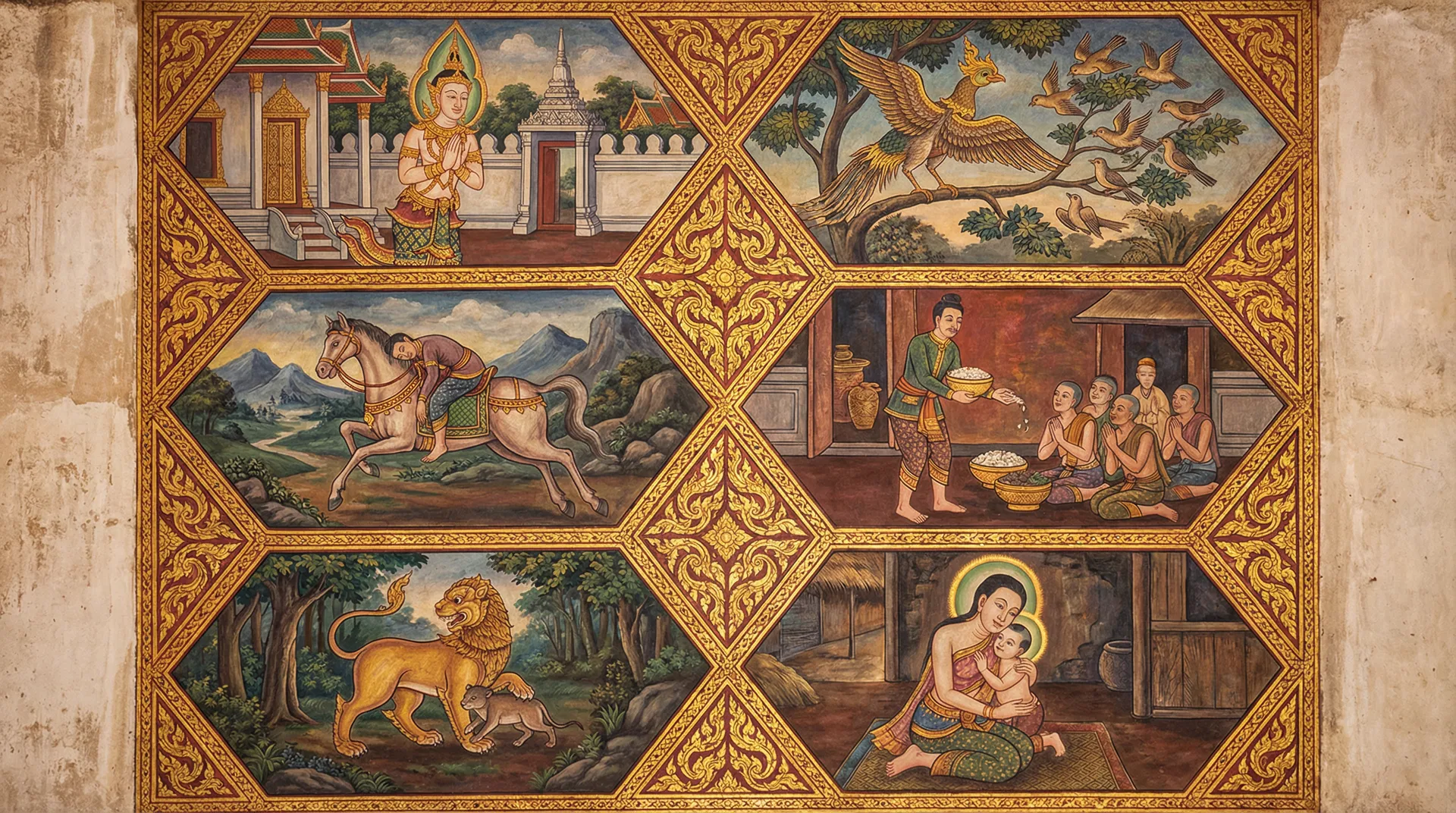
Though hesitant, the king agreed. Prince Mugapakkha, now a young man, was granted leave to explore the kingdom, accompanied by a loyal retinue. He rode through bustling marketplaces, serene villages, and dense forests. He saw the joys and sorrows of his people, the struggles of farmers, the anxieties of merchants, and the simple happiness of children. Though he could not speak, his eyes absorbed everything, his mind processed it all. He offered comfort with a gentle touch, shared in laughter with a knowing smile, and expressed empathy through his attentive gaze.
One day, while traveling near the border, the prince and his entourage stumbled upon a scene of great distress. A nearby village was being terrorized by a fearsome wild boar. The villagers, armed with only simple farming tools, were no match for the beast. They were trapped in their homes, living in constant fear.
The prince, seeing their plight, felt a surge of responsibility. Without a word, he dismounted his horse and, taking a sturdy spear from one of his guards, approached the boar's lair. His guards pleaded with him, "Your Highness, it is too dangerous! Let us handle this!" But the prince, resolute, shook his head. He knew this was his test, his chance to act.
With incredible agility and courage, Prince Mugapakkha faced the enraged boar. The battle was fierce. The boar charged, tusks gleaming, but the prince was quick. He dodged, weaved, and used his spear with precision. His silence did not hinder him; in fact, it seemed to sharpen his focus, allowing him to anticipate the beast's every move. After a prolonged and perilous struggle, the prince finally managed to subdue the boar, ending its reign of terror.
The villagers emerged from their hiding places, amazed and overjoyed. They saw not a mute prince, but a brave hero. They cheered, "He may not speak, but his courage speaks volumes! He has saved us all!"
News of the prince's bravery spread like wildfire throughout the kingdom. When he returned to Mithila, he was no longer seen as deficient, but as a champion. The people understood that true leadership was not about eloquent speeches, but about decisive action, courage, and compassion.
King Dhanañjaya, witnessing the adoration his son received and understanding the profound message of the sage, was filled with pride. He declared, "My son, Prince Mugapakkha, has proven himself worthy. His actions have spoken louder than any words could. He will be my successor, and I have no doubt he will rule with wisdom and strength."
And so, Prince Mugapakkha ascended the throne. He ruled Mithila for many years, not with a loud voice, but with a wise and compassionate heart. His reign was marked by peace, prosperity, and justice, a testament to the fact that true worth lies not in what one says, but in what one does. His silence, once a perceived weakness, became a symbol of his inner strength and profound character.
— In-Article Ad —
💡Moral of the Story
True leadership is demonstrated through actions, courage, and compassion, not merely through eloquent speech.
Perfection: Courage (Virya)
— Ad Space (728x90) —
More Jataka Tales You May Enjoy
25EkanipātaThe Bodhisatta as a Swan
The Bodhisatta as a SwanIn the shimmering expanse of a celestial lake, where the water was as clear ...
💡 True compassion knows no bounds, and celestial beings are called to act when suffering is present, bringing salvation.
 389Chakkanipāta
Mahasutasoma Jataka
Mahasutasoma JatakaIn a distant land, where ancient trees touched the heavens and rivers flowed like...
💡 True power lies in wisdom, compassion, and self-control, not in force or selfish indulgence. Understanding the nature of suffering and craving is the path to liberation.
97EkanipātaThe Tale of the Ancient Swan
In the city of Savatthi, while the Buddha resided at the Jetavana Monastery, he recounted a past lif...
💡 True nobility resides in the heart and character, not in status or possessions. Forgiveness and inner peace are more valuable than any worldly gain.
84EkanipātaUdapāna Jātaka
Udapāna Jātaka In a sun-scorched desert, where the sands stretched endlessly under a blazing sky, li...
💡 In times of hardship and despair, perseverance, faith, and collective effort are essential to overcoming challenges and finding solutions.
129EkanipātaMora Jataka
Mora JatakaIn the heart of a dense and ancient forest, where sunlight struggled to pierce the thick ...
💡 True power lies not in physical strength or material possessions, but in the purity of virtue, the wisdom of compassion, and the ability to inspire transformation through truth.
67EkanipātaThe Bodhisatta's Compassion for His Foes
In the glorious city of Rājagaha, the capital of Magadha, in an age when kingdoms were often rife wi...
💡 True strength is a combination of physical power, wisdom, and restraint. It is important to protect oneself and one's domain, but to do so without unnecessary violence.
— Multiplex Ad —