
Mūgapakkha Jātaka
Mūgapakkha Jātaka
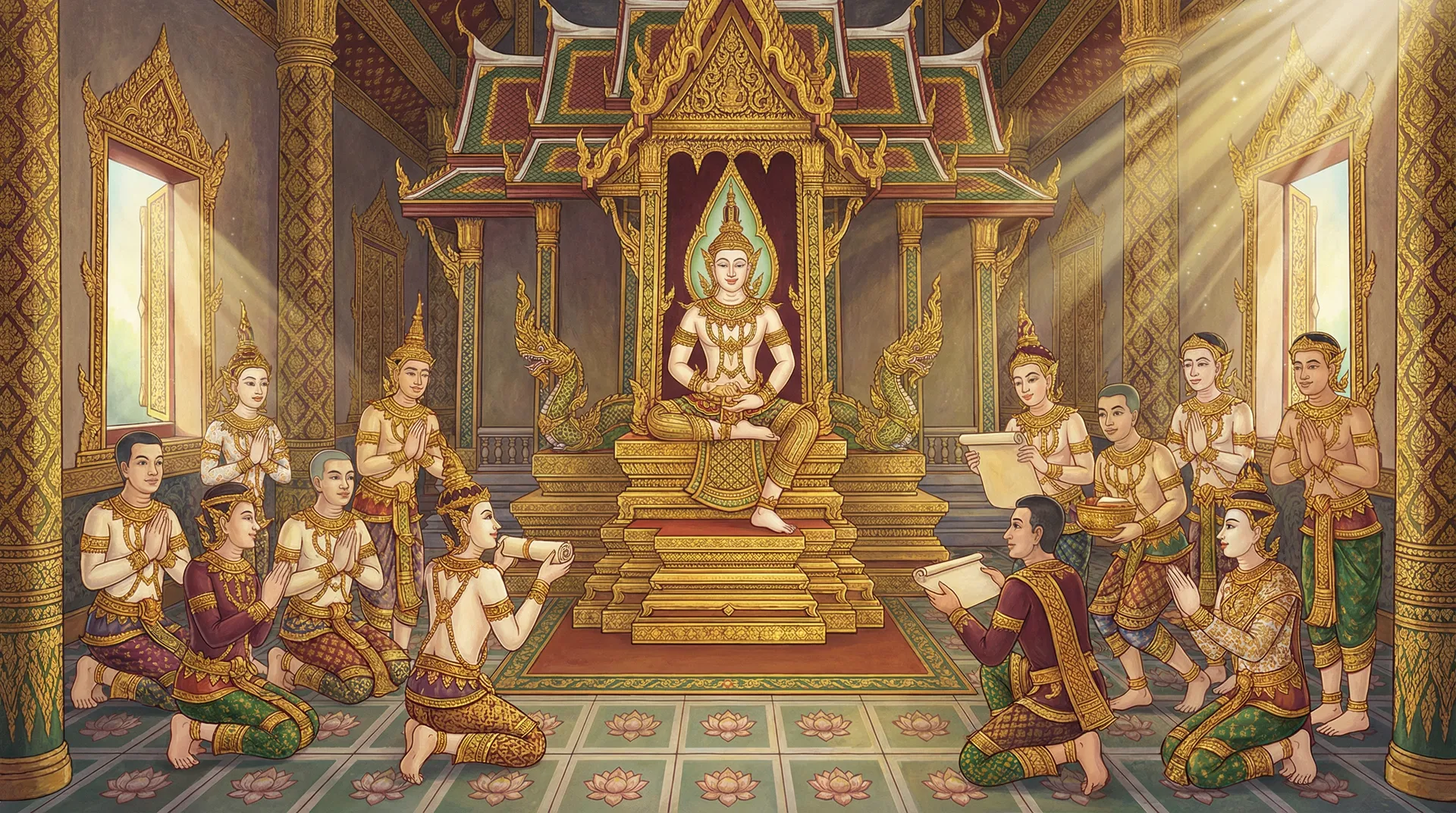
In the bustling city of Varanasi, renowned for its vibrant arts and thriving commerce, lived a Bodhisattva in the form of a prince named Disāpāmo. He was the youngest of King Brahmadatta's sons, a prince of exceptional character, gifted with a keen intellect and a heart full of compassion. However, he was born with a peculiar affliction: he was mute. From birth, he could not utter a single word, a silence that set him apart from his boisterous brothers and the courtly chatter.
Despite his inability to speak, Prince Disāpāmo possessed a remarkable ability to communicate through his actions and his expressive eyes. He learned to convey his thoughts and feelings through gestures, through the way he carried himself, and through the wisdom he demonstrated in his deeds. His silence, rather than being a weakness, became a profound source of his strength. It allowed him to observe, to listen, and to understand the world around him with unparalleled clarity, unclouded by the noise of constant chatter.
His elder brothers, on the other hand, were all skilled in rhetoric and debate. They reveled in their ability to persuade, to argue, and to command attention with their eloquent speeches. They often mocked their mute brother, seeing his silence as a sign of his inferiority. "Look at our brother," they would sneer, "a prince who cannot even voice his own name. How can he ever hope to rule? He is but a shadow, a silent spectator in the grand play of life."
King Brahmadatta, though he loved all his sons, often found himself swayed by the persuasive tongues of his elder sons. They would present their arguments with such flourish and conviction that the King, a man who valued eloquent discourse, would often find himself agreeing with their proposals, even when they were not entirely in the best interest of the kingdom.
One day, a neighboring kingdom, ruled by a cunning and ambitious king, sent envoys to Varanasi. They proposed a treaty of alliance, but their true intention was to subtly annex the prosperous kingdom of Varanasi. The envoys, skilled in diplomacy and deception, presented their proposal with honeyed words, painting a picture of mutual benefit and shared prosperity. The elder princes, impressed by their rhetoric and eager to prove their own diplomatic prowess, championed the treaty, arguing for its immediate ratification.
The King, listening to his elder sons' impassioned speeches, was on the verge of agreeing. However, Prince Disāpāmo, who had been observing the envoys with his usual keen gaze, felt a deep sense of unease. He noticed the subtle shifts in their expressions, the way their eyes darted away when certain questions were posed, the almost imperceptible tremor in their voices when they spoke of specific territorial concessions. He knew, with the certainty that his silent observation afforded him, that the envoys were not acting in good faith. The treaty was a trap.
But how could he warn his father and brothers? He could not speak. He could not argue, could not refute the eloquent arguments presented by the envoys and his own brothers. He felt a surge of frustration, but then, his mind, accustomed to finding solutions through action, began to work.
He waited for a moment when the King was alone with his sons. Then, he stepped forward. Instead of speaking, he began to act. He mimicked the actions of the envoys, subtly exaggerating their gestures of insincerity. He pretended to swallow something bitter, then smiled a false, wide smile, conveying deception. He then pointed to the maps that had been laid out, and with a swift, decisive movement, drew a line across a key territory, then shook his head vehemently, indicating a loss.
His elder brothers scoffed. "What is this mummering?" one sneered. "Is he trying to entertain us? This is a serious matter of state!"
But King Brahmadatta, who knew his mute son's profound understanding and keen observation, watched intently. He saw the deliberate nature of Disāpāmo's gestures. He noticed how the prince's actions seemed to mirror the subtle inconsistencies he himself had sensed in the envoys' words. Disāpāmo then picked up a piece of fruit, peeled it with great care, and then offered it to his father with a smile, but as the King reached for it, Disāpāmo quickly snatched it away and ate it himself, feigning delight. This, the King understood, symbolized the false promise of the treaty – an offering that was enticing on the surface but ultimately self-serving and harmful to the recipient.
The King paused, his gaze shifting from his eloquent sons to his silent, yet profoundly expressive, youngest son. He asked Disāpāmo to demonstrate the envoys' demeanor once more. Disāpāmo complied, his movements precise and revealing. He then pointed to the map again, this time drawing a serpent coiling around the proposed territory, a clear symbol of hidden danger.
The King, finally seeing through the deceptive facade, made a decision. "I thank my elder sons for their counsel," he announced, his voice firm. "However, my youngest son, in his silence, has spoken more truth than all the words spoken today. His actions have revealed the hidden dangers in this proposed treaty. We shall not ratify it."
The envoys, realizing their deception had been uncovered, were forced to withdraw in shame. The elder princes were stunned, their eloquence rendered useless by the silent wisdom of their brother.
From that day forward, King Brahmadatta understood the true value of observation and discernment. He realized that eloquent words could sometimes mask deceit, while silence, coupled with deep insight, could reveal the most profound truths. Prince Disāpāmo, the mute prince, became known not for his lack of speech, but for his extraordinary wisdom and his ability to see what others could not. He ruled alongside his father, his silent guidance proving more valuable than any eloquent decree, demonstrating that true leadership lies not in the loudness of one's voice, but in the clarity of one's vision and the integrity of one's actions.
— In-Article Ad —
💡Moral of the Story
True wisdom is not always expressed through eloquent words. Deep observation, keen discernment, and insightful actions can reveal truths that speech may conceal. Silence can be a powerful medium for conveying profound understanding.
Perfection: Wisdom (Prajñā)
— Ad Space (728x90) —
More Jataka Tales You May Enjoy
 148Ekanipāta
Mahasutasoma Jataka
Mahasutasoma JatakaIn the magnificent city of Indapatta, ruled a king named Pothila, whose reign was...
💡 True strength lies not in retaliation or aggression, but in unwavering adherence to non-violence, wisdom, and mercy, which can transform enemies into allies and overcome evil with good.
 519Vīsatinipāta
Temiya Jataka
The Prince Who Found Joy in StillnessIn the ancient city of Ujjeni, amidst the grandeur of a royal p...
💡 True happiness and liberation are found in detachment from worldly possessions and transient pleasures. Understanding the impermanence of all things leads to inner peace and freedom from suffering.
219DukanipātaSujambara Jataka
Sujambara JatakaIn the heart of a vast and ancient forest, where towering trees formed a canopy that...
💡 Greed and the pursuit of material wealth can lead to one's downfall. True riches lie in living in harmony with nature and cultivating compassion.
66EkanipātaThe Great Crane Jataka
Long ago, in an age when the Buddha had not yet appeared, in a time immeasurably distant, the Bodhis...
💡 True wealth is measured not by the abundance of possessions, but by the happiness and prosperity of one's people. Greed leads to suffering, while generosity and compassion bring true prosperity.
95EkanipātaMahasattva Jataka
Mahasattva JatakaIn the heart of ancient India, amidst the lush greenery and the symphony of chirpin...
💡 The highest form of love and compassion is self-sacrifice for the well-being of others. True greatness is demonstrated through selfless acts that bring life and salvation.
132EkanipātaKuddala Jataka
The Tale of the Weaver's Son Long ago, in the bustling city of Savatthi, renowned for its vibrant ma...
💡 A truly prosperous kingdom is one where the well-being of its poorest citizens is a priority, and where systematic compassion is integrated into governance.
— Multiplex Ad —