
Mahanaradajataka
Mahanaradajataka
In the magnificent city of Indrapura, ruled a wise and benevolent king named Brahmadatta. His kingdom flourished under his just reign, and his subjects lived in peace and contentment. The king, however, was deeply devoted to the pursuit of knowledge and the practice of virtue, and he often found solace in the company of wise ascetics.
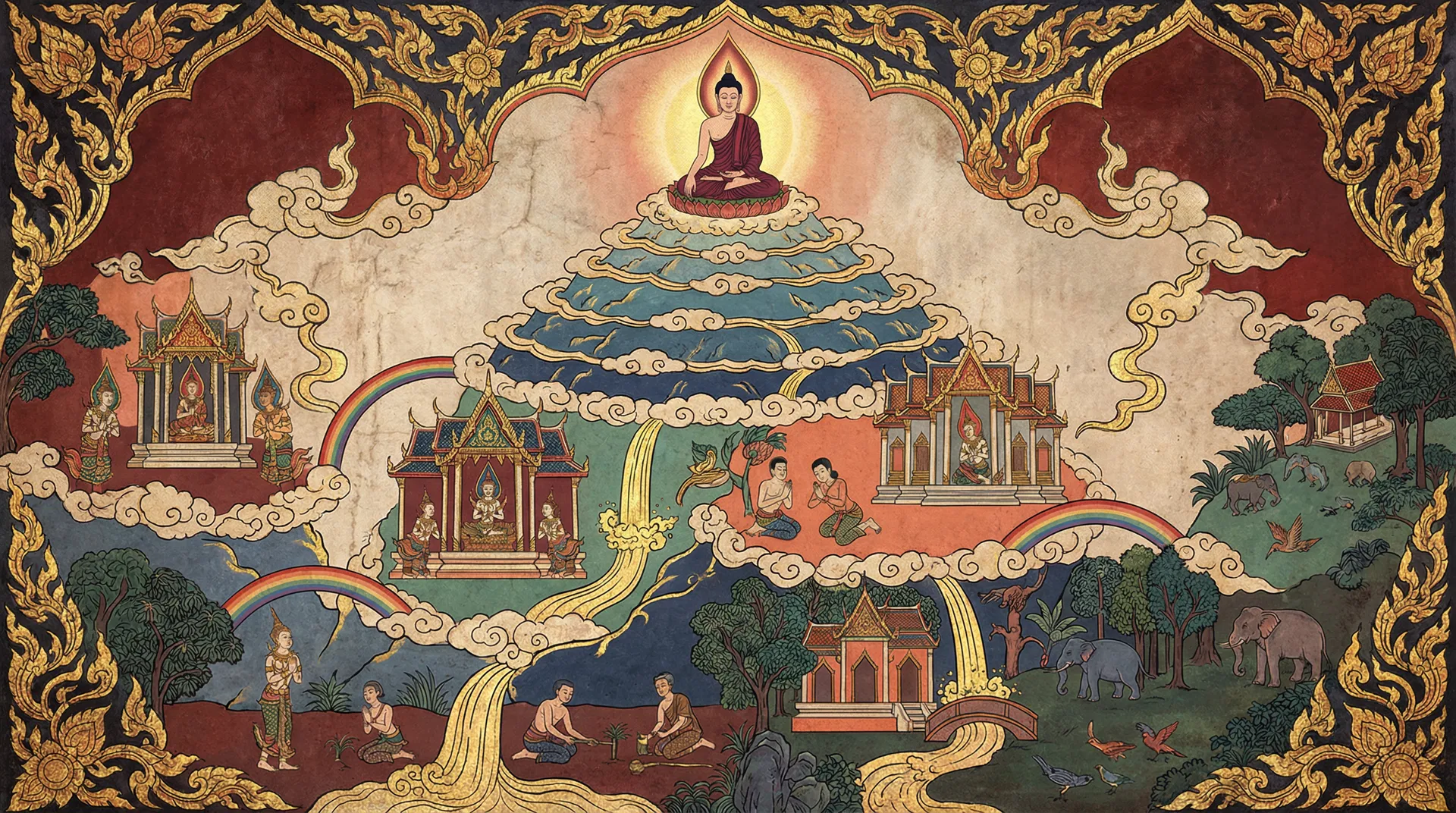
One day, a distinguished ascetic, renowned for his profound wisdom and ascetic practices, visited the king's court. This ascetic was none other than the Bodhisatta, in a life dedicated to the perfection of wisdom. He had attained such heights of spiritual understanding that his mind was as clear and vast as the boundless sky.
The king, recognizing the ascetic's extraordinary insight, engaged him in deep philosophical discourse. They spoke of the nature of reality, the causes of suffering, and the path to enlightenment. The Bodhisatta, with his unparalleled wisdom, expounded truths that resonated deeply with the king's own spiritual inclinations.
During their discussions, the king posed a challenging question. 'Venerable one,' he asked, his brow furrowed in thought, 'in the pursuit of enlightenment, what is the most crucial quality a being must cultivate? What is the ultimate key to unlocking the door to liberation?'
The Bodhisatta, after a moment of profound contemplation, replied, 'Your Majesty, while many qualities are essential on the path—compassion, generosity, patience—the most paramount is wisdom. For it is wisdom that illuminates the path, dispels ignorance, and allows one to see reality as it truly is. Without wisdom, even the most virtuous actions can be misguided, and the mind remains clouded by illusion.'
The king was deeply impressed by this explanation. He decided to test the Bodhisatta's wisdom further, believing that such a profound teacher should be recognized and honored. He announced a grand festival in the ascetic's honor, inviting scholars and dignitaries from far and wide.
During the festival, the king presented the Bodhisatta with a dilemma, a riddle designed to probe the depths of his understanding. 'Venerable one,' the king declared, 'I have heard tales of a mythical city, a city of pure gold, hidden beyond the treacherous mountains and guarded by fierce beings. It is said that this city holds treasures beyond imagination, and its inhabitants possess knowledge that can grant eternal bliss. Tell me, is this city real, and if so, how can one reach it?'
The court held its breath, eager to witness the Bodhisatta's response. Many believed such a city was merely a myth, a fanciful tale. Others hoped it was real, a secret path to ultimate happiness.
The Bodhisatta, with a serene smile, began to speak. 'Your Majesty, the city you describe, the city of gold, is indeed real. Its treasures are beyond measure, and its inhabitants possess profound knowledge. However, this city is not found on any earthly map, nor can it be reached by traversing physical mountains.'
He continued, his voice clear and resonant, 'The city of gold is the enlightened mind. Its golden walls are the virtues of wisdom, compassion, and detachment. Its immeasurable treasures are the insights into the nature of reality, the understanding of impermanence, and the realization of one's true nature. The knowledge that grants eternal bliss is the understanding of the Four Noble Truths and the Noble Eightfold Path.'
'The fierce beings that guard it,' he explained, 'are not external monsters, but the internal defilements: greed, hatred, and delusion. To reach this city, one must conquer these inner demons through diligent practice of mindfulness, meditation, and ethical conduct. The treacherous mountains are the obstacles of doubt and craving that one must overcome on the spiritual journey.'
The Bodhisatta's explanation captivated the entire court. The king, in particular, was awestruck. He realized that the ultimate treasure and the path to eternal bliss were not external discoveries, but an internal transformation that required diligent effort and profound wisdom.
'You have revealed a truth far greater than any earthly riches,' the king proclaimed, bowing deeply to the Bodhisatta. 'You have shown us that the greatest journey is the journey within, and the most precious treasure is the wisdom that illuminates our own minds.'
From that day forward, the king and his subjects dedicated themselves to cultivating wisdom. They understood that true liberation was not a destination to be found, but a state of being to be realized through diligent spiritual practice. The Bodhisatta, having planted the seeds of true understanding, departed, leaving behind a kingdom transformed by the light of wisdom, a testament to the profound teachings that lead to ultimate peace and enlightenment.
— In-Article Ad —
💡Moral of the Story
True enlightenment and ultimate happiness are found not in external pursuits or mythical treasures, but within the awakened mind. Wisdom is the key that unlocks the door to liberation, enabling us to overcome internal obstacles and realize our true nature.
Perfection: Wisdom (Prajna)
— Ad Space (728x90) —
More Jataka Tales You May Enjoy
 498Pakiṇṇakanipāta
Sasa Jātaka
Sasa JātakaIn the deep, verdant forests of ancient India, where sunlight dappled through a canopy of...
💡 Selfless compassion and the willingness to sacrifice one's own well-being for the benefit of others are the highest virtues.
 124Ekanipāta
Sutasoma Jataka
Sutasoma Jataka In the glorious city of Indapatta, there reigned a king named Pindola, a monarch of ...
💡 True victory is achieved not through violence or force, but through the unwavering power of truth, compassion, and understanding, which can transform even the darkest of hearts.
220DukanipātaVaka Jataka
Vaka JatakaIn a tranquil village beside a shimmering lake, lived a wise old crane named Bodhisattva....
💡 True skill and effectiveness are achieved through patience, wisdom, and observation, not through arrogance, haste, or boastfulness.
13EkanipātaThe Steadfast Brahmin
The Steadfast BrahminIn the ancient city of Varanasi, a beacon of spiritual learning, lived a devout...
💡 Unwavering steadfastness and a pure heart can inspire others and lead to rebuilding.
55EkanipātaThe Bodhisatta as the Young Brahmin
The Bodhisatta as the Young BrahminIn the ancient city of Ujjain, a place of profound spiritual lear...
💡 Selfless service and pure compassion, born from a heart devoted to alleviating suffering, can overcome even the greatest adversities and reveal the divine within.
157DukanipātaSasa Jataka
Sasa JatakaLong, long ago, in a time when the stars seemed closer and the moon cast a gentler glow, ...
💡 True virtue lies not in what one possesses, but in the willingness to give selflessly for the benefit of others.
— Multiplex Ad —