
Sankha Jātaka
The Tale of the Generous Prince Sankha
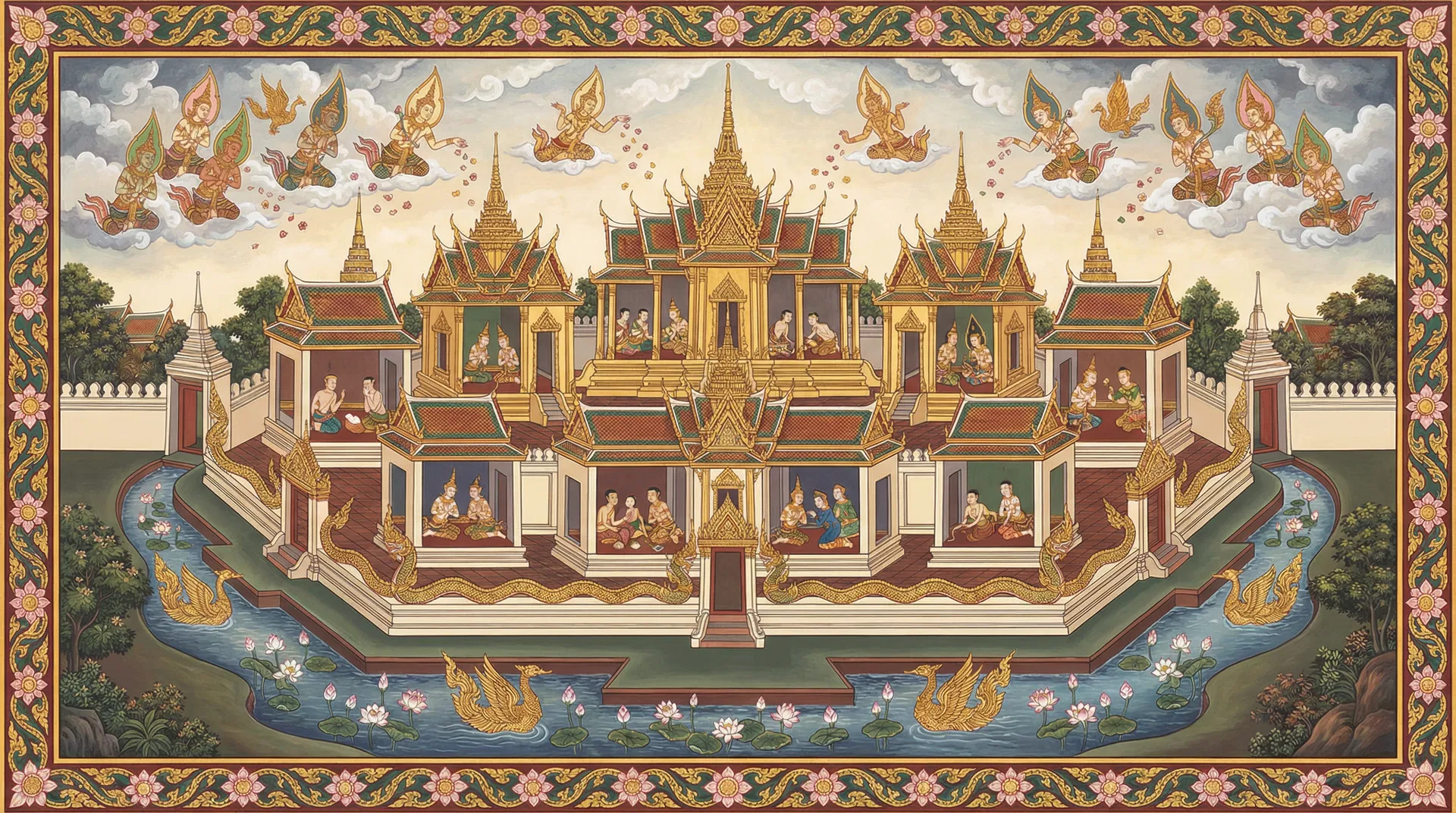
In the ancient kingdom of Indapatta, ruled a just and benevolent king. He had a son, Prince Sankha, who was known throughout the land not for his martial prowess or political acumen, but for his boundless generosity. From a young age, Prince Sankha possessed a heart that overflowed with compassion and a desire to share whatever he had.
His father, the king, though proud of his son's noble spirit, often worried about his extreme generosity. "My son," the king would say, "you give away so much that soon we will have nothing left! We must be prudent and save for the future."
Prince Sankha would reply with a gentle smile, "Father, true wealth is not in what we hoard, but in what we share. When we give to those in need, our hearts become richer, and the world becomes a better place. I have faith that as long as I continue to give with a pure heart, there will always be enough for everyone, including ourselves."
One day, a terrible famine struck the kingdom. The crops failed, the granaries were empty, and the people were starving. Despair gripped the land. The king, despite his best efforts, found his treasury depleted and his resources exhausted. He was at a loss, his heart heavy with the suffering of his people.
Prince Sankha, seeing the plight of the kingdom, was deeply distressed. He went to his father and said, "Father, we cannot let our people starve. I have something precious that I have kept, not for myself, but for an occasion such as this."
He led his father to a hidden chamber where he had stored his most treasured possessions: exquisite jewels, fine silks, rare perfumes, and vessels of pure gold. These were gifts he had received over the years, items he had kept not out of attachment, but as a reserve for a time of great need.
With tears in his eyes, the king looked at his son. "My son, this is the accumulated wealth of our family. To give it all away..."
"Father," Sankha interrupted, his voice firm yet gentle, "this wealth was given to me out of love and appreciation. It is only right that I now use it to alleviate the suffering of our people, who are our true family."
And so, Prince Sankha, with his father's hesitant blessing, began to distribute his entire fortune. He gave jewels to buy food, silks to trade for grain, gold to provide shelter, and perfumes to offer comfort. He worked tirelessly, ensuring that every hungry mouth was fed, every shivering body was clothed, and every despairing soul received a glimmer of hope.
He did not discriminate. Whether a farmer, a craftsman, a beggar, or a traveler, if they were in need, Prince Sankha offered his help. He shared not just his possessions, but also his time, his encouragement, and his unwavering belief in the goodness of humanity.
As the last of his treasures was distributed, a miraculous thing happened. The famine began to recede. Rains came, the land revived, and the harvest, though delayed, was bountiful. The kingdom slowly recovered, and the people, who had been on the brink of despair, were filled with renewed hope and gratitude.
More importantly, the act of selfless generosity had transformed the kingdom. The people, inspired by Prince Sankha's example, began to help each other. A spirit of community and mutual support blossomed, stronger than ever before.
Prince Sankha, having given away everything, was not diminished. Instead, he radiated a deeper contentment and peace. He had proven that true richness lies not in possession, but in giving. His generosity had not only saved his people from physical starvation but had nourished their spirits and fostered a lasting legacy of compassion and shared prosperity. The kingdom of Indapatta, once threatened by famine, became a beacon of hope, all thanks to the boundless generosity of Prince Sankha.
— In-Article Ad —
💡Moral of the Story
True wealth is found not in hoarding possessions, but in selfless giving. Generosity, when offered with a pure heart, can overcome scarcity and inspire a spirit of community and mutual support.
Perfection: Generosity (Dana Paramita)
— Ad Space (728x90) —
More Jataka Tales You May Enjoy
191DukanipātaKaccapajataka
Kaccapajataka In the ancient kingdom of Mithila, where palaces shimmered like lotus blossoms and riv...
💡 True wealth lies not in what we possess, but in our ability to be content with what we have. Greed is a bottomless pit that can never be filled.
230DukanipātaMahā-bodhi-jātaka
The Tale of the Bodhisatta and the Wise Parrot In the magnificent city of Benares, a city that glitt...
💡 True generosity involves selfless giving with a pure heart and complete trust. Overcoming deep-seated avarice through sincere remorse and acts of profound selflessness can break negative karmic cycles and bring about immense positive change.
177DukanipātaKuṅku Jātaka
Kuṅku JātakaIn the verdant plains of Kosala, where emerald rice paddies stretched as far as the eye ...
💡 True strength and peace originate from within. External objects, however comforting, cannot replace inner resilience, wisdom, and the courage to face adversity with integrity. Letting go of attachments, even cherished ones, can be an act of liberation.
 460Ekādasanipāta
Vidhurap paṇḍita Jātaka
Vidhurap paṇḍita JātakaIn the ancient city of Indapatta, capital of the Kuru kingdom, there lived a ...
💡 Righteousness, truth, and compassion are the greatest treasures. True wisdom can overcome malice and bring about peace and understanding.
219DukanipātaSujambara Jataka
Sujambara JatakaIn the heart of a vast and ancient forest, where towering trees formed a canopy that...
💡 Greed and the pursuit of material wealth can lead to one's downfall. True riches lie in living in harmony with nature and cultivating compassion.
195DukanipātaMahanaradajataka
Mahanaradajataka In the magnificent city of Indrapura, ruled a wise and benevolent king named Brahma...
💡 True enlightenment and ultimate happiness are found not in external pursuits or mythical treasures, but within the awakened mind. Wisdom is the key that unlocks the door to liberation, enabling us to overcome internal obstacles and realize our true nature.
— Multiplex Ad —