
Sasa Jataka
Sasa Jataka
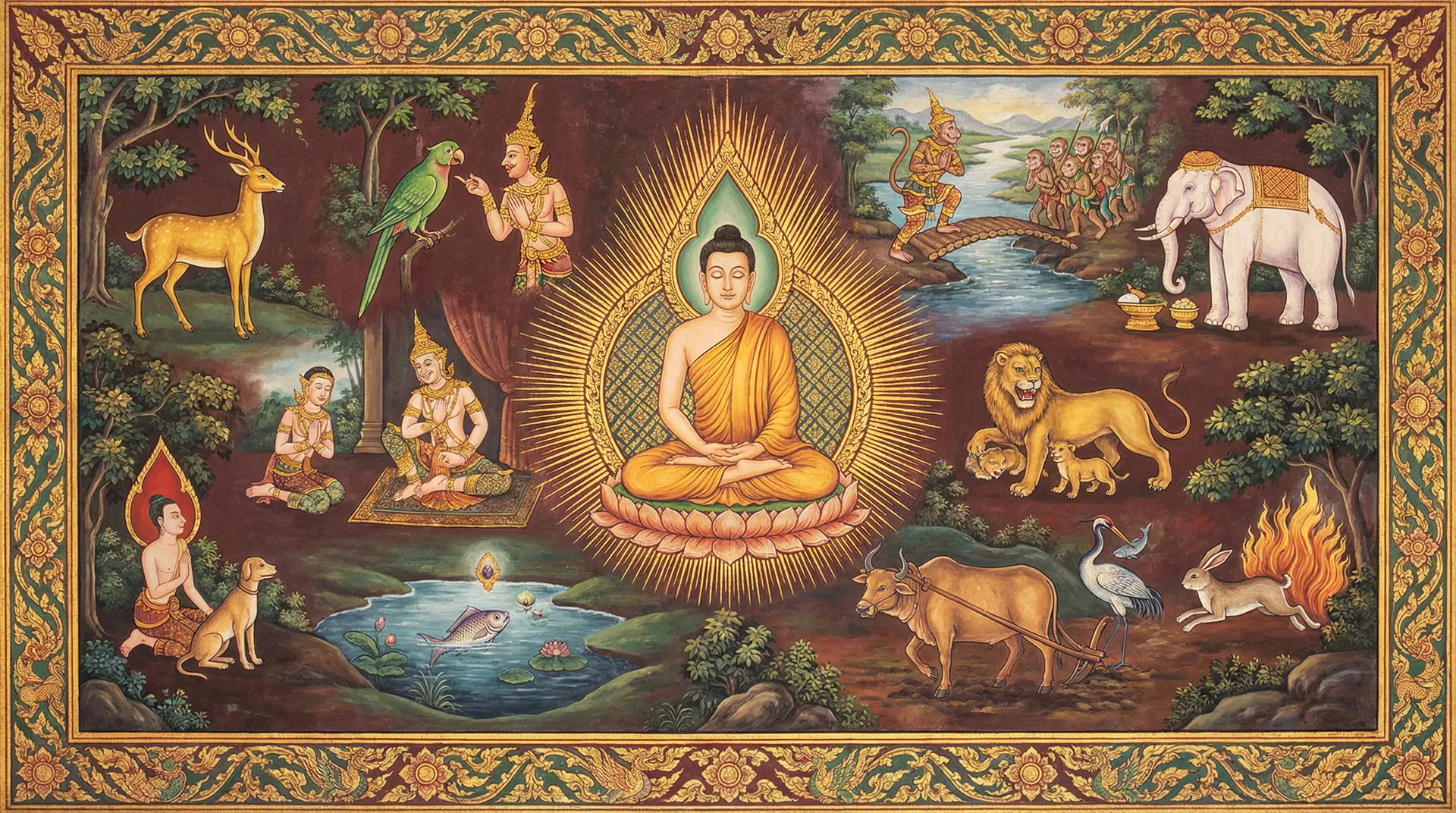
In a tranquil forest, bathed in the gentle light of the moon, lived a wise and compassionate Bodhisattva in the form of a rabbit. This was no ordinary rabbit; his fur was as white as the fresh snow, and his eyes held the deep understanding of a seasoned sage. He lived a simple life, content with the bounty of the forest, and was known throughout the animal kingdom for his kindness and his unwavering commitment to truth.
One day, a great famine descended upon the land. The earth was parched, the trees bore no fruit, and the streams ran dry. The animals, weakened by hunger, wandered aimlessly, their spirits broken. They gathered in a clearing, their cries of despair echoing through the desolate landscape.
As they lamented their fate, a divine being, a celestial hunter named Sakka, descended from the heavens. He had taken the form of a Brahmin, a mendicant seeking alms, and appeared before the starving animals. He declared, "I am hungry. If any of you have food to offer, I shall gladly accept it."
The other animals, desperate and focused on their own survival, could offer nothing. The lion had no prey, the deer had no grass, the fox had no small creatures to catch. Their hearts were filled with despair, for they had nothing to give.
The white rabbit, however, heard the Brahmin's plea. His heart ached for the suffering of his fellow creatures, and he felt a deep compassion for the hungry mendicant. He knew that he himself had little to offer in terms of flesh or grain. But he possessed something more precious: his own life, offered in the spirit of selfless generosity.
With unwavering resolve, the rabbit approached the Brahmin. "Venerable sir," he said, his voice clear and steady, "I have no grains, no fruits, and no flesh to offer. But I have my own body, which I am willing to give to you. If you wish, you may cook and eat me."
The Brahmin, who was Sakka in disguise, was astonished by the rabbit's profound act of generosity. He had intended to test the animals' compassion, but he had not expected such a selfless offering. He replied, "Noble rabbit, your offer is indeed noble. But how can I cook you? I have no fire, no pot, no utensils."
The rabbit, undeterred, said, "I shall find a fire for you." He then hopped towards a small pile of dry grass and leaves. Closing his eyes and focusing his mind on the purity of his intention, he willed a flame to ignite. Miraculously, a fire sprang to life, fueled by the rabbit's spiritual power and the sincerity of his sacrifice.
The Brahmin watched in awe as the fire blazed. He then turned to the rabbit, his eyes filled with admiration. "White rabbit," he said, his voice filled with emotion, "your compassion knows no bounds. Your willingness to give your life for others is a virtue rarely seen. I shall not cook you, for your offering is too precious to be consumed by mere hunger. Instead, I shall honor your sacrifice."
Sakka then plucked a cluster of radiant herbs from the ground and, using his divine power, pressed the image of the white rabbit onto a large moonstone. He then placed this moonstone in the sky, where it would forever shine as a reminder of the rabbit's great act of renunciation and compassion.
"Let all beings," declared Sakka, his voice resonating throughout the forest, "look upon this moon and remember the virtue of the white rabbit. Let them learn that true generosity is not about giving what is easily spared, but about offering one's very self for the sake of others."
The famine eventually passed, and the forest returned to its vibrant state. But the memory of the white rabbit's sacrifice remained. The animals, humbled and inspired, strove to emulate his kindness and his willingness to help those in need. They understood that true strength lies not in hoarding resources, but in sharing them, and that the greatest gift one can give is the gift of one's own well-being for the benefit of others.
The story of the Sasa Jataka became a timeless legend, a testament to the power of selfless generosity and unwavering compassion. It taught generations that even the smallest creature, through the purity of its heart and the depth of its virtue, can achieve a greatness that shines brighter than any celestial body.
— In-Article Ad —
💡Moral of the Story
True generosity lies in selfless sacrifice, offering one's very life for the well-being of others. Compassion and virtue can inspire all beings.
Perfection: Generosity (Dana) and Truthfulness (Sacca)
— Ad Space (728x90) —
More Jataka Tales You May Enjoy
 444Dasakanipāta
Mahasutasoma Jataka
Mahasutasoma JatakaIn the glorious city of Indapatta, the Bodhisatta was born as a prince named Maha...
💡 True prosperity and spiritual advancement come from inner transformation, compassion, and the renunciation of selfish desires, not from violence or external rituals.
153DukanipātaDaddabha Jātaka
Daddabha JātakaIn the verdant land of Mithila, ruled a king known for his love of music. His palace ...
💡 True mastery and profound communication stem from sincerity and heartfelt emotion, not just technical skill.
208DukanipātaMasa Jataka
Masa Jataka In the bustling city of Mithila, where artisans toiled and merchants traded, lived a dev...
💡 True wisdom lies not in outward displays of power or prestige, but in the internal cultivation of reverence, respect, and integrity for all beings and all things, no matter how small or seemingly insignificant.
 134Ekanipāta
Sattubhatta Jataka
The Tale of the King Who Sought True Happiness In the ancient and prosperous city of Kasi, ruled a k...
💡 True and lasting happiness is an inner state, cultivated through self-understanding, mindfulness, detachment, and compassion, rather than being dependent on external circumstances or possessions.
200DukanipātaSutasoma Jātaka
The Tale of the Bodhisattva as a Pacifist KingIn the ancient city of Suvarna, there reigned a king n...
💡 True strength lies in non-violence, restraint, and compassion. Conflicts can often be resolved through dialogue, understanding, and sincere efforts towards peace, rather than through aggression.
123EkanipātaSankhapala Jataka
Sankhapala Jataka In the ancient and prosperous city of Savatthi, there once lived a king named Supp...
💡 Our actions, even those seemingly minor, have far-reaching consequences. Forgiveness, compassion, and spiritual discipline are powerful forces that can heal suffering and mend karmic imbalances.
— Multiplex Ad —