
Mahāpañha Jātaka
Mahāpañha Jātaka
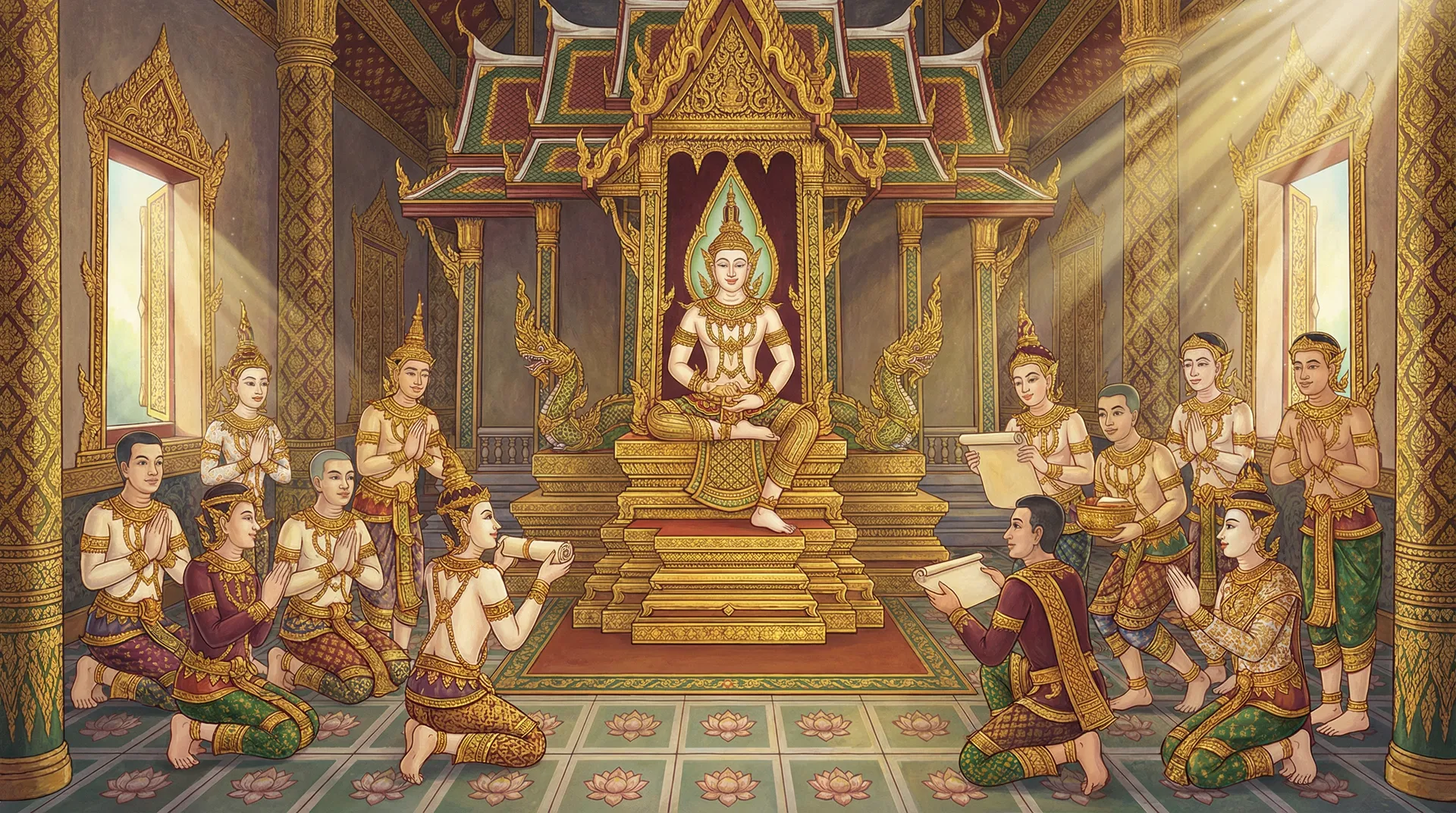
In the vibrant city of Savatthi, where merchants plied their wares and scholars debated the nature of existence, lived a king named Senaka. He was a just ruler, but a persistent question gnawed at him: what is the true measure of wisdom? One evening, as the moon cast its silver glow upon the royal gardens, the king confided in his chief advisor, a man whose wisdom was as deep as the ocean. The advisor, a former ascetic named Mahāpañha, smiled and began to recount a tale from a past life, the story of the Mahāpañha Jātaka.
Long ago, in a time when the Himalayas touched the sky with their snow-capped peaks, there stood a magnificent forest, vibrant with life and overflowing with natural wonders. In this forest lived a Bodhisattva, born as a wise and learned brahmin named Mahāpañha. He was renowned throughout the land for his profound knowledge of the scriptures, his sharp intellect, and his ability to solve the most complex riddles. People travelled from far and wide to seek his counsel and to test his wisdom.
One day, a delegation of kings arrived at Mahāpañha's humble abode. They were troubled by a series of perplexing questions that had been plaguing their courts, questions that no learned scholar or royal advisor could answer. "O wise Mahāpañha," they pleaded, "we are at our wits' end. Our kingdoms are filled with unrest because these enigmas remain unsolved. We implore you to shed your light upon them."
Mahāpañha, with his characteristic humility and grace, agreed to help. He listened patiently as the kings presented their riddles, each more intricate than the last. There was the riddle of the river that flowed uphill, the riddle of the bird that sang without a voice, and the riddle of the treasure that was both present and absent.
The Bodhisattva, Mahāpañha, did not dismiss these questions as mere absurdities. He understood that beneath the surface of every seemingly impossible riddle lay a profound truth waiting to be uncovered. He sat in deep contemplation, his mind a calm lake reflecting the wisdom of the ages. He saw the underlying principles, the hidden meanings, the metaphorical interpretations.
To the riddle of the river that flowed uphill, Mahāpañha explained, "This refers to the relentless pursuit of desire. Though it may seem a natural flow, it often leads us against the current of true contentment, pulling us upwards into a cycle of never-ending striving."
For the riddle of the bird that sang without a voice, he elucidated, "This is the silent wisdom that speaks directly to the heart. It is the intuition, the inner knowing, that does not need words to be understood. It is the song of the soul."
And regarding the riddle of the treasure that was both present and absent, Mahāpañha revealed, "This is the nature of impermanence and attachment. The 'treasure' is the joy we find in worldly possessions, which are always present yet ultimately absent, for they cannot be held onto forever. True treasure lies in detachment and understanding this truth."
The kings were astonished. Mahāpañha's answers were not mere solutions; they were profound insights into the human condition, philosophical lessons wrapped in the guise of riddles. They understood that true wisdom was not just about accumulating knowledge, but about understanding the deeper meanings of life.
As the kings prepared to depart, filled with gratitude and newfound understanding, Mahāpañha added a final piece of advice. "Remember, my lords," he said, his voice gentle yet firm, "the greatest wisdom lies not in answering difficult questions, but in understanding the questions themselves. It is in seeking the truth behind appearances, and in cultivating a mind that is both sharp and compassionate."
The kings returned to their kingdoms, not only with answers to their riddles but with a transformed perspective. They ruled with greater insight, understanding the needs of their people not just on a superficial level but at their core. The unrest in their kingdoms subsided, replaced by an era of peace and understanding.
The elder Mahāpañha concluded his tale, looking at King Senaka. "The Bodhisattva, in his life as Mahāpañha, demonstrated that true wisdom is not merely the accumulation of facts, but the ability to discern truth, to understand the underlying reality of things, and to apply this understanding with compassion. It is a wisdom that can solve not only the riddles of kings but the deeper enigmas of the human heart."
King Senaka nodded, his mind filled with the profound implications of the story. He realized that the questions he posed to himself were merely reflections of his own inner quest for understanding. He resolved to cultivate not just his intellect, but also his capacity for deep insight and compassion, knowing that this was the path to true wisdom.
— In-Article Ad —
💡Moral of the Story
True wisdom lies not just in knowing answers, but in understanding the questions and the underlying truths.
Perfection: Wisdom (Paññā)
— Ad Space (728x90) —
More Jataka Tales You May Enjoy
 514Vīsatinipāta
Nimi Jataka
The King Who Dreamt of HeavenIn the prosperous kingdom of Mithila, there reigned a virtuous and just...
💡 Virtuous actions, unwavering generosity, and a life dedicated to righteousness pave the path to heavenly realms and lasting peace. Aspirations for higher existence should be pursued through diligent merit-making.
 144Ekanipāta
Maca Hamsa Jataka
The Tale of the Golden Swan King In the realm of the Himalayas, amidst snow-capped peaks and crystal...
💡 True wealth lies in inner virtue, wisdom, and compassion, not in material possessions which are transient.
 242Dukanipāta
Kusa Jataka
Kusa JatakaIn the ancient kingdom of Mithila, nestled amidst verdant plains and whispering bamboo fo...
💡 True nobility lies not in birthright, but in character, resilience, and unwavering integrity, especially when faced with betrayal and hardship.
206DukanipātaKosiya Jataka
Kosiya Jataka In the ancient city of Varanasi, nestled beside the sacred River Ganges, there lived a...
💡 True wealth is not measured by possessions, but by the generosity and compassion shown to others. The greatest joy comes from alleviating suffering and contributing to the well-being of the community.
31EkanipātaThe Bodhisatta as a King of Elephants
The Bodhisatta as a King of ElephantsIn the heart of a vast and verdant forest, where ancient trees ...
💡 Wise leadership, determination, and the ability to inspire trust can guide a community through perilous journeys to safety.
183DukanipātaMuḷapariyāya Jātaka
The Tale of the Root of All EvilIn the ancient and prosperous city of Varanasi, ruled a king named B...
💡 The root of all suffering and evil lies within the human mind, stemming from craving, attachment, and ignorance. True peace is found by understanding and overcoming these internal afflictions.
— Multiplex Ad —