
Mūgapakkha Jātaka
Mūgapakkha Jātaka
In the bustling city of Ujjeni, a hub of commerce and culture, resided King Candapajjota. He was a powerful monarch, but his reign was shadowed by a relentless desire for fame and recognition. He craved to be known throughout the world for his conquests and his grandeur. One day, during a solemn court assembly, the king confessed his ambition to his chief minister, a man of quiet wisdom named Bhaddiyasena. The minister, understanding the king's restless spirit, proposed that they listen to the story of the Mūgapakkha Jātaka, a tale from a past life that spoke of a different kind of greatness.
Long ago, in a time when the earth was adorned with majestic forests and crystal-clear lakes, the Bodhisattva was born into a humble brahmin family in the kingdom of Kāsi. He was known as Mūgapakkha, meaning 'one who keeps silent'. From his birth, Mūgapakkha was a child of extraordinary intellect and profound inner peace. However, he chose to live a life of quiet contemplation, renouncing worldly pursuits and the desire for recognition. He dedicated himself to spiritual practices, seeking enlightenment through silence and meditation.
His parents, though loving, were perplexed by their son's unusual path. They urged him to engage with the world, to seek knowledge and status, and to make a name for himself. "Mūgapakkha, my son," his father would plead, "why do you remain silent? The world is full of wonders to explore, of knowledge to gain! Speak, engage, let your voice be heard!"
Mūgapakkha would only offer a gentle smile. He understood that true understanding came not from the clamor of the world, but from the stillness within. He found immense joy and wisdom in his silent observation of nature, in the subtle rhythms of life, and in the profound truths revealed through introspection.
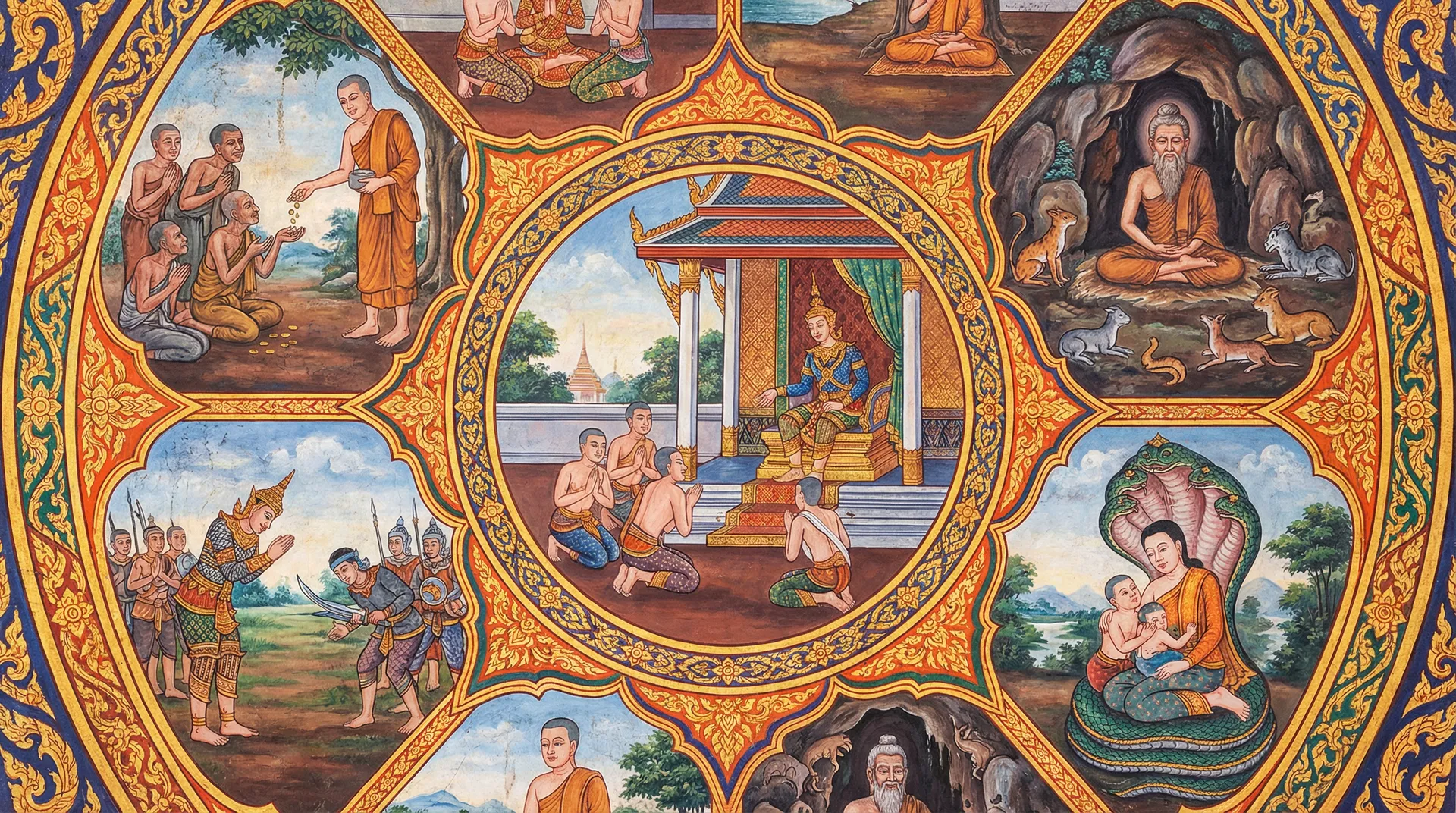
Despite his renunciation, Mūgapakkha's wisdom began to radiate outwards. Animals, sensing his pure heart, would gather around him. Birds would perch on his shoulders, and wild deer would rest at his feet. Even the fiercest predators seemed to lose their aggression in his presence. His silence was not emptiness, but a profound communication, a language understood by all beings.
One day, a terrible famine struck the land. The crops failed, the rivers dried up, and the people of Kāsi faced starvation. The king, in his desperation, consulted all his scholars and advisors, but none could find a solution. In their discussions, the name of the silent sage, Mūgapakkha, was mentioned. Though he lived in seclusion, his reputation for extraordinary inner peace and profound connection to nature had spread.
Skeptical but desperate, the king decided to seek Mūgapakkha's help. He travelled to the forest where the sage resided, accompanied by his retinue. When they found Mūgapakkha sitting serenely beneath a great banyan tree, surrounded by a host of peaceful creatures, the king was taken aback. He had expected a learned orator, a wise counselor who could offer grand pronouncements. Instead, he found a silent man whose presence exuded an unparalleled calm.
Hesitantly, King Candapala approached. "O wise sage," he began, "my kingdom is perishing from hunger. We have tried all means, but to no avail. We have heard of your profound connection to nature. Can you help us?"
Mūgapakkha, without uttering a word, rose and walked towards a specific spot in the forest. He gestured for the king to follow. He led them to a hidden spring, its waters flowing abundantly, and then to a grove of trees bearing ripe, nourishing fruits, untouched by the drought. He then sat down and pointed to the sky, as if indicating a coming change.
The king and his men, though amazed, were still unsure. Mūgapakkha then gently picked up a fallen leaf and, with his finger, drew an image in the dust – an image of clouds and rain. He then pointed to the spring and the fruit trees, implying that nature's bounty was still present for those who knew where to look.
As if in response to his silent gesture, the sky began to darken. Gentle clouds gathered, and soon, a soft, life-giving rain began to fall upon the parched land. The people of Kāsi, guided by Mūgapakkha's silent wisdom and the timely rain, were able to find sustenance from the hidden springs and fruit trees, and the famine eventually subsided.
The king, humbled and deeply moved, finally understood. He realized that true greatness was not in making noise or seeking fame, but in profound inner strength, wisdom, and a deep connection to the natural world. Mūgapakkha's silence had spoken louder than any words, his actions more powerful than any decree.
The minister Bhaddiyasena concluded his tale. "King Candapajjota, the Bodhisattva, in his life as Mūgapakkha, showed that true power lies not in external acclaim, but in inner stillness, wisdom, and compassion. His silence, born of deep understanding, brought salvation to a kingdom. The greatest achievements are often born not of ambition, but of serene dedication and a profound connection to the truth."
King Candapajjota listened, his ambition for fame fading like mist in the morning sun. He realized that a life of quiet service and inner peace was a far greater achievement than any conquest. He began to cultivate stillness within himself, understanding that true leadership was also about inner cultivation.
— In-Article Ad —
💡Moral of the Story
True greatness is found not in worldly fame or ambition, but in inner peace, profound wisdom, and a deep connection to life.
Perfection: Patience (Khanti) and Renunciation (Nekkhamma)
— Ad Space (728x90) —
More Jataka Tales You May Enjoy
 371Pañcakanipāta
Mugapakkha Jātaka
Mugapakkha JātakaIn the ancient kingdom of Varanasi, nestled beside the serene Ganges River, lived a...
💡 Beware of those who speak with honeyed words but harbor deceit in their hearts. True wisdom lies in discerning the hidden intentions behind actions.
 464Dvādasanipāta
Mugapakkha Jātaka
Mugapakkha JātakaIn the ancient land of Mithila, a realm renowned for its scholars and philosophers,...
💡 True strength and leadership are demonstrated through courageous actions and unwavering commitment, not necessarily through eloquent speech. Overcoming personal limitations and past karmic consequences requires inner strength and resolute will.
 333Catukkanipāta
Sattigumba Jātaka
Sattigumba JātakaIn the verdant forest of Kosala, where ancient trees whispered secrets to the wind ...
💡 True strength lies not in brute force or domination, but in unwavering courage, righteousness, and the defense of justice.
 392Chakkanipāta
Moggallana Jataka
Moggallana JatakaIn the ancient land of Savatthi, there lived a wealthy merchant named Punna. He was...
💡 Generosity and devotion to the Dharma are powerful virtues that lead to immense merit and spiritual growth. True wealth is found in giving.
317CatukkanipātaSutasoma Jataka
Sutasoma JatakaIn the ancient kingdom of Gandhara, nestled amidst rolling hills and verdant valleys,...
💡 True liberation from suffering comes through selfless sacrifice and detachment from worldly attachments, particularly the craving for existence.
 404Sattakanipāta
Sama Jataka
Sama JatakaIn the tranquil foothills of the Himalayas, where the air was crisp and the scent of pine...
💡 Filial piety (devotion to parents) and a life lived with unwavering virtue and sincerity possess immense power, capable of overcoming even the gravest of misfortunes.
— Multiplex Ad —