
Kusa Jataka
Kusa Jataka
In the opulent city of Varanasi, amidst a kingdom blessed with abundance, lived a king renowned for his magnificence and his vast treasures. He was adorned with jewels and gold, his palaces gleamed, and his coffers overflowed. Yet, despite his immense wealth, the king was plagued by a deep-seated discontent. He craved more, always more, and the pursuit of material possessions consumed his every thought.
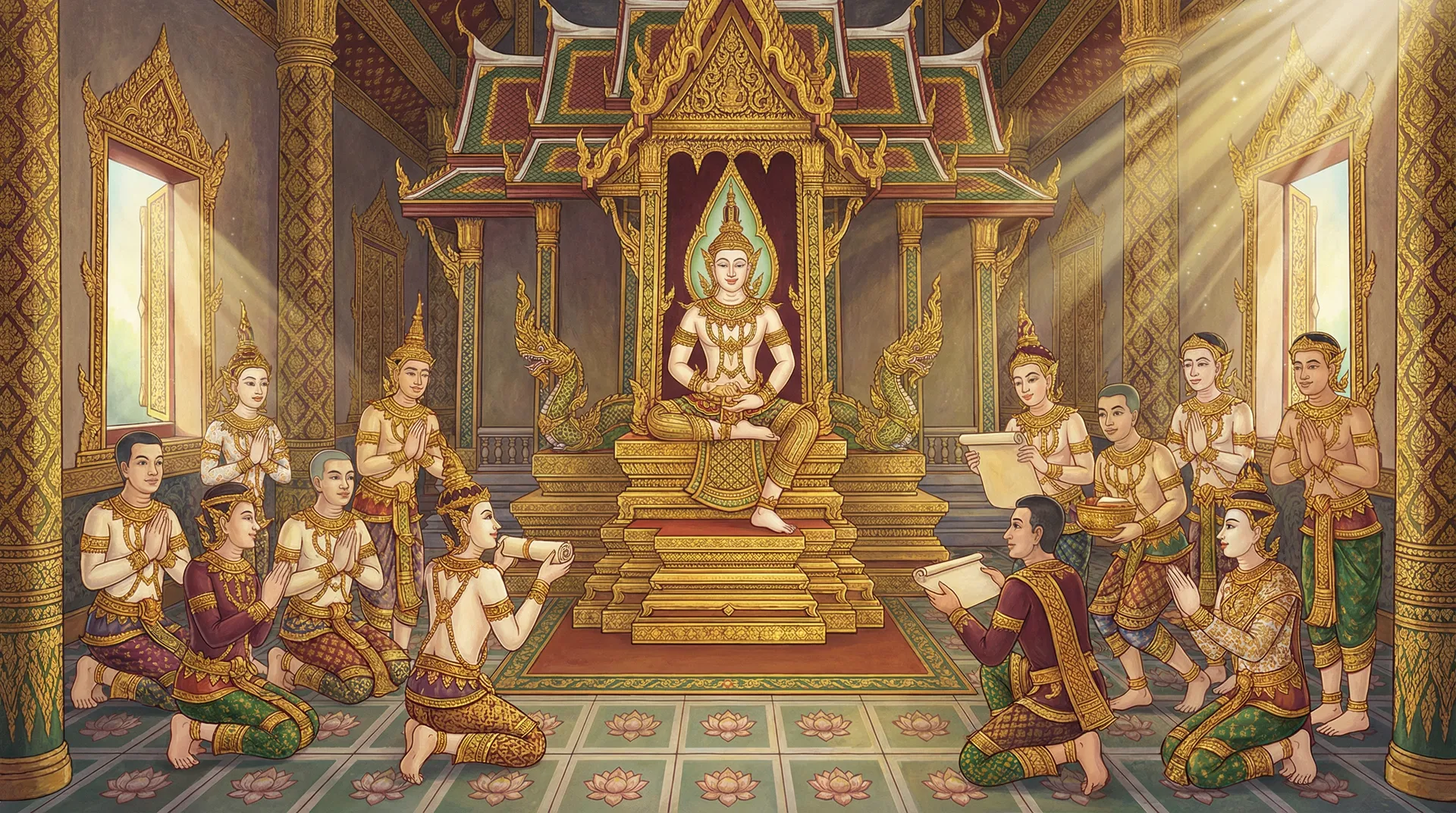
One day, a wise and ascetic prince, known for his renunciation of worldly pleasures and his profound understanding of the ephemeral nature of wealth, visited the king’s court. This prince, who had chosen the life of a mendicant, was named Kusa. Kusa wore simple saffron robes, carried a begging bowl, and his presence exuded a calm detachment that was the antithesis of the king’s restless ambition.
The king, seeing the prince, felt a pang of envy mixed with curiosity. “O Prince Kusa,” the king addressed him, his voice laced with the arrogance of his status, “you wander the land with nothing but a bowl and rags. You have renounced palaces and riches. Tell me, what joy can you possibly find in such a destitute existence? Surely, true happiness lies in the abundance of wealth and the power it commands.”
Prince Kusa smiled, his eyes reflecting a deep inner peace. “Your Majesty,” he replied gently, “you mistake the shadow for the substance. Wealth and possessions are like a mirage in the desert, appearing substantial but offering no true sustenance. They bind one to the cycle of craving, fear, and dissatisfaction. The more one accumulates, the more one has to lose, and the greater the anxiety that accompanies it.”
The king scoffed. “You speak of fear and anxiety. I have guards, armies, and fortresses! Nothing can touch me or my treasures.”
“Can your guards protect you from the inevitability of old age?” Kusa asked. “Can your fortresses shield you from sickness? Can your armies ward off the end of life itself? These are the true enemies that no amount of earthly wealth can defeat. My possessions are not of gold and jewels, but of wisdom, contentment, and inner peace. These are treasures that cannot be stolen, that decay not with time, and that accompany me beyond this life.”
The king was taken aback by the prince’s words. He had never considered his wealth in such terms. He saw Kusa’s serene countenance, his lack of any material burden, and felt a strange yearning for something he could not define.
“But surely,” the king persisted, “to live without the comforts and luxuries of life is a form of suffering in itself?”
“Suffering arises not from the absence of external comforts, but from the presence of internal attachments and aversions,” Kusa explained. “When one clings to possessions, one suffers when they are lost. When one craves pleasure, one suffers when it is denied. My path is one of letting go. By relinquishing the desire for external things, I find freedom from the suffering they inevitably bring. My begging bowl is not a symbol of poverty, but of independence. It represents my freedom from the need to acquire, to hoard, to protect. It allows me to be present in each moment, grateful for what is offered, and content with what I have.”
Prince Kusa stayed at the king’s court for a few days, sharing his wisdom. He spoke of the impermanence of all material things, the illusion of ownership, and the profound joy that comes from detachment. He demonstrated this by living simply, eating what was offered, and showing no preference or desire.
The king, through his interactions with Kusa, began to see the hollowness of his own opulent existence. He realized that his constant pursuit of wealth had made him a prisoner of his own possessions, constantly guarding them, constantly wanting more, and never truly at peace. He saw the freedom and genuine happiness that radiated from Prince Kusa, a happiness that no amount of gold could buy.
Though the king did not immediately renounce his throne, the seeds of change were sown. He began to question his own materialistic desires, to practice gratitude, and to understand the true meaning of wealth—not as accumulation, but as inner contentment and detachment. Prince Kusa, having fulfilled his purpose of awakening the king to a different perspective, continued his journey, a living testament to the fact that true riches are found not in what we possess, but in what we are willing to let go of.
— In-Article Ad —
💡Moral of the Story
True wealth lies not in material possessions or worldly power, but in inner contentment, detachment, and wisdom, which bring lasting peace and freedom from suffering.
Perfection: Renunciation, Wisdom, Patience
— Ad Space (728x90) —
More Jataka Tales You May Enjoy
 517Vīsatinipāta
Mahāsuvanna Jataka
The Golden Swan's FlightIn the ancient city of Mithila, nestled beside a shimmering lake, lived a ki...
💡 True power and prosperity are not achieved through aggression or conquest, but through wisdom, righteousness, and compassion. Upholding ethical principles is the foundation of a just and harmonious society.
 66Ekanipāta
The Great Crane Jataka
Long ago, in an age when the Buddha had not yet appeared, in a time immeasurably distant, the Bodhis...
💡 True wealth is measured not by the abundance of possessions, but by the happiness and prosperity of one's people. Greed leads to suffering, while generosity and compassion bring true prosperity.
132EkanipātaKuddala Jataka
The Tale of the Weaver's Son Long ago, in the bustling city of Savatthi, renowned for its vibrant ma...
💡 A truly prosperous kingdom is one where the well-being of its poorest citizens is a priority, and where systematic compassion is integrated into governance.
71EkanipātaThe Jataka of the Clenched Fist
In a time long past, in the prosperous city of Varanasi, the Bodhisatta was born as a young Brahmin ...
💡 True leadership lies in protecting the vulnerable, even at great personal risk.
 200Dukanipāta
Sutasoma Jātaka
The Tale of the Bodhisattva as a Pacifist KingIn the ancient city of Suvarna, there reigned a king n...
💡 True strength lies in non-violence, restraint, and compassion. Conflicts can often be resolved through dialogue, understanding, and sincere efforts towards peace, rather than through aggression.
198DukanipātaMahosadha Jātaka
The Tale of the Brilliant Sage MahosadhaIn the magnificent city of Mithila, there lived a Bodhisattv...
💡 True ownership is demonstrated through genuine care, responsibility, and concern for the well-being of what one possesses, rather than mere assertion of claim or possession.
— Multiplex Ad —