
Sutasoma Jātaka
Sutasoma Jātaka
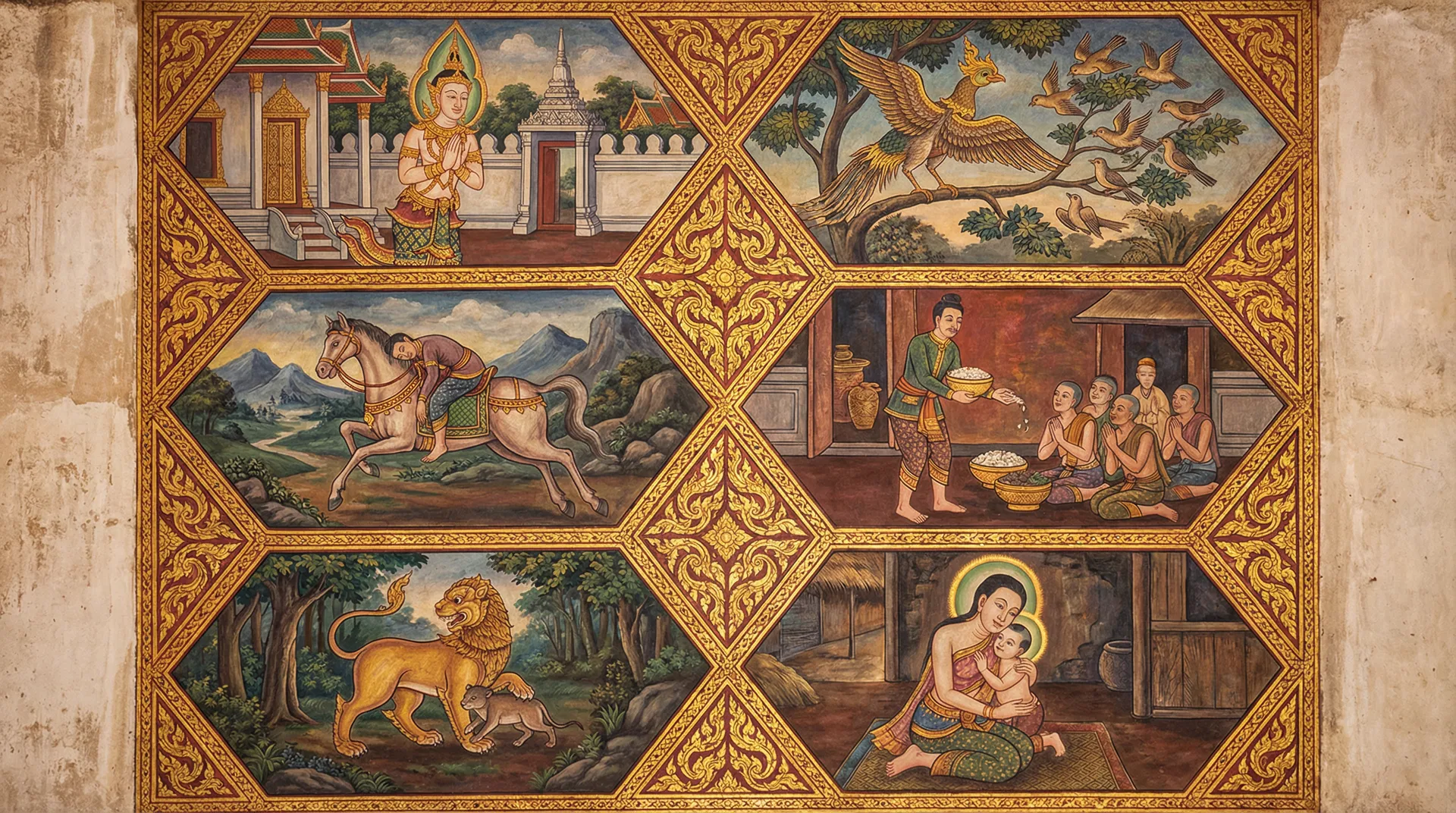
Long ago, in the land of Kasi, there lived a wise and virtuous king named Sutasoma. He was known throughout the realm for his unwavering commitment to truth and righteousness. His kingdom flourished under his benevolent rule, and his people lived in peace and prosperity. However, one day, a terrible plague swept through the land, bringing with it suffering and death. The king, deeply saddened by the plight of his subjects, vowed to find a cure, no matter the cost.
He consulted with the wisest scholars and physicians in his kingdom, but none could offer a solution. Desperate, the king turned to ancient texts and prophecies. He discovered a legend that spoke of a magical herb, hidden deep within the treacherous Himalayas, that possessed the power to heal any ailment. The journey to the Himalayas was fraught with danger, but King Sutasoma, driven by compassion, resolved to undertake it himself.
He bid farewell to his queen and his people, promising to return with the cure. With a small band of loyal companions, he set off towards the towering mountains. The journey was arduous. They faced harsh weather, treacherous terrain, and wild beasts. Many of his companions fell ill or turned back, but King Sutasoma pressed on, his determination unwavering.
One day, they encountered a fearsome ogre, a creature of immense strength and malevolence, who guarded the path to the mountains. The ogre demanded a tribute: a hundred young men, strong and healthy, to be sacrificed to him. King Sutasoma, witnessing the fear in the eyes of his remaining companions, knew he could not allow them to be harmed. He stepped forward, offering himself as a substitute.
The ogre, amused by the king's bravery, agreed to the exchange. King Sutasoma was taken to the ogre's lair, a dark and desolate cave. The ogre prepared for the ritual, intending to devour the king. But King Sutasoma, remembering his vows, remained calm. He knew that his compassion and his willingness to sacrifice himself for others were his greatest strengths.
As the ogre prepared to strike, King Sutasoma began to speak. He spoke of the suffering of his people, of the importance of kindness, and of the futility of violence. He told stories of past kings who had ruled with compassion and wisdom, and how their kingdoms had prospered. The ogre, who had lived a life of solitude and cruelty, was moved by the king's words. He had never encountered such genuine kindness and selflessness.
Tears welled up in the ogre's eyes. He realized the error of his ways. He confessed that he too had suffered greatly and that his cruelty was born out of loneliness and despair. King Sutasoma, extending his hand in forgiveness, offered the ogre friendship and a chance for redemption. The ogre, overwhelmed with gratitude, agreed to help the king find the magical herb.
Together, they ventured into the deepest parts of the Himalayas. The ogre, with his knowledge of the mountains, guided King Sutasoma to the hidden grove where the herb grew. The king carefully gathered the herb, giving thanks to the ogre and the celestial beings who had protected him on his perilous journey.
King Sutasoma returned to his kingdom, the magical herb in hand. He prepared a potent medicine, which quickly cured the plague. His people rejoiced, showering their king with praise and gratitude. King Sutasoma, however, attributed his success not to his own strength, but to the compassion and forgiveness he had shown. He had learned that even the fiercest of hearts could be softened by kindness, and that true strength lies not in power, but in empathy.
— In-Article Ad —
💡Moral of the Story
True strength lies in compassion, forgiveness, and selflessness. Kindness can conquer even the most hardened hearts.
Perfection: Compassion (Karuna) and Forgiveness (Khanti)
— Ad Space (728x90) —
More Jataka Tales You May Enjoy
 394Chakkanipāta
Sujata Jataka
Sujata JatakaIn a bustling city, there lived a young woman named Sujata. She was known throughout th...
💡 Truth and integrity are paramount. Even in the face of slander, a virtuous character will ultimately shine through.
 186Dukanipāta
Khuddakapota Jataka
The Tale of the Little DoveIn the ancient city of Varanasi, nestled beside the mighty Ganges River, ...
💡 Great accumulations are often the result of small, consistent efforts, and true wealth can be found in perseverance and patience.
 81Ekanipāta
Māhāsukha Jātaka
Māhāsukha Jātaka Long ago, in the bustling city of Mithila, lived a king named Brahmadatta. He was a...
💡 True happiness is found not in external possessions or status, but in inner peace, detachment, and boundless compassion.
118EkanipātaUdaya Jataka
Udaya Jataka In the kingdom of Mithila, a land renowned for its skilled artisans and vibrant markets...
💡 True wisdom lies in discerning truth from falsehood, and in valuing integrity and honesty above material gain or superficial promises. Appearances can be deceiving; a sharp mind and a pure heart are the best defenses against deception.
93EkanipātaAssaka Jataka
Assaka JatakaIn the ancient kingdom of Kasi, nestled beside the gentle flow of the River Ganges, sto...
💡 True generosity requires discernment. One must be careful not to be deceived by outward appearances or false piety, ensuring that one's charitable acts benefit those who are genuinely in need.
48EkanipātaThe Bodhisatta as the Generous King
The Bodhisatta as the Generous KingIn the ancient and prosperous kingdom of Varanasi, ruled a king n...
💡 True generosity is not deterred by pride or rejection; it finds ways to benefit all, demonstrating the highest form of leadership.
— Multiplex Ad —