
Sutasoma Jataka
Sutasoma Jataka
In the ancient and prosperous kingdom of Pancala, there lived a wise and benevolent king named Pancala. His reign was marked by peace and prosperity, and his people adored him. Yet, the king harbored a secret yearning for a son who would inherit his wisdom and continue his righteous rule. He performed many virtuous deeds, hoping to be blessed with a child who would embody the highest ideals of kingship.
One day, his prayers were answered. Queen Pancala gave birth to a son, a prince of extraordinary beauty and intelligence. He was named Sutasoma, and from his very birth, it was clear that he was no ordinary child. His eyes shone with a deep understanding, and his laughter seemed to echo with ancient wisdom. As he grew, he displayed an insatiable thirst for knowledge, mastering not only the martial arts and statecraft but also the intricate philosophies and spiritual teachings of the time.
Prince Sutasoma was particularly drawn to the teachings of non-violence and compassion. He believed that true strength lay not in the ability to inflict harm, but in the power to restrain oneself and to protect others. This belief often put him at odds with the prevailing customs of his time, where prowess in battle was highly esteemed.
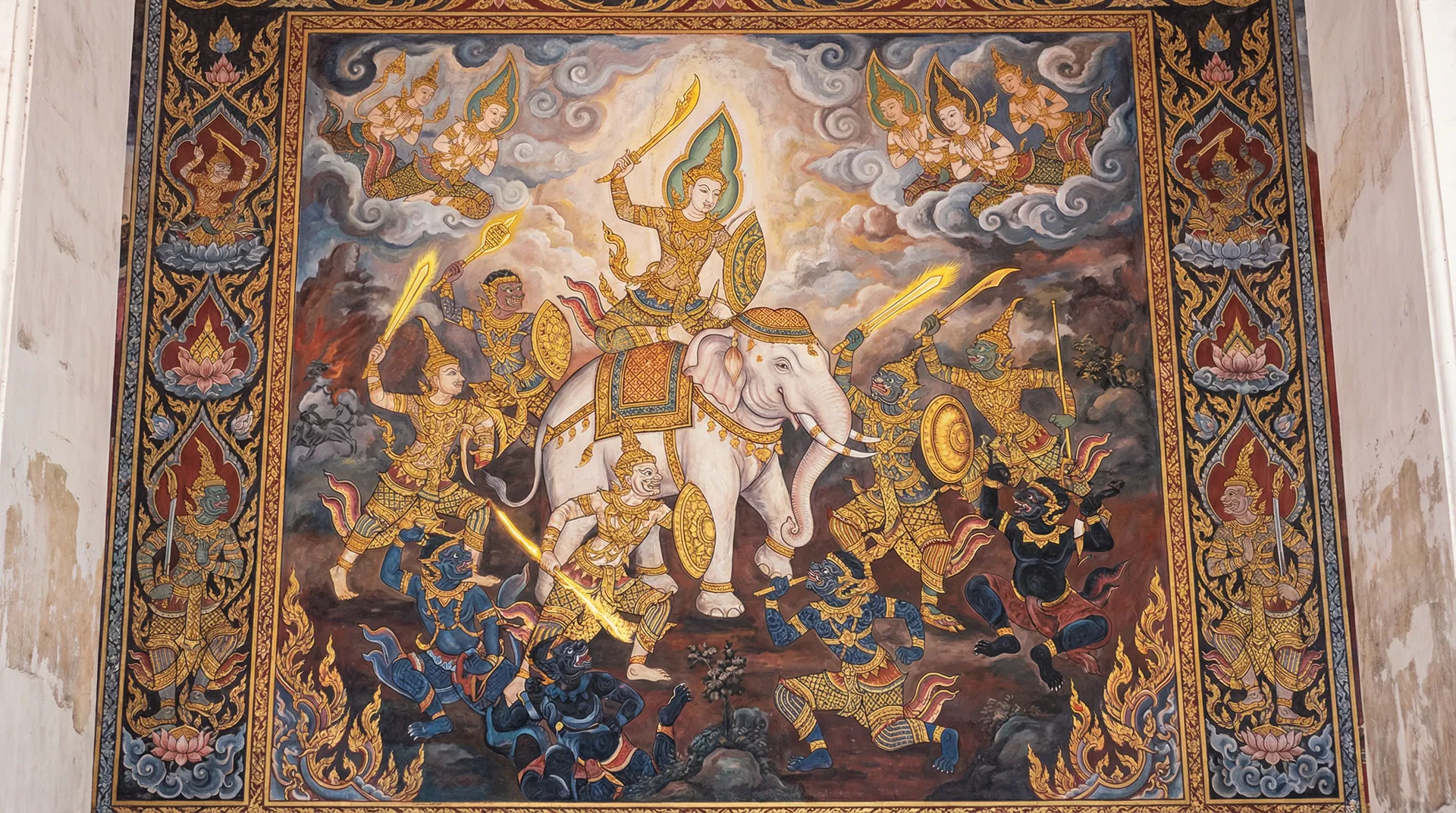
One day, a formidable demon, known as Kalayavana, terrorized the neighboring kingdom of Videha. Kalayavana was a monstrous being, whose strength was legendary and whose cruelty knew no bounds. He demanded tribute of young men and women from the terrified populace, and those who refused were met with brutal destruction. The king of Videha, desperate and helpless, sent emissaries to King Pancala, pleading for aid.
King Pancala, deeply troubled by the plight of his neighbors, consulted with his advisors. Many urged him to send his armies, to meet force with force. But Prince Sutasoma, though young, stepped forward with a different proposal. 'Father,' he said, 'this demon thrives on violence. He delights in destruction. If we meet him with weapons, we only feed his power and perpetuate the cycle of suffering. I believe there is another way.'
'And what way is that, my son?' the king asked, his brow furrowed with concern.
'I will go to Kalayavana myself,' Sutasoma declared. 'I will face him not with an army, but with my own understanding of strength. I will try to subdue him not with might, but with wisdom and compassion.'
The king was hesitant. 'My son, this is a demon of immense power. He has destroyed many brave warriors. It is too dangerous!'
'Fear not, Father,' Sutasoma replied with a calm smile. 'True victory lies not in conquering an enemy, but in transforming him. I will undertake this task.'
Despite the king's reservations, Prince Sutasoma, accompanied by a small retinue, journeyed to the kingdom of Videha. The people of Videha, witnessing the prince's courage, felt a flicker of hope rekindle in their hearts. Sutasoma, radiant with inner strength, marched towards the demon's lair, a place shrouded in darkness and fear.
When Sutasoma arrived, Kalayavana roared with laughter, his voice like thunder. 'So, a prince comes to challenge me! Do you bring an army, little one? Or have you come to offer yourself as tribute?'
Sutasoma stood tall, his demeanor serene. 'O Kalayavana,' he said, his voice clear and unwavering, 'I have come alone. I do not seek to conquer you, nor do I offer myself as tribute. I have come to understand you.'
The demon was taken aback. No one had ever spoken to him in such a manner. 'Understand me? What is there to understand? I am power! I am destruction!'
'Power can be used for creation as well as destruction,' Sutasoma replied gently. 'And destruction only breeds more destruction. Tell me, why do you cause such suffering? What is it you truly seek?'
Kalayavana, unused to such questions, grew agitated. He lashed out with his mighty fists, but Sutasoma, with incredible agility and inner calm, dodged every blow. He did not retaliate, but continued to speak, his words like soothing balm on the demon's rage.
'You possess great strength, Kalayavana,' Sutasoma continued. 'Imagine if that strength were used to build, to protect, to heal, instead of to destroy. Would that not bring you greater fulfillment?'
The demon faltered. For the first time in his existence, he felt a flicker of doubt, a pang of something other than rage. He saw in Sutasoma's eyes not fear or defiance, but genuine understanding and compassion. He saw a reflection of a potential he had never dared to consider – a life lived not in fear and destruction, but in purpose and peace.
Sutasoma continued to speak of the interconnectedness of all beings, of the suffering caused by hatred and violence, and of the profound peace that comes from inner control and benevolence. He spoke of the true nature of strength – the strength to resist one's own baser instincts, the strength to forgive, the strength to love.
Slowly, the rage within Kalayavana began to subside. He saw the futility of his destructive path. He realized that his power had brought him only fear and isolation. In Sutasoma, he saw a different kind of power, a power that emanated from inner peace and boundless compassion.
Finally, Kalayavana bowed his head. 'Prince Sutasoma,' he rumbled, his voice now subdued, 'you have shown me a truth I have never known. My strength has been my curse, my violence my prison. I have lived in darkness, and you have brought me light. I am no longer Kalayavana, the destroyer. I wish to change.'
Prince Sutasoma, his mission accomplished, embraced the transformed demon. He taught Kalayavana how to use his strength for good, to protect the weak and to help those in need. The kingdom of Videha was saved, not by the clash of swords, but by the power of wisdom, compassion, and understanding. Prince Sutasoma returned to Pancala, a hero not for his prowess in battle, but for his extraordinary ability to conquer the hearts of even the most fearsome beings.
The story of Prince Sutasoma became a legend, a testament to the fact that true strength lies in the ability to transform, to overcome negativity not with force, but with love and understanding. It showed that even the darkest hearts could be touched by compassion, and that the greatest victory was the victory over one's own destructive tendencies.
— In-Article Ad —
💡Moral of the Story
True strength lies in compassion, wisdom, and the ability to transform others through understanding, rather than through force or violence. Non-violence and empathy can overcome even the most formidable adversaries.
Perfection: Wisdom (Prajna Paramita), Compassion (Karuna Paramita), Non-violence (Ahimsa Paramita)
— Ad Space (728x90) —
More Jataka Tales You May Enjoy
 522Mahānipāta
Ghata Jataka
Ghata JatakaIn a time long past, when the Bodhisatta was born as a wise and exceptionally strong pot...
💡 True strength is not measured by outward displays of force or arrogance, but by inner fortitude, skill, integrity, and the quiet power of diligence and honest work.
 174Dukanipāta
Kuṅkuṇavaṅga Jātaka
Kuṅkuṇavaṅga JātakaIn the verdant land of Kasi, a kingdom renowned for its vibrant silks and skilled...
💡 True mastery and excellence are achieved through unwavering patience, dedication, and meticulous attention to detail. Haste and impatience lead to flaws and mediocrity.
 251Tikanipāta
Nandiya-Jātaka
Nandiya-JātakaIn the heart of a lush forest, where ancient trees whispered secrets to the wind and s...
💡 True fulfillment and lasting happiness are found not in worldly possessions or power, but in detachment, simplicity, and the pursuit of spiritual enlightenment. The greatest leadership is often demonstrated through selfless sacrifice and the courage to follow one's highest calling.
 106Ekanipāta
Bhaddasala Jataka
The Tale of the Wise Elephant and the Foolish King In the ancient kingdom of Mithila, ruled a king n...
💡 True wisdom often comes from unexpected sources. A leader's true strength is shown not in anger or pride, but in humility, compassion, and the willingness to serve their people.
13EkanipātaThe Steadfast Brahmin
The Steadfast BrahminIn the ancient city of Varanasi, a beacon of spiritual learning, lived a devout...
💡 Unwavering steadfastness and a pure heart can inspire others and lead to rebuilding.
56EkanipātaThe Jataka of Dighavu, the Wrathful Prince
In the magnificent city of Savatthi, in days long past, there reigned a king named Koravya. He posse...
💡 Beware of those who speak with honeyed words but harbor venom in their hearts. True wisdom lies not in seeking external remedies but in cultivating inner truth and understanding.
— Multiplex Ad —