
Kosiyavattha Jātaka
Kosiyavattha Jātaka
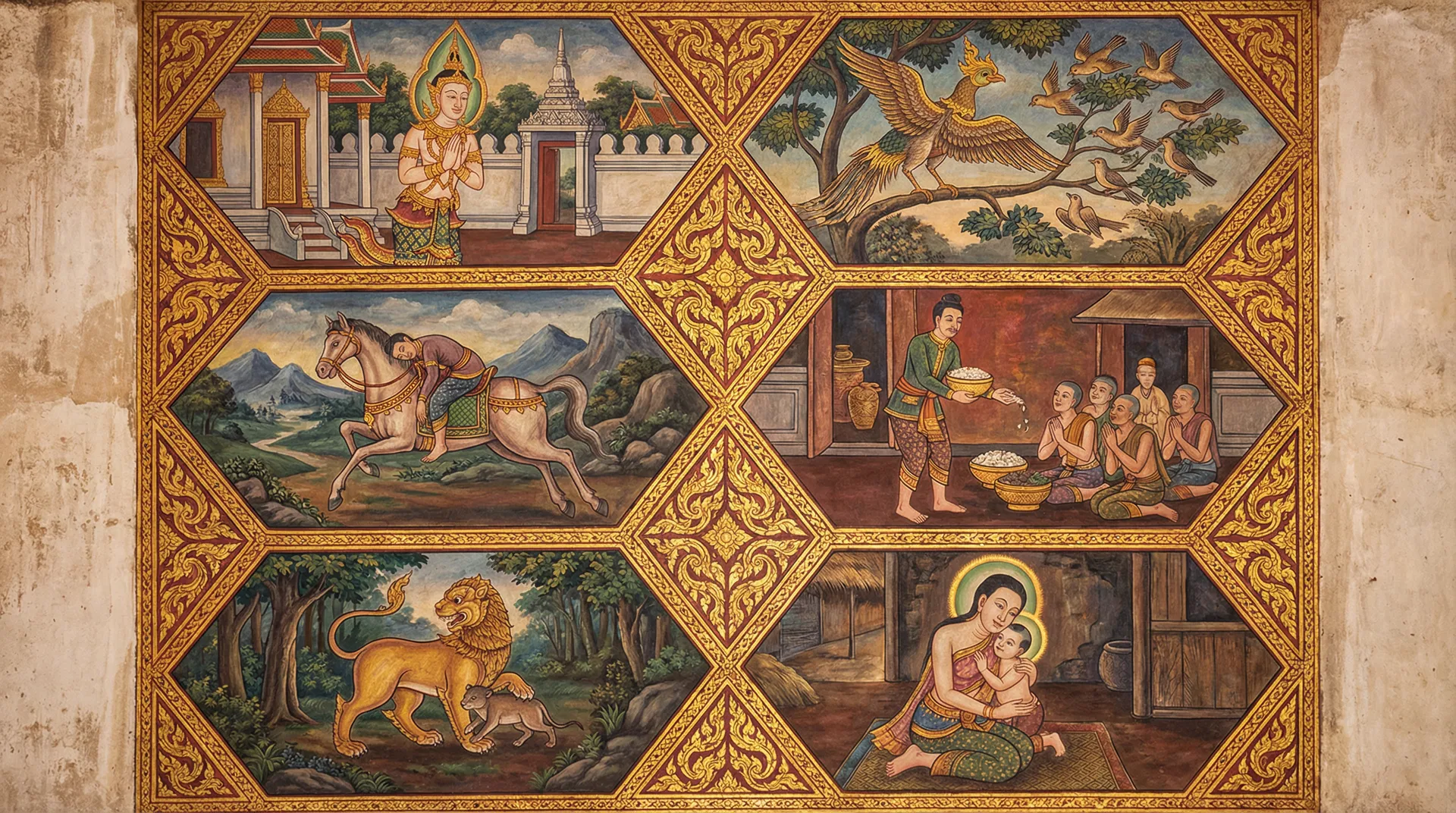
In the ancient kingdom of Mithila, renowned for its wise king and its prosperous people, there lived a merchant named Kosiyavattha. He was a man of great wealth, his ships sailing to distant lands, bringing back silks, spices, and precious stones. Yet, despite his immense fortune, Kosiyavattha was not content. He was plagued by a gnawing dissatisfaction, a constant feeling that something was missing in his life.
He had a beautiful wife, a grand mansion, and servants at his beck and call, but true happiness eluded him. He would often sit by his window, gazing at the bustling marketplace, observing the simple lives of the common folk. He saw vendors hawking their wares, children playing in the dust, and elders sharing stories, and he wondered if their simple existence held a joy that his wealth could not buy.
One day, a venerable ascetic, his body lean and his eyes serene, passed through Mithila. He was known throughout the land for his profound wisdom and his detachment from worldly pleasures. Kosiyavattha, hearing of his arrival, felt an inexplicable pull. He decided to seek the ascetic’s counsel.
He found the ascetic meditating under a large banyan tree on the outskirts of the city. Approaching with respect, Kosiyavattha bowed low. "Venerable Sir," he began, his voice tinged with a mixture of awe and desperation, "I am a man of great wealth, yet my heart is restless. I possess everything the world can offer, yet I feel empty. What is it that I lack? How can I find true contentment?"
The ascetic opened his eyes, which shone with a gentle light. He looked at Kosiyavattha, not with judgment, but with deep understanding. "Merchant," he said, his voice like the rustling of leaves, "your wealth is like a vast ocean. It can carry you to any shore, but if you do not know where you are going, you will simply drift forever. You are seeking external treasures, but true contentment lies within."
Kosiyavattha listened intently. "But how, Venerable Sir? How can I find this inner treasure?"
The ascetic smiled. "Observe the world around you, not with the eyes of a merchant seeking profit, but with the heart of a seeker of truth. See the impermanence of all things. The finest silks will fray, the sweetest spices will lose their aroma, the most precious jewels will be lost or stolen. Your wealth, vast as it is, is subject to the same laws of decay and loss."
He continued, "True wealth is not what you possess, but what you cultivate within yourself. It is generosity, kindness, compassion, wisdom, and peace. These are treasures that cannot be taken away. They grow when they are shared, and they bring an enduring joy that no amount of gold can buy."
Kosiyavattha pondered the ascetic’s words deeply. He returned to his opulent home, but his perspective had shifted. He began to look at his possessions differently. He saw them not as sources of security or status, but as temporary stewardships.
He started to practice what the ascetic had advised. He began to give generously, not just a portion of his wealth, but with a true spirit of selfless giving. He established free dispensaries for the sick, provided food for the hungry, and supported aspiring artisans. He listened to the problems of his workers, offering not just solutions but also empathy. He spent time learning from the scholars and engaging with the elders, seeking wisdom rather than profit.
As he practiced these virtues, a remarkable transformation occurred within him. The restlessness in his heart began to subside, replaced by a quiet sense of peace. The emptiness he had felt was filled with a burgeoning joy. He found that the more he gave, the richer he became, not in material wealth, but in spirit.
His servants noticed the change. His wife marveled at his newfound serenity. The people of Mithila, who had once seen him as a distant, wealthy merchant, now revered him as a benevolent and wise man. He had discovered that true contentment was not in accumulating, but in cultivating the inner qualities of a noble heart. His wealth, once a source of his discontent, now became a tool for spreading happiness and embodying the virtues he had learned.
Kosiyavattha never forgot the ascetic or his profound lesson. He continued to live a life of purpose, his immense wealth now a vessel for his inner richness, a testament to the truth that the greatest treasures are those cultivated within the heart.
— In-Article Ad —
💡Moral of the Story
True contentment and inner peace are found not in the accumulation of material wealth, but in cultivating virtues such as generosity, compassion, and wisdom.
Perfection: Generosity (Dāna) and Virtue (Sīla)
— Ad Space (728x90) —
More Jataka Tales You May Enjoy
 387Chakkanipāta
Sutasoma Jataka
Sutasoma JatakaIn a kingdom nestled between whispering mountains and a shimmering sea, there lived a...
💡 Wisdom and compassion are more powerful than brute force. True liberation comes from understanding and overcoming ignorance.
 506Pakiṇṇakanipāta
Mugapakkha Jataka
The Tale of the Mute PrinceIn the ancient kingdom of Mithila, ruled a wise and benevolent king. His ...
💡 True strength and leadership are not defined by eloquent speech alone, but by courage, wisdom, and unwavering determination in the face of adversity. Inner qualities shine brighter than outward appearances.
317CatukkanipātaSutasoma Jataka
Sutasoma JatakaIn the ancient kingdom of Gandhara, nestled amidst rolling hills and verdant valleys,...
💡 True liberation from suffering comes through selfless sacrifice and detachment from worldly attachments, particularly the craving for existence.
388ChakkanipātaSamkicca Jataka
Samkicca JatakaIn the vibrant city of Savatthi, a place alive with the chatter of merchants and the ...
💡 Honesty and integrity are the most valuable treasures. Even when faced with deception and adversity, speaking the truth and maintaining one's principles will ultimately lead to vindication.
309CatukkanipātaMūga-Pakṣa Jātaka
The Silent SageIn the kingdom of Mithila, there lived a king named Vidhuratha. He was a just ruler, ...
💡 True wisdom is not always expressed through eloquent speech; profound understanding and inner peace can be conveyed through silence and action. Do not be swayed by superficial appearances or clever words; seek the deeper truths that lie beneath.
 285Tikanipāta
Mūga-pakkhaya Jātaka
Mūga-pakkhaya JātakaIn a serene hermitage nestled amidst the verdant hills, lived a Bodhisattva know...
💡 True wisdom is often found in silence and deep contemplation, rather than in endless debate or attachment to one's own opinions. Be open to questioning your own understanding.
— Multiplex Ad —