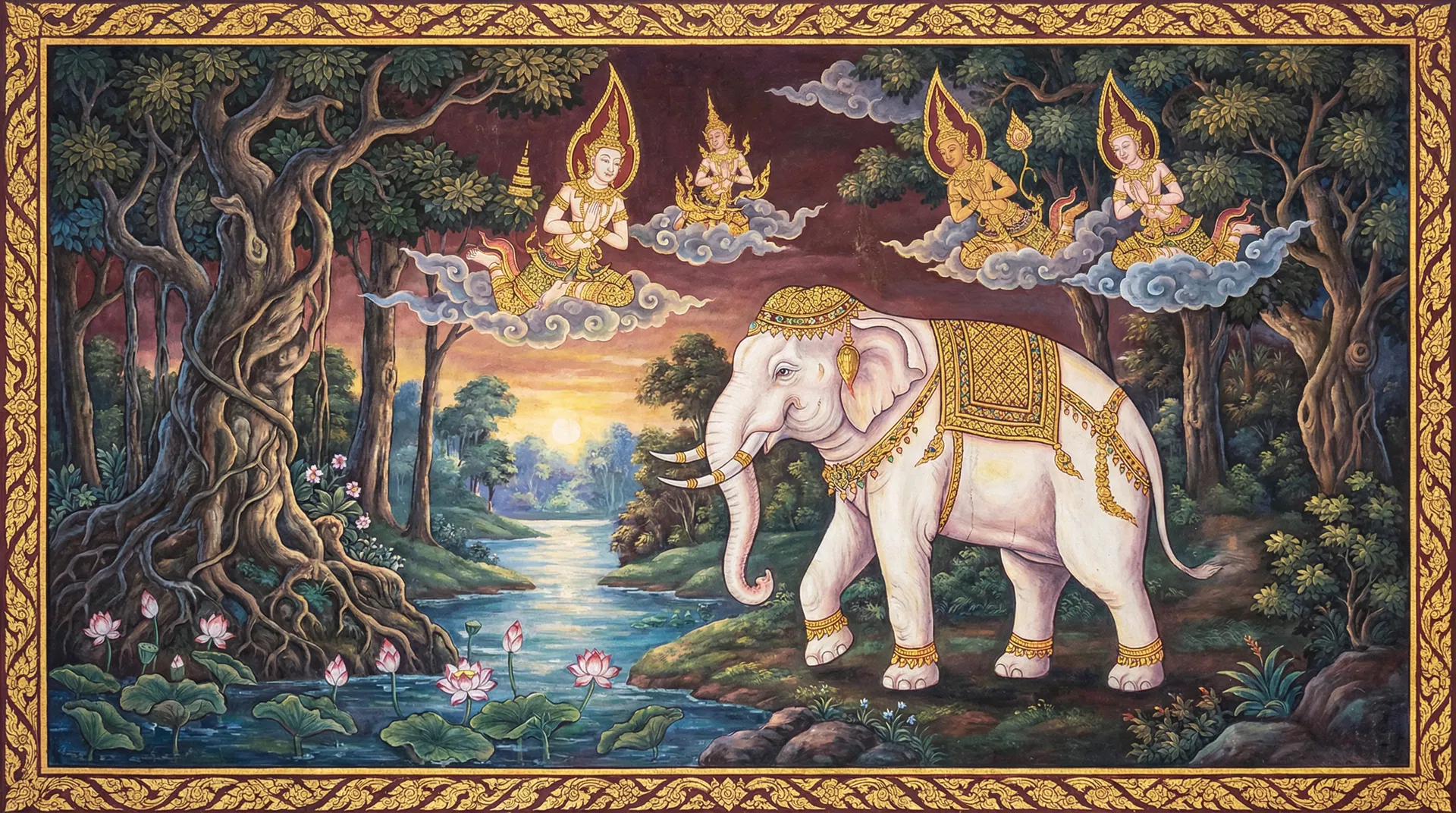
Mūkapakkha Jātaka
The Mute Bird Jātaka
In the lush, vibrant jungle of the Himalayan foothills, where ancient trees touched the sky and hidden streams whispered secrets, there lived a flock of colorful birds. Among them was a young bird named Puppha, whose plumage was a dazzling array of crimson and gold. Puppha was not just beautiful; he possessed a voice that could enchant the very leaves on the trees. His songs were melodies woven from sunlight and dew, intricate and joyous, filling the forest with an unparalleled splendor. The other birds, the monkeys chattering in the branches, and even the shy deer would often pause their activities, captivated by Puppha's enchanting serenades.
However, there was a shadow that hung over Puppha's life, a secret sorrow he carried within his tiny heart. He was born mute. While his internal songs were a symphony, his throat could produce no sound. He could only mimic the sounds of the forest – the rustling leaves, the chirping crickets, the babbling brook – but his own unique melody remained trapped inside. This inability to express his inner music caused him immense sadness. He longed to share the beauty he felt, to sing his own songs for the world to hear.
One day, a wise old owl, who had seen many seasons pass and understood the deeper rhythms of life, observed Puppha's plight. The owl, named Dhamma, perched on a high branch, his ancient eyes observing the young bird's dejected posture as he mimicked the calls of other birds, his heart heavy with unspoken melodies.
"Young one," Dhamma hooted softly, his voice like the rustle of dry leaves, "why do you carry such a burden of sorrow? Your mimicry is skillful, but I sense a deeper music yearning to be set free."
Puppha, startled, looked up at the owl. He had never dared to dream that his silent struggle was visible to others. With great effort, he conveyed his predicament, using gestures and the sounds he could mimic to express his inability to sing his own songs. He fluttered his wings in despair, then pointed to his throat, a silent plea for understanding.
The owl listened patiently. "The world often judges by what it hears, young Puppha. But true beauty, true expression, often lies in the silent spaces, in the actions that speak louder than words. Your inability to sing does not diminish the music within you. It merely asks you to find another way to share it."
Dhamma then shared a story of a great sage who, after years of silence, found a way to communicate profound truths through intricate gestures and the sculpting of divine forms. "Your voice may be silent, Puppha," the owl continued, "but your spirit is not. You have a unique perspective, a depth of feeling that can be expressed in ways beyond mere sound."
Inspired by the owl's words, Puppha began to observe the world with renewed intensity. He noticed the intricate patterns of spiderwebs glistening with dew, the delicate architecture of a bird's nest, the vibrant hues of a blooming flower. He began to use his beak and claws to create. He would arrange fallen leaves into beautiful mosaics, sculpt delicate figures from soft mud, and arrange colorful petals into intricate mandalas on the forest floor. He learned to weave strands of grass into delicate baskets and to carve intricate designs into fallen bark.
The other animals, initially confused by Puppha's unusual activities, soon became mesmerized. They saw in his creations a reflection of the beauty they had always heard in his silent presence. The monkeys marveled at his mud sculptures, the deer admired his leaf mosaics, and the other birds were awestruck by the artistry of his woven nests. His creations spoke a language of their own, a language of form, color, and texture that resonated deeply with their hearts.
One day, a fearsome tiger, known for its ferocity and unpredictable temper, prowled into the clearing where Puppha was meticulously arranging a tapestry of wildflowers. The other animals scattered in fear. The tiger, its eyes fixed on the vibrant display, approached Puppha. The young bird, though trembling, did not flee. He continued his work, his focus unwavering. As the tiger drew closer, Puppha gently picked up a particularly beautiful crimson petal and offered it to the tiger with his beak.
The tiger, taken aback by this act of unexpected gentleness from such a small creature, paused. It lowered its massive head and sniffed the petal. Then, in a gesture that surprised even itself, it nudged the petal softly with its nose, a gesture of acceptance. For the first time, the fearsome tiger felt a sense of peace, a quiet appreciation for the beauty presented to it.
From that day on, the tiger no longer saw Puppha as prey. It would often sit near the clearing, watching the bird's silent artistry with a strange sense of calm. The other animals, witnessing this interaction, understood. Puppha's creations had not only brought beauty and joy but had also fostered understanding and peace. He had found a way to express the music of his soul, not through sound, but through the language of art and action.
The wise old owl, Dhamma, observed this transformation with a knowing smile. Puppha, the mute bird, had proven that true expression transcends the limitations of the physical. His silence had become his greatest strength, allowing him to communicate a profound and beautiful message to the world, a message of peace, creativity, and the enduring power of the spirit.
— In-Article Ad —
💡Moral of the Story
True expression and inner beauty can be conveyed through actions and creations, transcending physical limitations and fostering understanding and peace.
Perfection: Patience (Khanti Pāramī)
— Ad Space (728x90) —
More Jataka Tales You May Enjoy
 250Dukanipāta
Sasa Jataka
Sasa JatakaIn a time long past, when the world was young and the forests were vast and untamed, ther...
💡 The greatest gift one can offer is oneself, given freely and with boundless compassion, for the benefit of all.
 414Sattakanipāta
Anusa-Jataka
Anusa-JatakaIn the ancient land of Kashi, where the mighty Ganges flowed majestically, lived a king ...
💡 Virtuous upbringing, self-awareness, and a steadfast commitment to compassion and justice can overcome even the most dire prophecies. Destiny is not merely predetermined, but shaped by our choices and actions.
 532Mahānipāta
Sasa Jātaka
Sasa JātakaIn a time long past, when the world was a wilder and more wondrous place, there lived a m...
💡 The highest form of generosity is the willingness to sacrifice oneself for the sake of others. True compassion lies in understanding the suffering of others and acting to alleviate it, even at great personal cost.
 366Pañcakanipāta
KUKKURA JATAKA
KUKKURA JATAKALong ago, in a kingdom nestled beside a sparkling river, there lived a king renowned f...
💡 True loyalty is an intrinsic quality, not merely a result of training. It stems from love, trust, and a genuine bond, and can manifest in unexpected ways, even leading to acts of selflessness.
355PañcakanipātaMulasiri Jataka
Mulasiha Jataka In the magnificent city of Savatthi, there lived a king named Mulasiha. He was a rul...
💡 Suspicion and paranoia lead to suffering; true strength and security are found in trust, honesty, and self-acceptance.
 380Chakkanipāta
Mahā-bodhijātaka
Mahā-bodhijātakaIn the celestial realm, where clouds of pure light drifted and music of the spheres ...
💡 True generosity lies in giving selflessly, with a pure heart, and without attachment to one's possessions or the outcome. Greed and possessiveness diminish the value of any gift, while selfless giving brings the greatest joy.
— Multiplex Ad —