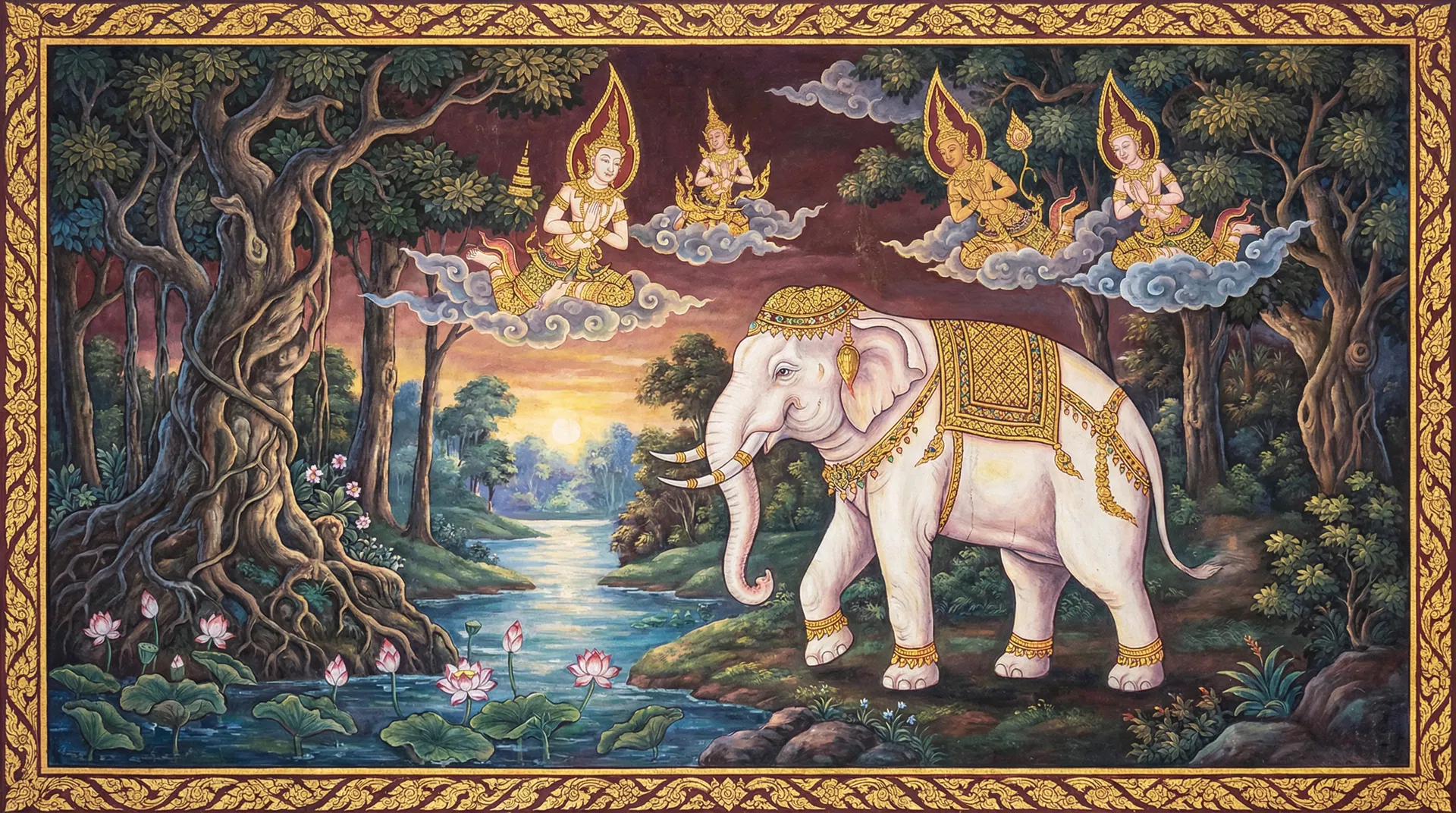
Mahāsīlava Jātaka
The Great Virtue Jātaka
In the prosperous city of Varanasi, nestled on the banks of the sacred Ganges, lived a merchant named Sirivaddhana. He was a man of immense wealth and influence, his ships sailing across vast oceans, bringing back riches from distant lands. Yet, despite his material abundance, Sirivaddhana was not content. He possessed a restless spirit, always seeking something more, something that his vast fortune could not buy.
He had a son, a young man named Mahāsīlava, who was his opposite in many ways. While Sirivaddhana was driven by the pursuit of wealth and worldly pleasures, Mahāsīlava was drawn to a simpler, more virtuous life. He was kind, compassionate, and dedicated to upholding the highest moral principles. He found joy not in possessions, but in acts of selfless service and the practice of virtue.
One day, a great famine struck the land. The rains failed, crops withered, and the granaries of the wealthy began to empty. The common people suffered immensely, their hunger gnawing at their bellies, their hope dwindling with each passing day. Sirivaddhana, despite his vast wealth, saw the suffering around him but was reluctant to part with his riches. He hoarded his grain, fearing that if he gave it away, he would be left with nothing.
His son, Mahāsīlava, however, could not bear to see the people suffer. He pleaded with his father. "Father," he urged, "we have more than enough to sustain ourselves for years. It is our duty to help those in need. What is wealth if it cannot alleviate the suffering of others?"
Sirivaddhana scoffed. "You are a fool, Mahāsīlava! You speak of duty and virtue, but you do not understand the harsh realities of the world. Wealth is to be protected, not squandered. If I give away my grain, I will become poor like them."
Mahāsīlava, disheartened by his father's callousness, decided to take matters into his own hands. He secretly began to distribute the grain he could access from his father's storehouse to the starving villagers. He worked tirelessly, often under the cover of darkness, his heart filled with compassion for the suffering people.
As Mahāsīlava continued his charitable acts, his father grew suspicious. He noticed that his stores were depleting faster than they should. One night, he followed his son and discovered his secret mission. Enraged, Sirivaddhana confronted Mahāsīlava. "You disobedient wretch! You are betraying my trust and wasting my hard-earned wealth!"
Mahāsīlava stood his ground, his voice calm but firm. "Father, I cannot stand by and watch our people starve while we live in plenty. True wealth is not in hoarding, but in giving. My actions are guided by compassion, a virtue that brings true richness to the soul."
The argument escalated, and in his fury, Sirivaddhana disowned his son. "If you are so devoted to charity, then leave my house! Go and live among the poor you so cherish. You are no longer my son!"
Mahāsīlava, though deeply hurt by his father's rejection, accepted the challenge. He left his father's opulent mansion with nothing but the clothes on his back and the unwavering virtue in his heart. He went to live among the villagers, sharing their meager rations and working alongside them in the fields, planting seeds of hope in the parched earth.
Despite his hardship, Mahāsīlava never wavered in his commitment to virtue. He continued to help others in any way he could, offering comfort, sharing what little he had, and inspiring those around him with his resilience and kindness. His selfless actions did not go unnoticed. The villagers, who had once been strangers, now saw him as one of their own, a beacon of hope in their darkest hour.
As fate would have it, a neighboring kingdom, renowned for its wise and just king, heard tales of Mahāsīlava's exceptional virtue and selfless spirit. The king, impressed by the young man's unwavering commitment to compassion, even in the face of adversity and rejection, sent for him. He offered Mahāsīlava a position of honor in his court, recognizing the true wealth that lay within him.
Meanwhile, Sirivaddhana, after his son's departure, found his business ventures faltering. His greed and lack of compassion had alienated his trading partners, and his hoarded wealth brought him no solace. He was wealthy, but deeply unhappy and alone.
Years passed. Mahāsīlava, under the patronage of the neighboring king, rose to prominence. His wisdom, integrity, and compassionate policies brought prosperity and well-being to the kingdom he served. He became known throughout the land as a man of unparalleled virtue.
One day, the king of Varanasi, Mahāsīlava's father, fell gravely ill. His vast wealth could not buy him health, and his loneliness weighed heavily upon him. In his despair, he heard whispers of a virtuous young man in a neighboring kingdom who had once been his son. He sent emissaries to seek him out, hoping for a miracle.
When Mahāsīlava heard of his father's plight, his heart, though wounded, was filled with compassion. He did not hesitate. He returned to Varanasi, not with anger or resentment, but with a heart full of forgiveness and a desire to help. He nursed his father back to health, sharing his wisdom and his gentle spirit.
As Sirivaddhana recovered, he looked at his son with newfound respect and profound regret. He saw the true richness that Mahāsīlava possessed – a wealth of character, compassion, and virtue that far surpassed any material fortune. He realized the folly of his own pursuits and the profound wisdom of his son's path.
In his final days, Sirivaddhana renounced his worldly attachments and dedicated himself to the practice of virtue, inspired by Mahāsīlava. He understood that true happiness and lasting fulfillment come not from accumulating possessions, but from cultivating a virtuous heart and serving others with boundless compassion. Mahāsīlava, true to his name, lived a life of great virtue, proving that the greatest wealth one can possess is a heart filled with goodness and a spirit of selfless generosity.
— In-Article Ad —
💡Moral of the Story
True wealth lies not in material possessions but in a virtuous heart, selfless generosity, and compassion for others. Forgiveness and understanding can mend even the deepest rifts.
Perfection: Generosity (Dāna Pāramī) and Virtue (Sīla Pāramī)
— Ad Space (728x90) —
More Jataka Tales You May Enjoy
 501Pakiṇṇakanipāta
Mūkapacca Jātaka
Mūkapacca Jātaka In the ancient kingdom of Mithila, nestled amidst verdant plains and traversed by t...
💡 True wisdom and strength are often found in quiet contemplation and keen observation, rather than in outward pronouncements. A lack of outward expression does not signify a lack of understanding or capability; indeed, it can foster deeper insight.
 1Ekanipāta
The Tale of the Great Lotus
The Tale of the Great Lotus In a time long past, when the world was a canvas of verdant forests and...
💡 Impatience is like a fire that burns everything, but wisdom and concentration are the tools that allow us to control situations and achieve goals with stability.
 264Tikanipāta
Samudrapala Jataka
Samudrapala JatakaIn a time long past, in the bustling port city of Bharukaccha, lived a Bodhisattva...
💡 Dishonesty and greed ultimately lead to ruin. True success and lasting fortune are achieved through honesty, integrity, and ethical conduct, which the forces of justice will ultimately uphold.
36EkanipātaThe Tale of the Horse-Breeder
In a past aeon, in the flourishing city of Varanasi, the Bodhisatta was born as a young Brahmin, end...
💡 The highest form of virtue is selfless compassion, willing to sacrifice for the well-being of others.
106EkanipātaBhaddasala Jataka
The Tale of the Wise Elephant and the Foolish King In the ancient kingdom of Mithila, ruled a king n...
💡 True wisdom often comes from unexpected sources. A leader's true strength is shown not in anger or pride, but in humility, compassion, and the willingness to serve their people.
 170Dukanipāta
Mahā-pankatanta Jātaka
Mahā-pankatanta JātakaIn the vast, sun-drenched plains bordering the great ocean, there dwelled a mi...
💡 True strength lies not just in power, but in wisdom, diplomacy, and the ability to foster harmony and cooperation, especially in times of crisis.
— Multiplex Ad —