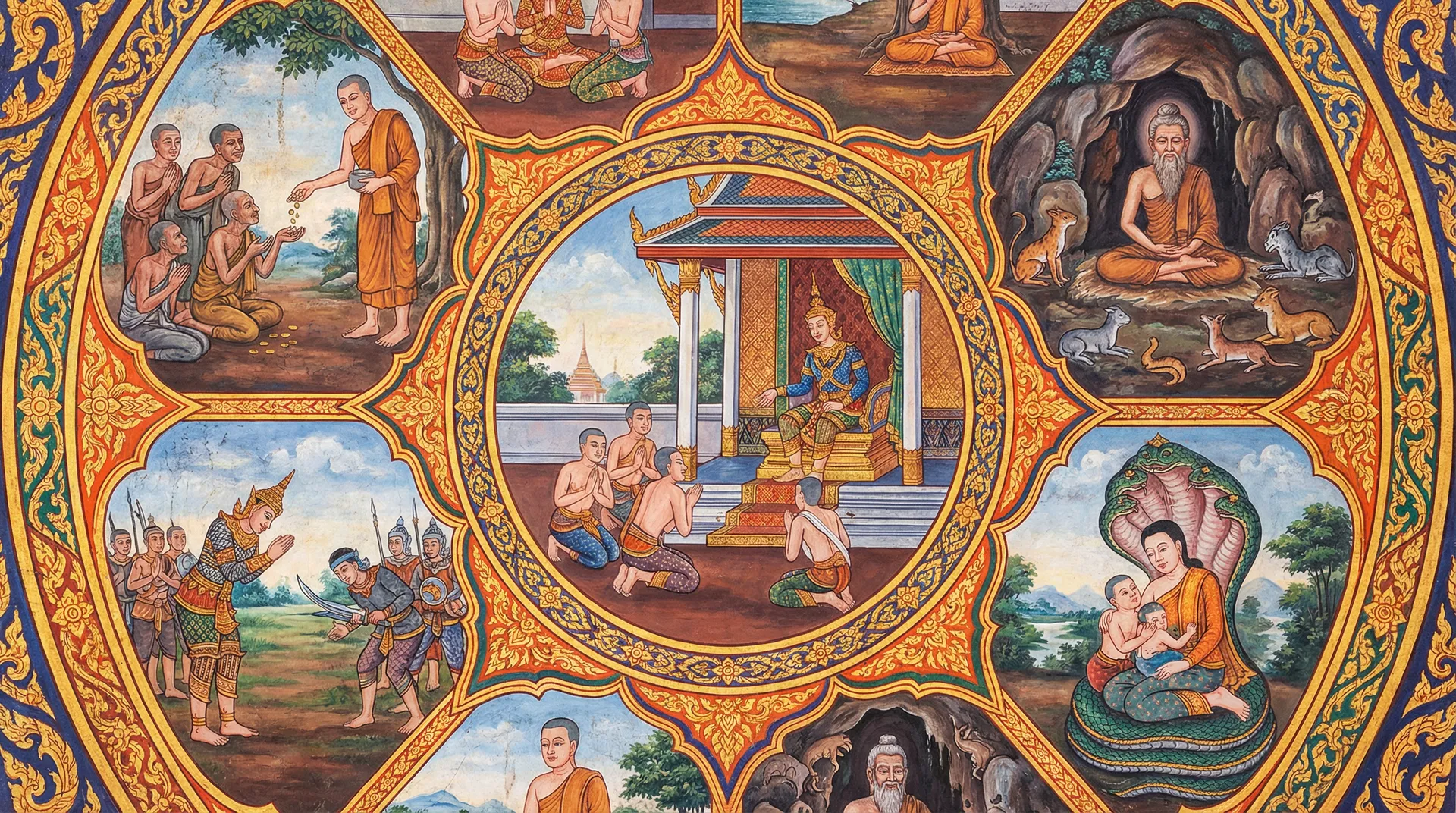
Mulaka Jataka
Mulaka Jataka
In the bustling city of Savatthi, renowned for its vibrant markets and learned scholars, lived a Bodhisatta known for his extraordinary patience and unwavering integrity. In this life, he was born as a humble potter named Mulaka. His hands, stained with the rich earth he molded, possessed a unique skill. He could shape clay into vessels of unparalleled beauty and strength, each piece reflecting a quiet artistry that spoke of his deep connection to his craft.
Mulaka’s pottery was sought after not only for its aesthetic appeal but also for its durability. He took immense pride in his work, ensuring that every pot, bowl, and plate was crafted with meticulous care. He believed that true worth lay in the quality of one’s labor and the honesty with which one conducted business. His small workshop, filled with the earthy scent of clay and the gentle hum of creation, was a sanctuary of integrity.
In the same city lived a king named Uggasena, a ruler whose heart was as hard as the unworked stone. King Uggasena was known for his capricious nature and his cruel disposition. He delighted in imposing arbitrary rules and punishing those who, in his eyes, failed to meet his impossible standards. His court was a place of fear, where sycophants thrived and honest counsel was rarely heard.
One day, King Uggasena, in one of his many whims, decided to hold a grand competition. He declared that the finest craftsman in the kingdom would be rewarded with a position of honor in his court. The challenge was simple: to create the most perfect vessel imaginable. The king, however, harbored a secret intention. He secretly desired to find fault with every entry, for he found no pleasure in rewarding excellence, only in finding reasons to punish perceived inadequacy.
News of the competition spread, and artisans from all corners of Savatthi flocked to the royal palace. Mulaka, though hesitant to engage with the king’s unpredictable temperament, felt compelled by his dedication to his craft. He spent days preparing, selecting the finest clay, carefully tending his kiln, and pouring all his skill and dedication into a single, exquisite water vessel.
When the day of the competition arrived, the palace courtyard buzzed with anticipation. Potters, sculptors, and metalworkers presented their creations. King Uggasena, seated on his throne with a scowl etched on his face, examined each piece with a critical eye, finding fault with every single one. He declared a sculptor’s vase too ornate, a metalworker’s pitcher too plain, and another potter’s bowl too fragile.
Finally, it was Mulaka’s turn. He presented his water vessel, a masterpiece of elegant simplicity. Its form was perfect, its glaze smooth and lustrous, and it radiated a sense of profound balance and harmony. The vessel was not ostentatious, but its perfection was undeniable.
King Uggasena inspected the vessel. He turned it over, tapped it, and peered into its depths, searching for any imperfection. Mulaka stood calmly, his heart steady, his conscience clear. He had done his best, and he had done it with integrity.
After a long, tense silence, the king finally spoke, his voice dripping with malice. “This vessel,” he declared, “is too perfect. Its flaw lies in its very flawlessness. Such perfection is unnatural, impossible. Therefore, this potter has deceived us. He has created something that cannot truly exist. Such trickery deserves punishment!”
The court gasped. Mulaka, though stunned, did not falter. He bowed respectfully. “Your Majesty,” he said, his voice calm and clear, “I have used the finest materials and my utmost skill. If there is perfection in this vessel, it is not a deception, but a testament to diligent effort and the inherent beauty of well-worked clay. If my work displeases you, I accept your judgment, but I stand by the honesty of my craft.”
The king, enraged by Mulaka’s quiet dignity and his refusal to be intimidated, ordered him to be banished from the city. Mulaka, carrying only his tools and a few meager supplies, left Savatthi, his heart heavy but his integrity intact. He wandered through the countryside, seeking a place where his work would be valued, not scorned.
He eventually settled in a small village far from the capital, a place where the people were simple and honest. He set up his workshop once more, and soon, his reputation for creating durable and beautiful pottery spread. The villagers, who understood the value of hard work and genuine skill, cherished his creations. They paid him fairly, treated him with respect, and his life, though modest, was filled with contentment.
Meanwhile, back in Savatthi, King Uggasena’s reign continued its downward spiral. His arbitrary judgments and cruel punishments fostered an atmosphere of fear and distrust. The artisans, afraid of incurring his wrath, began producing shoddy work. The city, once known for its excellence, began to decline. The king’s treasury, though filled with the spoils of his unjust decrees, offered no real security or happiness.
One day, a severe drought struck Savatthi. The king’s reservoirs ran dry, and the people suffered immensely. The king ordered his men to find water, but the few vessels they had were poorly made and cracked under the strain of carrying precious water. Desperate, the king’s advisors suggested finding the banished potter, Mulaka, whose reputation for durable vessels had not entirely faded.
Reluctantly, King Uggasena sent for Mulaka. When Mulaka arrived, he was treated not with scorn, but with deference. The king, humbled by his circumstances, acknowledged his past error. “Mulaka,” he said, his voice lacking its usual arrogance, “we are in dire need. Our city thirsts. Your pots, they say, are strong and true. Can you help us?”
Mulaka, ever compassionate, agreed without hesitation. He returned to Savatthi and, with the help of the villagers, began crafting sturdy water vessels. His pots held water, they withstood the heat, and they brought relief to the suffering city. The king, witnessing the effectiveness of Mulaka’s work and the gratitude of his people, finally understood the error of his ways.
He publicly apologized to Mulaka and offered him a place of honor. But Mulaka declined. “Your Majesty,” he said, “my reward is in the satisfaction of my work and the well-being of the people. I seek no titles, only the freedom to practice my craft with integrity.”
King Uggasena, deeply moved, learned a valuable lesson. He began to rule with more fairness and compassion, recognizing that true strength lies not in arbitrary power, but in justice, integrity, and the appreciation of genuine skill. Mulaka continued to serve the people of Savatthi, his pottery a symbol of enduring quality and the unwavering strength of an honest heart.
— In-Article Ad —
💡Moral of the Story
Integrity and honest hard work are virtues that ultimately bring true reward and respect, even when initially met with injustice. True perfection lies in dedication and honesty, not in pleasing the whims of the corrupt.
Perfection: Patience (Khanti Paramita), Integrity (Sacca Paramita)
— Ad Space (728x90) —
More Jataka Tales You May Enjoy
 263Tikanipāta
Kaka Jataka
Kaka JatakaIn the heart of a dense forest, lived a wise and ancient crow named Kaka. Kaka was no ord...
💡 Wisdom, courage, and compassion are essential virtues for leadership, especially in times of crisis. By working together and following wise guidance, even the most daunting challenges can be overcome.
 16Ekanipāta
The Monkey King's Courage
The Monkey King's CourageIn the heart of a verdant jungle, teeming with life and vibrant with the ch...
💡 True courage lies in facing fear and acting for the protection of others, regardless of the odds.
134EkanipātaSattubhatta Jataka
The Tale of the King Who Sought True Happiness In the ancient and prosperous city of Kasi, ruled a k...
💡 True and lasting happiness is an inner state, cultivated through self-understanding, mindfulness, detachment, and compassion, rather than being dependent on external circumstances or possessions.
85EkanipātaVessantara Jātaka
Vessantara Jātaka In the magnificent kingdom of SiBī, ruled the noble King Sanjaya and his virtuous ...
💡 True generosity comes from the heart and requires immense courage and sacrifice. The practice of giving, even when it leads to personal suffering, leads to profound spiritual merit and liberation.
72EkanipātaThe Golden Elephant Jataka
In a tranquil land, blessed with lush forests and a clear, flowing river, lived a herd of wild eleph...
💡 Wisdom is found in careful observation, unbiased listening, and the humility to admit one's mistakes.
73EkanipātaThe Tale of the Elephant Prince
In a time long past, when the Bodhisatta was yet to attain full Buddhahood and was circulating throu...
💡 True loyalty and devotion can overcome deception and protect the innocent.
— Multiplex Ad —