Mūgapakkha Jātaka
Mūgapakkha Jātaka
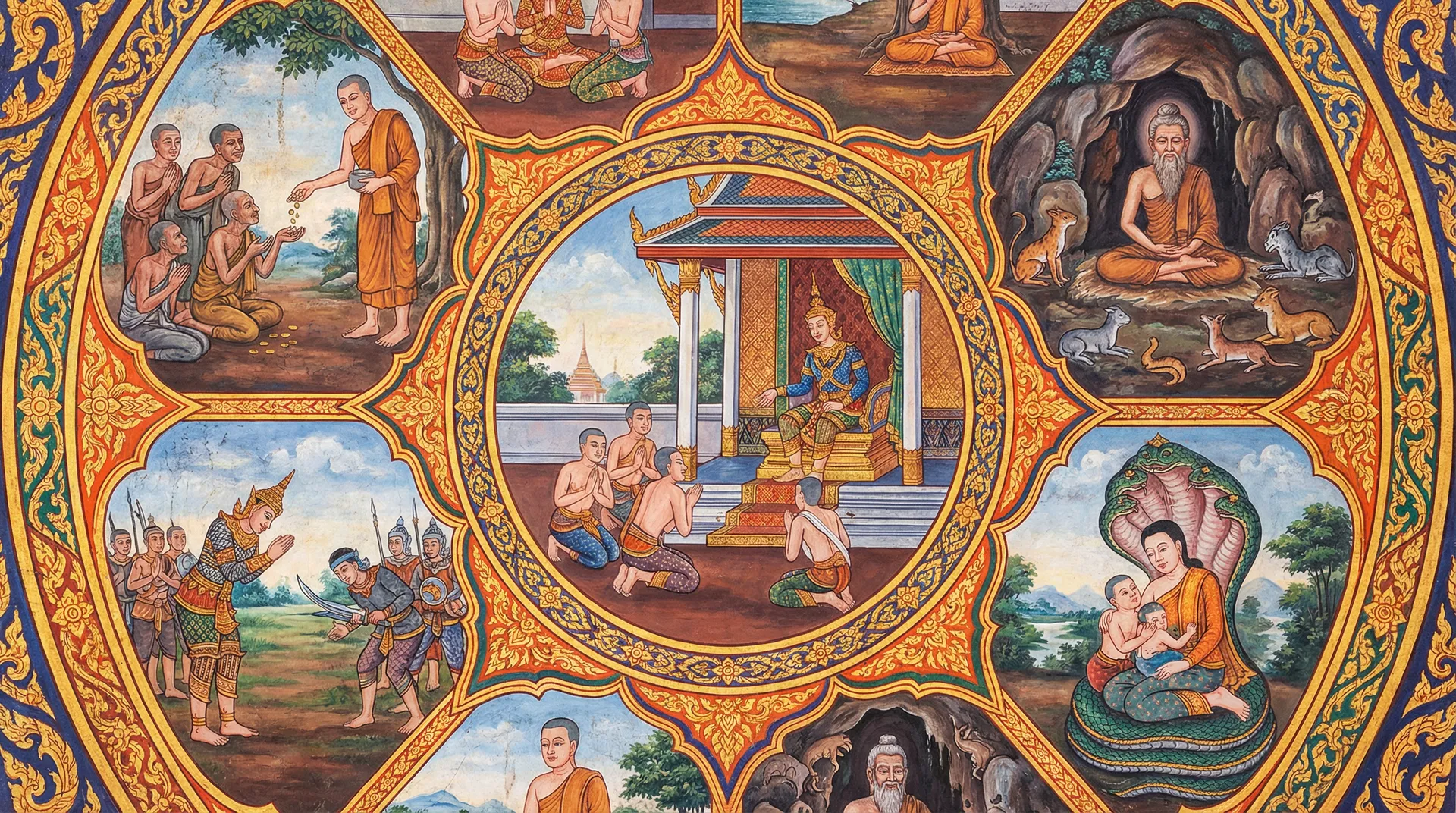
In the heart of a bustling kingdom, ruled by a wise and just king, lived a Bodhisatta, the future Buddha, in his previous life as a prince. This prince, however, was born under an unusual star. From birth, he was mute, unable to utter a single sound, and also blind, seeing only a dim, hazy world. The court physicians were baffled, and many whispered that this was a curse, a sign of ill fortune. But the king, a man of profound faith, refused to believe such negativity. He saw in his son a quiet strength, a deep well of understanding that transcended the need for words or sight.
As the prince grew, he spent his days in the palace gardens, accompanied by a devoted nursemaid who understood his every need through his gentle touch and the subtle shifts in his posture. He learned to navigate the world through sound and touch, his hearing becoming exceptionally acute, able to discern the faintest rustle of leaves, the distant chirping of birds, and the approaching footsteps of any visitor. His sense of touch was equally refined; he could feel the texture of every petal, the coolness of the stone beneath his feet, and the warmth of the sun on his skin. Though he could not see the vibrant colors of the flowers or the majestic architecture of the palace, he perceived their essence through their scents and forms.
One day, a renowned sage, his beard like spun silver and his eyes sparkling with ancient wisdom, arrived at the court. He had heard tales of the blind and mute prince and felt a calling to meet him. The king welcomed him with great reverence. When the sage was brought before the prince, he did not speak of the prince's afflictions. Instead, he sat beside him, radiating an aura of peace. He began to hum a gentle, melodic tune, a song that spoke of the interconnectedness of all things, of the silent language of nature, and of the inner light that dwells within every being. The prince, who had never heard such profound music, felt his entire being resonate with the melody. He reached out a tentative hand, his fingers finding the sage's arm. The sage smiled, a warm, knowing smile. He then placed his hand on the prince's forehead and began to speak, not with his voice, but through a deep, telepathic connection, a direct transfer of thoughts and feelings. He conveyed to the prince that his silence was not an emptiness, but a space for profound contemplation, and his blindness was not a lack of vision, but an invitation to see with the heart.
The sage stayed for many days, sharing his wisdom with the prince. He taught him about the nature of suffering and the path to liberation, about the importance of cultivating inner peace and compassion. He explained that true sight comes from within, and true speech is the expression of a pure heart. The prince absorbed every lesson, his mind becoming a fertile ground for wisdom. He learned to meditate, to still his mind and connect with the universal consciousness. Though he remained physically silent and blind, his inner world bloomed with extraordinary clarity and understanding. He began to send out thoughts of goodwill and loving-kindness to all beings, and those around him, particularly the king and the devoted nursemaid, felt a palpable sense of peace and well-being when they were near him.
News of the prince's spiritual development reached neighboring kingdoms. One day, a powerful and arrogant king from a distant land, fueled by envy and a desire to assert his dominance, decided to visit. He was accompanied by a retinue of boastful warriors and flattering courtiers, all eager to witness the supposed 'afflicted' prince. The visiting king, seeking to humiliate the prince and his father, declared, "I have heard of your son, the silent one. He cannot speak, he cannot see. What use is such a ruler? My kingdom is strong, my armies are vast. I shall prove that true strength lies in the power of the tongue and the keenness of the eye."
The wise king of the prince's kingdom, though outwardly calm, was inwardly distressed. He trusted in his son's inner strength, but he knew the visiting king's pride was a dangerous thing. The sage, who had remained nearby, sensed the impending conflict. He approached the Bodhisatta prince and communicated, "Your silence and blindness are your greatest strengths. They have allowed you to cultivate a wisdom that others cannot fathom. Now is the time to demonstrate this."
The Bodhisatta prince, through his deep meditative state, agreed. When the arrogant king and his entourage arrived, they were met with a display of grandeur, but also with an unsettling quietness emanating from the prince's chambers. The arrogant king, impatient and loud, demanded to see the prince. He was led to a pavilion where the prince sat in serene contemplation, his face illuminated by an inner light. The visiting king scoffed, "So, this is the great sage-prince? He cannot even greet me! He is a burden to his kingdom!"
At that moment, the Bodhisatta prince, without opening his lips or his eyes, projected his thoughts with immense power. The assembled crowd, including the arrogant king and his warriors, suddenly felt their minds overwhelmed by a torrent of profound truths. They saw visions of their own arrogance, their cruelty, and the suffering they had caused. They felt the pain of those they had wronged, and the emptiness of their materialistic pursuits. The arrogant king felt his pride crumble as he realized the futility of his power. He saw his own internal blindness, the inability to perceive true worth and genuine peace.
The Bodhisatta prince's projected thoughts continued, not as accusations, but as gentle revelations. He showed them the beauty of humility, the strength of compassion, and the enduring joy of inner peace. He conveyed that true vision is not of the external world, but of the heart, and true speech is the expression of wisdom and kindness. The arrogant king, humbled and ashamed, fell to his knees. His warriors, their bravado gone, stood in stunned silence. The courtiers, who had always flattered him, now saw the hollowness of their words. The entire assembly felt a profound shift within them, a realization of their own shortcomings and the vastness of true wisdom.
The sage then spoke aloud, his voice carrying through the stunned silence, "You have come seeking to mock a prince who cannot see or speak, yet you have been shown the blindness of your own hearts and the emptiness of your boasts. This prince, in his silence and darkness, possesses a light that illuminates the path for all who are willing to see and hear with their souls."
The arrogant king, deeply moved, bowed his head in respect. He apologized for his insolence and pledged to rule his kingdom with greater wisdom and compassion. He recognized that true power did not lie in armies or in loud pronouncements, but in the cultivation of inner virtues. The sage then guided the king and his entourage to a place of quiet reflection, where they could contemplate the lessons they had learned.
The Bodhisatta prince, having demonstrated the profound power of inner wisdom, returned to his silent contemplation. His kingdom rejoiced, not in a display of military might or eloquent speeches, but in the quiet strength and profound peace that now permeated their lives. The king, his heart filled with pride and gratitude, knew that his son, though physically limited, was destined for greatness, for he possessed the wisdom of the heart, the true sight that transcends all physical senses.
— In-Article Ad —
💡Moral of the Story
True strength and wisdom are not measured by outward appearances or physical abilities, but by the depth of one's inner understanding, compassion, and spiritual insight. Silence can be a powerful vessel for profound wisdom, and inner vision can be far more illuminating than physical sight.
Perfection: Wisdom (Paññā Pāramī)
— Ad Space (728x90) —
More Jataka Tales You May Enjoy
 242Dukanipāta
Kusa Jataka
Kusa JatakaIn the ancient kingdom of Mithila, nestled amidst verdant plains and whispering bamboo fo...
💡 True nobility lies not in birthright, but in character, resilience, and unwavering integrity, especially when faced with betrayal and hardship.
 510Pakiṇṇakanipāta
Bhuri Datta Jataka
The Serpent Prince's Noble DeedsIn the ancient kingdom of Kampila, nestled beside the mystical Himal...
💡 True strength lies in virtue, compassion, and the ability to forgive. Malice and greed ultimately lead to one's own downfall.
 390Chakkanipāta
Saddhanta Jataka
Saddhanta JatakaIn a thriving city known for its bustling marketplace and its scholarly pursuits, th...
💡 Honesty and integrity are paramount, even in the face of severe consequences. True value lies not in outward perfection, but in truthfulness and the courage to admit one's flaws.
 345Catukkanipāta
Mahā-Ummagga Jātaka
Mahā-Ummagga Jātaka In the magnificent city of Mithila, ruled King Jayaddisa, a monarch whose reign ...
💡 Wisdom, ingenuity, and psychological strategy can be more effective in overcoming challenges than brute force alone.
322CatukkanipātaMahamora Jataka
Mahamora JatakaIn a lush and verdant forest, teeming with life and vibrant with the songs of countle...
💡 True wealth and lasting happiness are not found in material possessions or the satisfaction of greed, but in wisdom, contentment, compassion, and a life lived virtuously. Wisdom and compassion have the power to transform even the most hardened hearts.
343CatukkanipātaKosiyavattha Jātaka
Kosiyavattha Jātaka In the ancient kingdom of Mithila, renowned for its wise king and its prosperous...
💡 True contentment and inner peace are found not in the accumulation of material wealth, but in cultivating virtues such as generosity, compassion, and wisdom.
— Multiplex Ad —