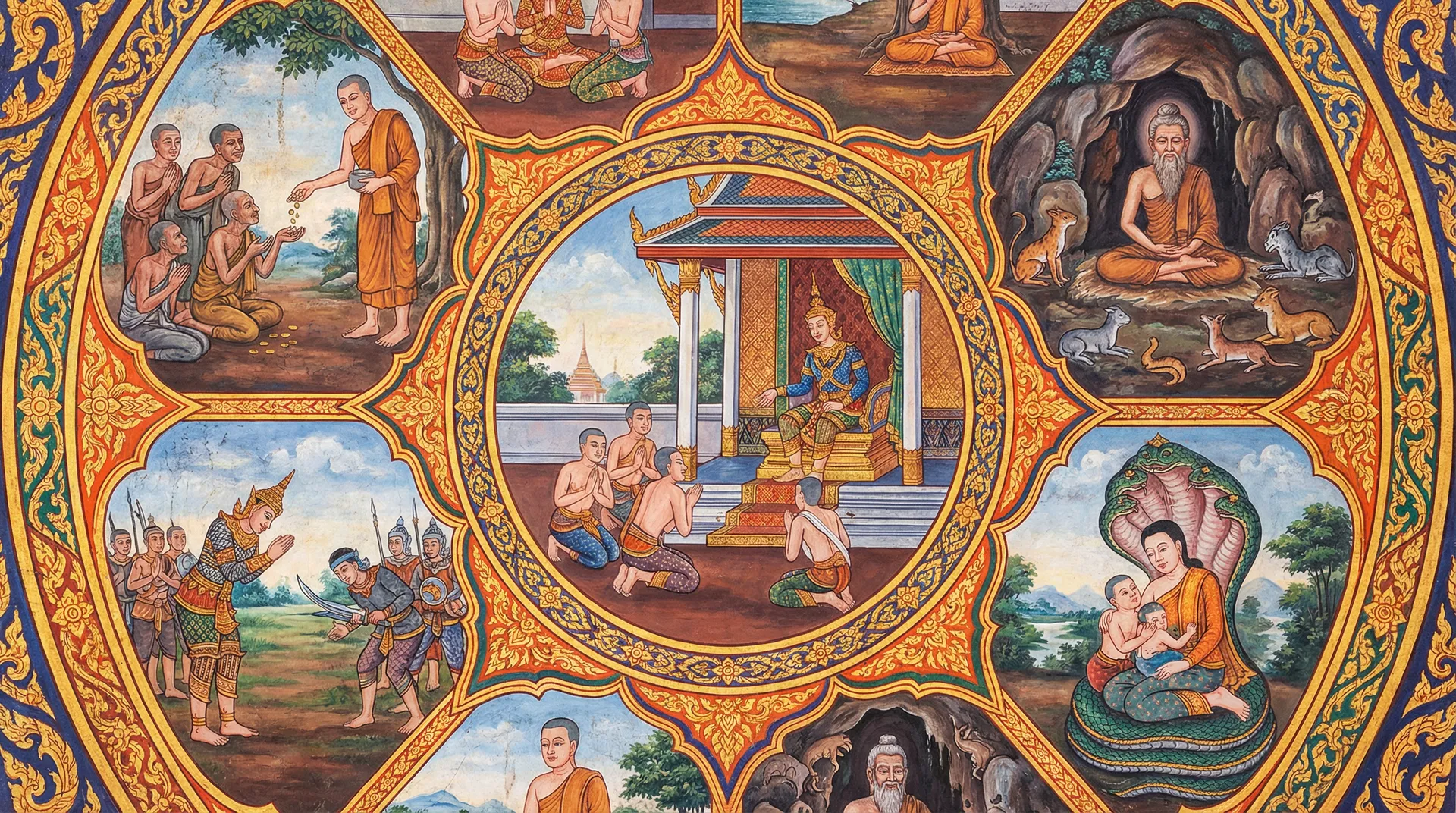
Cūḷabodhi Jātaka
Cūḷabodhi Jātaka
In the ancient city of Benares, nestled by the sacred River Varuna, lived a king named Brahmadeva, a monarch whose wisdom was as deep as the ocean and whose compassion was as boundless as the sky. His reign was a testament to the power of Dharma, and his kingdom was a haven of peace and prosperity. Yet, even in such a land of virtue, the seeds of conflict could be sown by those who were blinded by their own ignorance and attachment. A powerful king from a neighboring land, King Kalābu, a ruler known for his pride and his unyielding nature, became consumed by a desire to possess Benares and its wise king.
King Kalābu, in his arrogance, believed that no king could match his prowess or intellect. He heard tales of King Brahmadeva's wisdom, and instead of seeking knowledge, he felt challenged and resentful. He decided to confront King Brahmadeva, not with an army, but with a series of riddles and philosophical challenges, believing that he could outwit the wise king and thus prove his own superiority.
King Kalābu dispatched a messenger to King Brahmadeva, bearing a scroll filled with intricate questions and perplexing enigmas. The message read: "I, King Kalābu, the mightiest of kings, challenge you, King Brahmadeva, to a contest of intellect. Answer these riddles within seven days, or surrender your kingdom and your crown. If you fail, your wisdom will be proven a fraud, and your reign a sham." The messenger presented the scroll to King Brahmadeva, his voice echoing the arrogance of his master.
King Brahmadeva, upon reading the scroll, felt no fear, only a gentle understanding of King Kalābu's misguided pride. He knew that true wisdom was not about proving superiority, but about seeking truth and understanding. The Bodhisatta, who at this time was the chief advisor to King Brahmadeva, a sage of immense knowledge and profound equanimity, understood the king's heart. He knew that King Kalābu's challenge was born not of genuine inquiry, but of ego and a desire for domination.
The Bodhisatta, addressing King Brahmadeva, said, "Your Majesty, King Kalābu seeks to ensnare you in the webs of his own pride. His riddles are not questions seeking truth, but traps designed to expose perceived flaws. Let us answer his challenge not with mere intellect, but with the wisdom that transcends worldly pride and attachment." The king agreed, and together, they began to ponder the riddles.
For six days, King Brahmadeva, guided by the Bodhisatta's profound insights, contemplated each question. He did not merely seek answers, but sought the underlying principles and the deeper meanings. On the seventh day, as the messenger arrived to collect the answers, King Brahmadeva presented them. The answers were not just correct; they were delivered with such clarity, compassion, and profound understanding that they addressed not only the surface questions but also the root of King Kalābu's misguided challenge.
For instance, to a riddle about the nature of true wealth, King Brahmadeva answered, "True wealth is not gold or jewels, but a mind free from greed and a heart filled with compassion." To a question about the greatest strength, he replied, "The greatest strength is not in arms, but in the ability to forgive and to love." His answers revealed a depth of wisdom that King Kalābu had never encountered.
Upon receiving the answers, King Kalābu was utterly astonished. He had expected a struggle, a battle of wits that he could win. Instead, he was humbled by the profound truths presented. He realized that his own pride had blinded him to a wisdom far greater than his own. The riddles, intended to expose King Brahmadeva, had instead exposed his own ignorance and arrogance.
King Kalābu, deeply moved and ashamed of his own presumption, confessed his folly. He apologized to King Brahmadeva and sought his forgiveness. He understood that true royalty lay not in conquest or intellectual dominance, but in wisdom, compassion, and humility. He abandoned his desire for Benares and returned to his own kingdom, forever changed by the encounter.
The Cūḷabodhi Jātaka teaches that true wisdom is not about proving one's superiority or winning intellectual battles, but about understanding the nature of reality, cultivating compassion, and transcending ego. It shows that genuine wisdom can disarm even the most arrogant of adversaries and lead them towards a path of self-awareness and humility.
— In-Article Ad —
💡Moral of the Story
True wisdom lies in understanding, compassion, and humility, not in intellectual prowess or the desire to dominate. Ego and pride are barriers to true knowledge.
Perfection: Wisdom (Prajna)
— Ad Space (728x90) —
More Jataka Tales You May Enjoy
 538Mahānipāta
Kusa Jataka
The Tale of Prince Kusa and the Trials of Love In the magnificent city of Indapatta, ruled King Okka...
💡 True love is characterized by loyalty, commitment, and unwavering devotion. Infatuation is fleeting and can lead to great suffering, while true love endures through trials and tribulations.
 165Dukanipāta
Mahasattva Jataka
The Bodhisatta's Compassion for the Hungry TigressIn the vast, untamed wilderness of the Himalayas, ...
💡 The highest form of compassion is selfless sacrifice, willing to give one's own life for the well-being of others, even for animals, to alleviate suffering and demonstrate ultimate love.
163DukanipātaMaha-Ummagga Jataka
The Great Wisdom of Prince Vessantara (The King of Wisdom)In the magnificent city of Jetuttara, rule...
💡 True generosity lies in selfless giving, not for recognition or reward, but for the alleviation of suffering and the pursuit of peace. Wisdom is found in understanding the impermanence of possessions and transcending attachment.
 147Ekanipāta
Sutasoma Jataka
Sutasoma JatakaIn the ancient kingdom of Kampila, nestled amidst verdant plains and gurgling rivers,...
💡 True victory is achieved not by defeating an enemy through violence, but by transforming them through compassion, understanding, and the power of righteous living.
223DukanipātaCullapada Jataka
Cullapada JatakaIn the bustling city of Mithila, a jewel of the eastern lands, ruled King Janaka, a ...
💡 Honesty and integrity, even regarding minor flaws or imperfections, build trust and are more valuable than a superficial claim of perfection. True worth is found in acknowledging reality.
220DukanipātaVaka Jataka
Vaka JatakaIn a tranquil village beside a shimmering lake, lived a wise old crane named Bodhisattva....
💡 True skill and effectiveness are achieved through patience, wisdom, and observation, not through arrogance, haste, or boastfulness.
— Multiplex Ad —