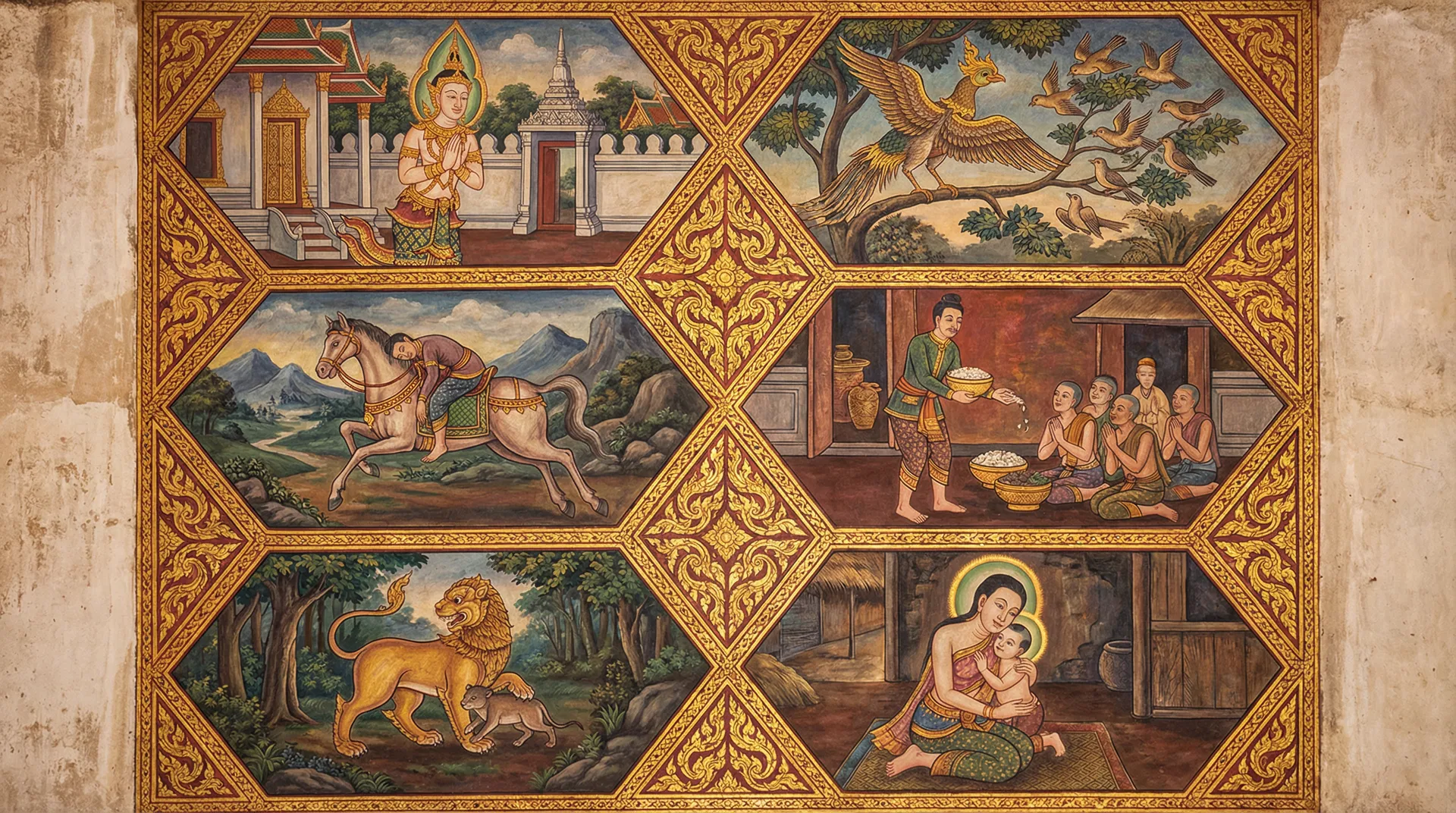
Sākhāmbaga Jātaka
Sākhāmbaga Jātaka
In the ancient city of Savatthi, a hub of commerce and culture, lived a king named Supparaka, whose reign was known for its fairness and prosperity. His kingdom was a testament to the rewards of diligent governance and the well-being of its citizens. Yet, as in all realms of existence, the seeds of conflict and misunderstanding could still sprout, often from the most unexpected of sources.
In one of his many past lives, the Bodhisatta was born as a wise and virtuous brahmin named Sākhāmbaga. He possessed profound knowledge of the Vedas and a deep understanding of the principles of righteousness. He lived a life of contemplation and teaching, guiding his disciples towards wisdom and ethical conduct.
One day, a dispute arose between two powerful chieftains who were vassals of King Supparaka. The first chieftain, a man of fiery temper and quick to anger, accused the second chieftain of encroaching upon his ancestral lands and stealing his cattle. The second chieftain, a man of more measured disposition but equally proud, vehemently denied the accusations, claiming the lands were rightfully his and that the cattle had wandered there of their own accord.
The dispute escalated, threatening to plunge the region into a bloody conflict. Both chieftains rallied their forces, their followers eager for battle. King Supparaka, hearing of the impending turmoil, was deeply concerned. He knew that such a conflict would not only cause immense suffering to his people but would also weaken his kingdom.
The king summoned his wisest advisors, seeking a solution to this volatile situation. Among them was the learned brahmin Sākhāmbaga, the Bodhisatta. Sākhāmbaga, with his calm demeanor and profound insight, listened intently to the accounts of both chieftains. He observed their anger, their pride, and the deep-seated resentment simmering between them.
After careful consideration, Sākhāmbaga addressed the king and the chieftains. "Your Majesty, and noble lords," he began, his voice resonating with wisdom, "the path of conflict is a path of destruction. Let us not allow anger and pride to lead us to bloodshed. I propose a different approach, one that seeks understanding and reconciliation."
Sākhāmbaga then turned to the chieftains. "Tell me, esteemed lords, what are your claims? What evidence do you possess to support your assertions?"
The first chieftain, his voice booming with indignation, declared, "These lands have been in my family for generations! And my cattle, fine beasts they are, would never wander so far unless they were driven! This man is a thief and a usurper!"
The second chieftain, with a more measured tone but no less conviction, replied, "My lineage traces its roots to these very lands. The boundary markers have been moved over time, and the cattle, as I said, simply strayed. There is no malice in my heart, only a desire for justice."
Sākhāmbaga listened patiently, his gaze steady. He then proposed a test, a way to resolve the dispute without resort to violence. "Let us perform a simple ritual," he suggested. "Each of you shall bring forth a measure of earth from the disputed land. We shall then place these offerings before the sacred fire, and the truth, I believe, will be revealed."
The chieftains, though skeptical, agreed to the brahmin's proposal. They were wary of violence and intrigued by the prospect of a peaceful resolution, however unconventional. Each chieftain gathered a portion of earth from the contested territory and presented it to Sākhāmbaga.
As Sākhāmbaga placed the earth near the sacred fire, he began to chant ancient verses. He invoked the purity of the earth, the honesty of intentions, and the consequences of deceit. As the fire blazed, a miraculous phenomenon occurred. The earth offered by the first chieftain, the one who genuinely believed the land was his ancestral domain, began to emit a soft, radiant glow. It seemed to shimmer with an inner light, a testament to his honest conviction.
The earth offered by the second chieftain, however, remained inert. It showed no such luminescence, no sign of inner truth. The contrast was stark and undeniable.
The chieftains were astonished. The elders present were awe-struck. Sākhāmbaga, with a gentle smile, explained, "The earth itself bears witness to the truth. The land that is truly and honestly held by a lineage, with righteous intent, resonates with a purity that can be perceived. The land that is claimed with doubt or with deceit remains silent."
The first chieftain, witnessing this undeniable proof, felt his anger subside, replaced by a deep sense of vindication. The second chieftain, seeing the clear manifestation of truth, was humbled. He realized that his claims, perhaps based on a misunderstanding or a less deeply rooted connection, were not as strong as he had believed.
The dispute was resolved. The first chieftain's claim was validated, and the second chieftain, acknowledging the truth revealed by the sacred fire, relinquished his claim and apologized for any misunderstanding. King Supparaka was immensely pleased. He praised Sākhāmbaga for his wisdom and his ability to resolve a potentially devastating conflict with such grace and insight.
The Sākhāmbaga Jātaka teaches us the importance of seeking truth through honest inquiry and the power of sincere intention. It illustrates that even in disputes, a path of understanding and reconciliation can be found by seeking evidence and relying on principles of righteousness, rather than succumbing to anger and pride. The Bodhisatta, in his form as Sākhāmbaga, demonstrated that true wisdom lies in seeking clarity and fostering harmony, even in the face of conflict.
— In-Article Ad —
💡Moral of the Story
Honest inquiry and sincere intention, rather than anger and pride, are the keys to resolving disputes and revealing the truth.
Perfection: Wisdom (Paññā)
— Ad Space (728x90) —
More Jataka Tales You May Enjoy
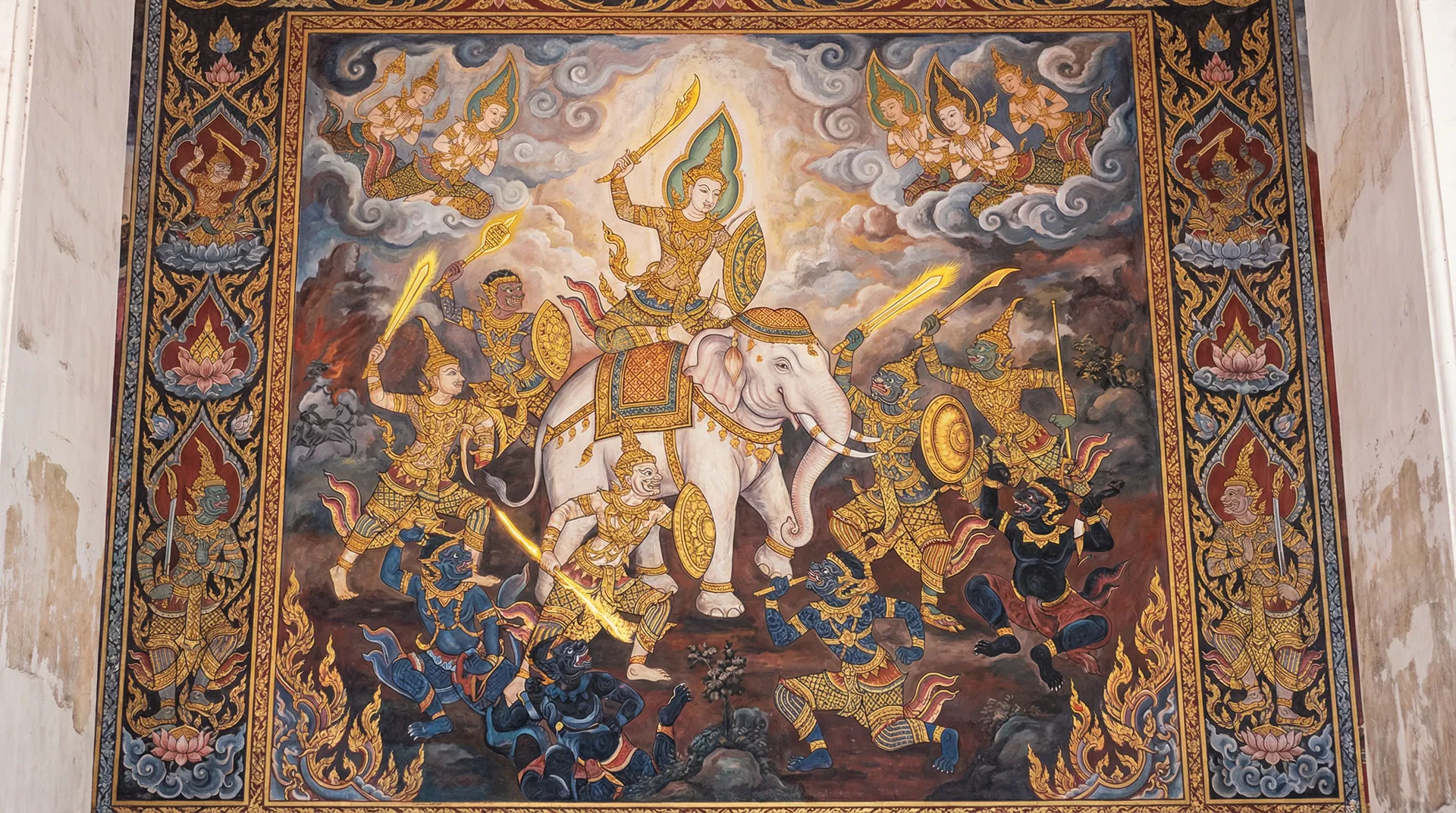 523Mahānipāta
Sutasoma Jataka
Sutasoma JatakaIn the ancient city of Indapatta, ruled a benevolent king named Sutasoma. He was know...
💡 Boundless compassion and selfless sacrifice have the power to transform even the most fearsome beings and to end cycles of suffering, offering a path to redemption for all.
 331Catukkanipāta
Mūgapakkha Jātaka
Mūgapakkha JātakaIn the sun-drenched land of Mithila, ruled a king named Brahmadatta, a monarch whos...
💡 True wisdom is revealed not through eloquent speech, but through careful observation, strategic patience, and decisive action.
 296Tikanipāta
Kacchapa Jataka
The Kacchapa Jataka: The Steadfast Tortoise In the ancient land of Mithila, ruled by a wise and just...
💡 True strength lies not in avoiding hardship, but in enduring it with steadfastness, patience, and unwavering hope. Compassion and perseverance can inspire even the most pragmatic to choose a more humane path.
284TikanipātaMahāpaduma Jātaka
Mahāpaduma JātakaIn the heart of a lush forest, far from the clamor of human settlements, lived a Bo...
💡 True beauty and value lie within the heart, not in external possessions or trophies. Greed and cruelty ultimately lead to sorrow and regret.
315CatukkanipātaTemiya Jataka
Temiya JatakaIn the grand city of Varanasi, nestled beside the sacred Ganges, ruled a wise and just ...
💡 True liberation comes from understanding the impermanence of worldly life and the suffering it entails, leading to detachment and the pursuit of spiritual freedom.
287TikanipātaThe King of the Elephants (Makhādeva Jātaka)
The King of the Elephants (Makhādeva Jātaka) Long ago, in a lush forest teeming with life, a majesti...
💡 True leadership requires immense courage, self-sacrifice, and unwavering determination to protect and provide for one's followers, even in the face of insurmountable challenges.
— Multiplex Ad —