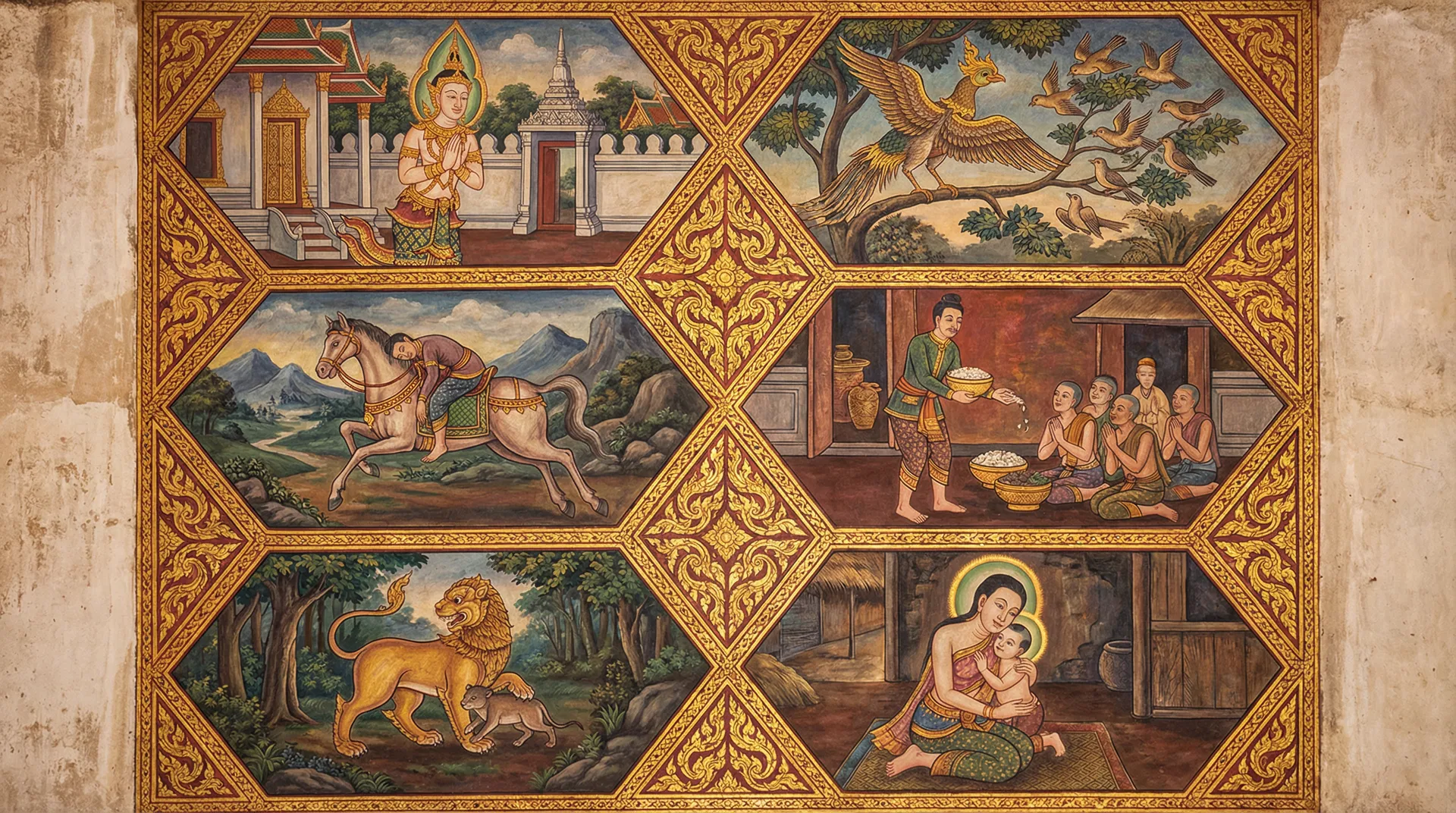
Nimi Jataka
Nimi Jataka
Long ago, in a kingdom of ancient India, lived King Nimi, a ruler renowned for his righteousness and devotion. His reign was a golden age, marked by prosperity and peace, for he governed with wisdom and compassion, always striving to uphold justice. One day, the great god Sakka, king of the Devas, descended from his celestial abode to visit King Nimi. Sakka, impressed by the king's virtues, offered him a boon, a wish that would be granted. King Nimi, however, was a man of deep spiritual inclination. Instead of earthly riches or power, he requested the knowledge of the heavens, of the realms of the gods, and the path to attain them. Sakka, pleased with the king's noble request, granted him this divine insight. He revealed to King Nimi the secrets of the celestial realms, the consequences of good deeds, and the punishments for wicked actions. He showed the king the arduous yet rewarding path of virtue that leads to rebirth in the heavens. King Nimi, now enlightened with this divine knowledge, was filled with a profound desire to share it with his people. He understood that true happiness lay not in worldly possessions but in cultivating merit and righteousness. He began to preach to his subjects, not with the authority of a king, but with the humility of a teacher, guiding them towards the path of virtue. He spoke of the impermanence of life, the suffering inherent in attachment, and the liberation that comes from detachment. He described the joyous abodes of the gods, sustained by acts of generosity, morality, and meditation, and the terrible suffering of those who fall into lower realms due to their negative karma. His sermons were captivating, his words imbued with the wisdom of the heavens. People were drawn to his teachings, and the kingdom flourished not only in material wealth but also in spiritual enlightenment. The king himself, through his dedicated practice of virtue, began to experience glimpses of divine bliss. However, the weight of his royal duties and the constant demands of his kingdom began to take a toll on his spiritual pursuits. He found it increasingly difficult to dedicate the time and focus required for deep meditation and contemplation. One evening, as he sat reflecting on the celestial realms he had been shown, King Nimi felt a pang of longing. He yearned to experience the heavenly abodes directly, to immerse himself in the pure bliss of the Devas. As this desire grew strong, the celestial chariot of Sakka appeared before him once more. Sakka, sensing the king's aspiration, invited him to visit the heavens. He offered to take King Nimi on a celestial journey, allowing him to witness the wonders of the divine realms firsthand. King Nimi, overjoyed, accepted the offer. He bid farewell to his queen and his kingdom, entrusting them to his wise ministers, and ascended the celestial chariot. The journey was breathtaking. They soared through the clouds, past stars and galaxies, until they reached the heavenly kingdom of Sakka. King Nimi was astounded by the beauty and grandeur of the divine realms. He saw palaces made of pure gold and jewels, gardens filled with celestial flowers that bloomed eternally, and beings of radiant beauty engaged in blissful activities. He witnessed the great assemblies of the gods, where they discussed matters of cosmic importance and enjoyed celestial music and dance. Sakka guided King Nimi through various heavenly realms, explaining the origins of each, and the merits that had led beings to be reborn there. He showed him the consequences of even the smallest acts of kindness and the devastating effects of even minor transgressions. King Nimi was deeply humbled and inspired by what he saw. He realized that the heavenly realms were not merely places of pleasure, but realms earned through immense merit and sustained by continuous virtuous conduct. He saw that even the gods, though powerful and beautiful, were bound by the laws of karma and were not exempt from the cycle of birth and death. After spending a considerable time in the heavens, King Nimi felt a renewed sense of purpose. He understood that while the heavenly realms were glorious, the ultimate goal was liberation from the cycle of existence altogether. He thanked Sakka profusely for the extraordinary experience and expressed his gratitude for the profound lessons learned. Sakka, in turn, commended King Nimi for his wisdom and his unwavering commitment to virtue. As King Nimi prepared to return to his earthly kingdom, Sakka offered him a final piece of advice: 'Remember, King Nimi, that true happiness is not found in the fleeting pleasures of the heavens, but in the cultivation of inner peace and wisdom. The path to liberation lies within your own heart.' With these words, King Nimi descended back to his kingdom, his heart filled with a deeper understanding of the Dharma. He continued to rule with even greater wisdom and compassion, inspiring his people to live lives of virtue and mindfulness. He devoted the rest of his days to spiritual practice, guiding his subjects towards the ultimate goal of Nirvana, the cessation of suffering and the attainment of eternal peace. The story of King Nimi became a legend, a testament to the power of wisdom, virtue, and the aspiration for spiritual liberation. It served as a reminder to all that the true treasures of life are not material wealth, but the cultivation of a noble heart and a luminous mind.
The true path to happiness lies not in external pleasures, but in the cultivation of inner wisdom and virtuous conduct. The celestial realms are temporary rewards, but liberation is the ultimate goal.
— In-Article Ad —
💡Moral of the Story
True happiness is found in inner peace and wisdom, not fleeting pleasures. The ultimate goal is liberation from suffering.
Perfection: Wisdom (Panna)
— Ad Space (728x90) —
More Jataka Tales You May Enjoy
 215Dukanipāta
Cullabodhi Jataka
The Courage of ConvictionIn the vibrant city of Savatthi, lived a prince named Bodhi. He was not the...
💡 True courage lies in upholding justice and compassion, even in the face of opposition. Lasting order and prosperity are built on mercy and understanding, not on fear and harshness.
 123Ekanipāta
Sankhapala Jataka
Sankhapala Jataka In the ancient and prosperous city of Savatthi, there once lived a king named Supp...
💡 Our actions, even those seemingly minor, have far-reaching consequences. Forgiveness, compassion, and spiritual discipline are powerful forces that can heal suffering and mend karmic imbalances.
33EkanipātaThe Bodhisatta as a Brave Lion
The Bodhisatta as a Brave LionIn the heart of a vast and ancient forest, where towering trees formed...
💡 True courage is demonstrated by the willingness to make the ultimate sacrifice for the well-being of others.
92EkanipātaSasa Jataka
Sasa JatakaLong, long ago, in a time when the forests were vaster and the stars shone brighter, ther...
💡 True generosity lies not in giving what is easily spared, but in sacrificing one's own comfort and even life for the sake of others. Selflessness and compassion are the highest virtues.
18EkanipātaThe Bodhisatta as a King of Deer
The Bodhisatta as a King of DeerIn the heart of a vast and ancient forest, where sunlight dappled th...
💡 True leadership and love manifest in selfless sacrifice, inspiring even the hardest hearts.
8EkanipātaThe Wise King of Birds
The Wise King of BirdsPerched atop the highest peak of the Himalayas, where the air was thin and cry...
💡 True wisdom lies in selfless compassion, and the greatest sacrifices bring about miraculous salvation.
— Multiplex Ad —