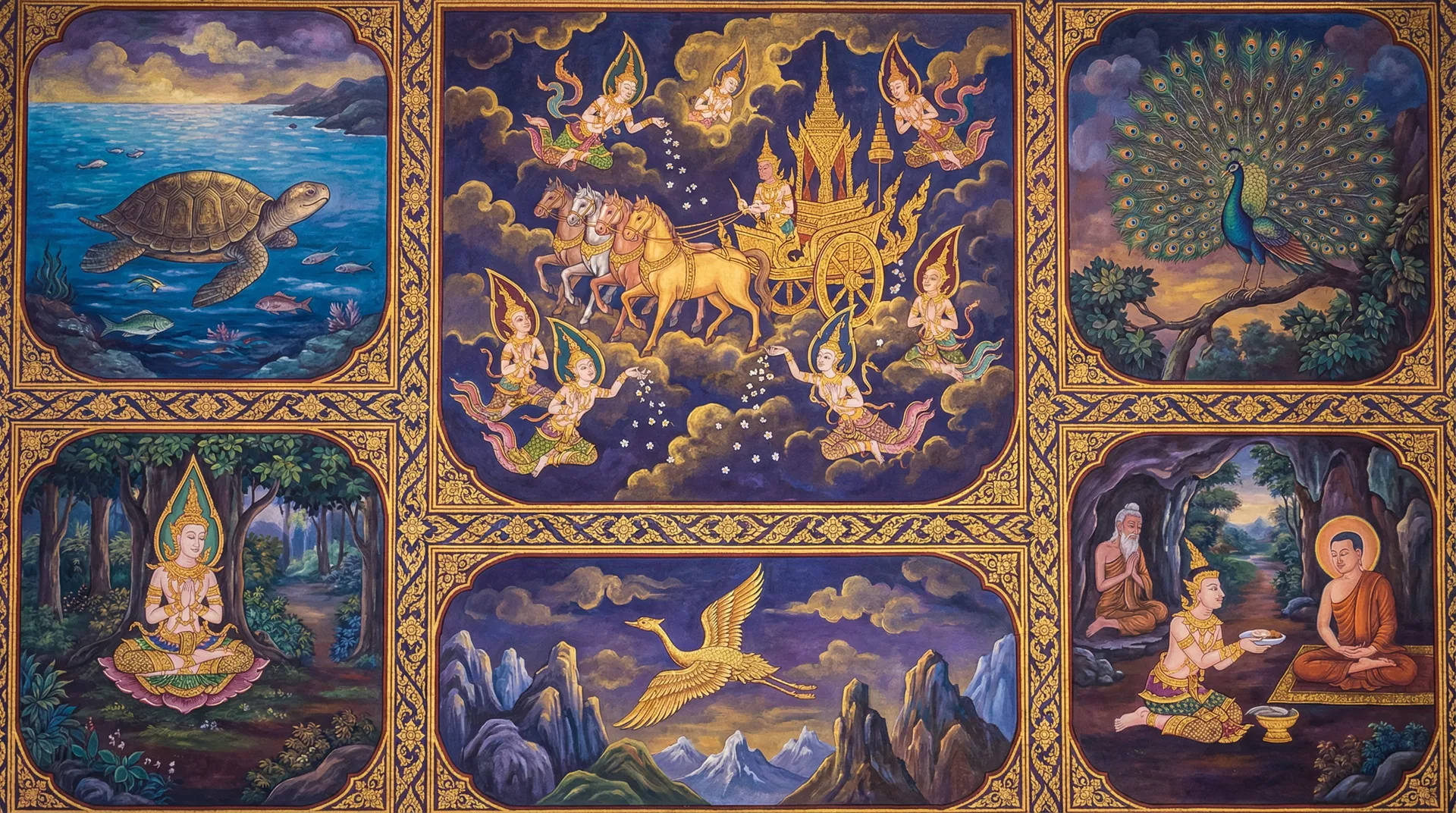
Gambhira-Jataka
Gambhira-Jataka
In the ancient city of Mithila, nestled amidst lush emerald forests and sparkling rivers, lived a wise and benevolent king named Brahmadatta. His reign was marked by justice, prosperity, and a deep respect for all living beings. Yet, even in this idyllic kingdom, the seeds of doubt and temptation could sprout, testing the virtue of even the most righteous. One day, a troubling rumor began to circulate amongst the royal courtiers. A renowned sage, known for his profound wisdom and ascetic practices, had suddenly vanished from his hermitage, leaving behind only a cryptic note that spoke of a hidden treasure of immeasurable value.
The king, a man of keen intellect and unwavering integrity, was immediately intrigued. He summoned his most trusted advisors, his heart heavy with a sense of responsibility. "My esteemed counselors," he began, his voice resonating with authority, "a matter of grave concern has come to our attention. A learned sage, whose knowledge is said to surpass the stars, has disappeared. His last words hint at a treasure, a treasure that could bring untold riches to our kingdom, but also, perhaps, untold peril."
Among the advisors was a cunning but ambitious minister named Vidura. His eyes, sharp and calculating, gleamed with avarice. "Your Majesty," Vidura declared, stepping forward, his voice smooth as silk, "this is indeed a matter that demands our immediate attention. Such a treasure, if real, could elevate our kingdom to unprecedented heights of power and influence. I propose we form an expedition, led by the bravest and most resourceful men, to seek out this hidden wealth."
Another advisor, a venerable elder named Dhira, known for his calm demeanor and profound understanding of the human heart, gently cautioned the king. "Your Majesty, while the allure of riches is strong, let us not forget the wisdom of the sage. Perhaps this 'treasure' is not of gold and jewels, but of knowledge, or of inner peace. We must proceed with caution, lest our pursuit of material wealth blind us to true value."
King Brahmadatta, however, was swayed by Vidura's persuasive arguments. The prospect of enhancing his kingdom's prosperity was too tempting to ignore. He agreed to the expedition, dispatching a large contingent of soldiers and explorers, all eager to unearth the legendary treasure. Among them was a young, idealistic soldier named Subala, who, while driven by loyalty to his king, also harbored a deep respect for the sage's teachings.
The expedition ventured deep into the dense, ancient forest where the sage's hermitage was located. Days turned into weeks, and the search yielded nothing but dense foliage and echoing silences. The soldiers grew weary and disheartened. Vidura, however, pressed on, his determination fueled by his insatiable greed. He urged his men to delve deeper, to search every nook and cranny, believing the treasure was within their grasp.
One sweltering afternoon, while exploring a particularly remote and overgrown section of the forest, Subala stumbled upon a hidden cave, its entrance obscured by thick vines. A faint, ethereal light emanated from within. Driven by a sense of curiosity, he pushed aside the vines and stepped inside. The cave was surprisingly spacious, its walls adorned with ancient carvings that depicted scenes of spiritual enlightenment and profound wisdom. In the center of the cave, resting on a simple stone pedestal, was not a chest of gold, but a single, ancient manuscript.
As Subala reached out to touch the manuscript, a voice, soft yet powerful, echoed from the shadows. "Do not be afraid, seeker. This is the treasure I spoke of." A figure emerged from the darkness, the very sage who had disappeared. He was an old man, his face etched with kindness, his eyes sparkling with an inner light. "The greatest treasure," the sage continued, "is not the fleeting wealth of the material world, but the enduring riches of knowledge and understanding. This manuscript contains the secrets to a life of purpose, compassion, and true happiness."
Subala, awestruck, explained the king's quest and Vidura's relentless pursuit of gold. The sage listened patiently, a gentle smile playing on his lips. "Greed," he said, "is a powerful illusion. It blinds men to the true value of things, leading them down paths of suffering and dissatisfaction. Vidura, blinded by his desire for riches, will never find the true treasure. He will exhaust himself and his men in a fruitless pursuit, ultimately finding only emptiness."
Meanwhile, Vidura, furious at the lack of progress, continued to push his men, their spirits broken and their bodies weary. They dug and searched relentlessly, their efforts yielding only dirt and disappointment. Vidura, however, refused to acknowledge defeat. He became increasingly desperate, his obsession consuming him.
Subala, carrying the precious manuscript, returned to Mithila and presented it to King Brahmadatta. The king, upon reading the sage's words, was filled with profound remorse. He understood the folly of his pursuit and the deceptive nature of material wealth. He immediately dispatched messengers to recall Vidura and his men, his heart filled with a newfound understanding of true wealth.
When Vidura finally returned, emaciated and defeated, he was met not with the king's anger, but with his compassion. The king, now guided by the wisdom of the manuscript, understood Vidura's misguided nature. He offered Vidura a chance to learn from the sage's teachings, to find true contentment within himself rather than in the external pursuit of riches.
The sage, witnessing the king's transformation, continued to impart his wisdom, not only to the king but to all who sought it. The manuscript became a revered text in Mithila, its teachings guiding the kingdom towards a path of enlightenment, generosity, and lasting peace. The people of Mithila, no longer chasing the ephemeral gleam of gold, found their true wealth in wisdom, compassion, and the profound joy of a life lived with purpose.
— In-Article Ad —
💡Moral of the Story
True treasure lies not in material wealth, but in wisdom, knowledge, and inner peace. Greed blinds individuals to the real value of life, leading to suffering and dissatisfaction.
Perfection: Wisdom (Prajna Paramita)
— Ad Space (728x90) —
More Jataka Tales You May Enjoy
 99Ekanipāta
The Tale of King Videha
In the prosperous city of Mithila, situated in the thriving kingdom of Videha, renowned for its comm...
💡 True wealth is found in selfless giving and compassion. Generosity, when offered with a pure heart, can bring about miracles and spiritual abundance.
413SattakanipātaSankha-Jataka
Sankha-JatakaIn the bustling city of Varanasi, amidst a labyrinth of narrow lanes and vibrant market...
💡 True wealth is not measured in material possessions, but in the knowledge and compassion that enable us to serve others and alleviate suffering. Youthful impetuosity, if unchecked, can lead to great regret.
 333Catukkanipāta
Sattigumba Jātaka
Sattigumba JātakaIn the verdant forest of Kosala, where ancient trees whispered secrets to the wind ...
💡 True strength lies not in brute force or domination, but in unwavering courage, righteousness, and the defense of justice.
346CatukkanipātaMahā-Ummagga Jātaka
The Great Wisdom Bore JātakaIn the ancient kingdom of Mithila, nestled beside the mighty Ganges, the...
💡 True wisdom lies not in brute strength, but in profound understanding, patience, and the strategic application of knowledge to overcome even the most formidable challenges.
 423Aṭṭhakanipāta
Daddabha Jātaka
Daddabha JātakaIn the verdant kingdom of Mithila, ruled a king named Brahmadatta, a monarch renowned...
💡 Mastery over one's emotions, particularly anger, is a sign of true strength and wisdom. By cultivating patience and mindfulness, one can transform destructive impulses into constructive actions.
 494Pakiṇṇakanipāta
The Story of the Kind Merchant and the Fierce Tiger
The Story of the Kind Merchant and the Fierce Tiger In the bustling city of prosperity, there lived ...
💡 Compassion and kindness extended to those in need, even those who seem dangerous, can lead to unexpected gratitude and protection. True wealth is measured by our generosity and our ability to alleviate suffering.
— Multiplex Ad —