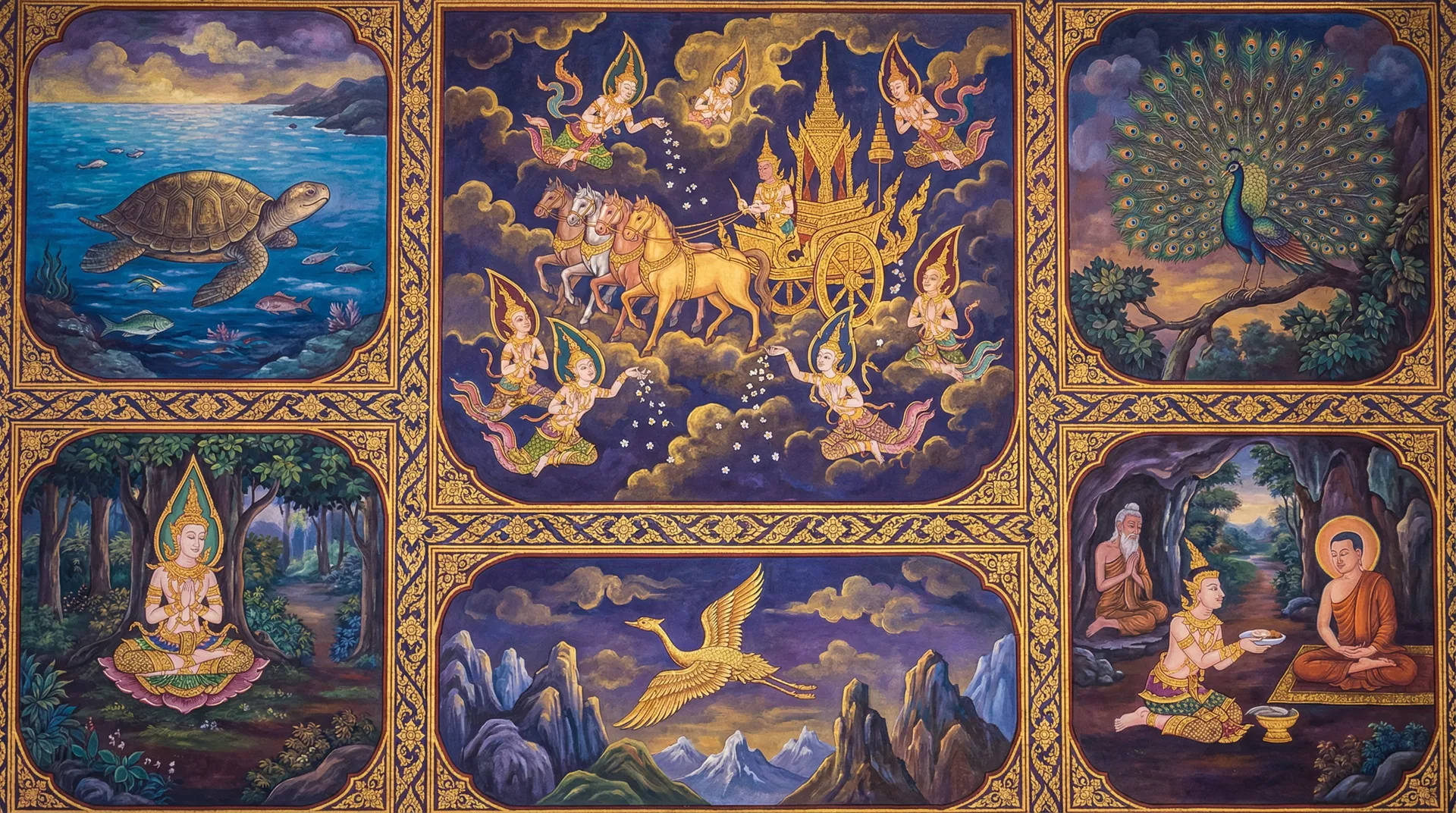
Kusa-Jataka
Kusa-Jataka
In the ancient kingdom of Videha, nestled beside the mighty River Ganges, reigned King Okkaka, a monarch known for his immense wealth and his even greater ego. He had a beautiful daughter, Princess Kusa, whose beauty was so legendary that poets sang of it in hushed tones, and princes from distant lands vied for her hand. However, Kusa was not merely beautiful; she possessed a sharp intellect and a spirit as free as the wind. She declared that she would marry only a man who could surpass her in wit and wisdom, a challenge that few dared to accept.
One day, a humble ascetic, known for his extraordinary beauty and his serene countenance, arrived at the royal court. He was no ordinary man; he was a Bodhisattva, a being destined for enlightenment, who had taken this form to test the hearts and minds of mortals. His name was Kusa, and his mere presence seemed to calm the turbulent winds and bring a sense of peace to all who beheld him.
When Princess Kusa met Kusa, she was instantly captivated. His beauty was unlike any she had ever seen, and his words, though few, were filled with a profound wisdom that resonated deep within her soul. She felt an undeniable connection, a pull towards this enigmatic ascetic. Ignoring the protests of her father and the whispers of the court, she declared, "I will marry this man!"
King Okkaka was furious. He could not fathom his beloved daughter marrying a mere ascetic, devoid of royal lineage and vast riches. He devised a cruel plan to test Kusa's worthiness. "You wish to marry my daughter?" the king sneered, his voice dripping with disdain. "Then you must prove yourself. You must bring me the most precious gift imaginable, a gift that no ordinary man can procure." He demanded, with a malicious glint in his eye, the eyes of a thousand swans, believing this impossible task would surely drive Kusa away.
Kusa, though gentle, possessed an inner strength that belied his serene exterior. He accepted the king's challenge without hesitation. "Your Majesty," he replied, his voice calm, "I shall fulfill your demand." He then set out, not with an army or a retinue, but with a quiet determination. He wandered through forests and plains, his journey guided by an inner knowing.
He encountered a flock of swans by a tranquil lake. With his immense compassion and understanding of the natural world, Kusa approached them not as a hunter, but as a friend. He spoke to them, not in words, but in a language of the heart, explaining his plight and the king's impossible demand. The swans, moved by his sincerity and the purity of his intentions, agreed to help him. They offered their eyes, not by force, but as a gift of love and understanding. Kusa, however, refused to take their eyes, for he would not cause suffering to any being. Instead, he asked them to grace him with their shed feathers, which, when woven together with strands of moonlight and dew, would create an illusion so perfect, it would fool even the most discerning eye.
He returned to the palace with a magnificent cloak, woven from these ethereal materials. It shimmered with an otherworldly light, and when draped around him, it created the illusion that he was adorned with the eyes of a thousand swans, each one sparkling with life and beauty. King Okkaka, though astonished, was still not satisfied. He devised another test, demanding Kusa to fetch him the most fragrant flower in the world, one that bloomed only in the highest, most treacherous peaks of the Himalayas.
Again, Kusa did not falter. He journeyed to the snow-capped mountains, facing biting winds and perilous cliffs. He found the flower, its fragrance so divine it could heal any ailment and bring peace to any troubled soul. He gently plucked it, its petals radiating a soft, warm light.
Finally, King Okkaka, defeated by Kusa's unwavering resolve and extraordinary abilities, had no choice but to accept him as his son-in-law. Princess Kusa rejoiced, her heart filled with love for the man who had proven his worth not through might or riches, but through compassion, wisdom, and unwavering determination.
Their marriage was a joyous occasion, and the kingdom of Videha prospered under their wise and benevolent rule. Kusa, the Bodhisattva, continued to guide his people with compassion and understanding, teaching them the value of inner strength and the true meaning of beauty, which lay not in outward appearance but in the purity of the heart.
The legend of Kusa and Princess Kusa became a timeless tale, a testament to the fact that true worth is found not in wealth or status, but in the strength of one's character, the depth of one's compassion, and the unwavering pursuit of virtue, even in the face of impossible odds.
— In-Article Ad —
💡Moral of the Story
True worth is not measured by wealth or status, but by compassion, wisdom, integrity, and the courage to face challenges with a pure heart. Inner beauty and strength are far more valuable than outward appearances.
Perfection: Compassion (Karuna Paramita), Generosity (Dana Paramita), Patience (Khanti Paramita)
— Ad Space (728x90) —
More Jataka Tales You May Enjoy
 68Ekanipāta
The Swan King's Wisdom
In a time long past, when the Bodhisattva was reborn as a magnificent white swan, he resided in the ...
💡 True loyalty and intuition can often detect hidden dangers that are not apparent to others. It is wise to heed the warnings of those who are loyal and observant.
 342Catukkanipāta
Sākhā Jātaka
Sākhā Jātaka In the verdant foothills of the Himalayas, where ancient trees whispered secrets to the...
💡 In times of danger, wise counsel and trust are essential for survival; succumbing to panic and ignoring guidance often leads to disaster.
 201Dukanipāta
Nimi Jataka
Nimi Jataka In the heart of a magnificent kingdom, ruled a just and wise king named Nimi. His reign ...
💡 Even the highest celestial pleasures are impermanent and subject to the law of karma. True happiness and liberation are found in understanding and practicing the Dhamma, leading to the cessation of suffering.
119EkanipātaMasa Jataka
Masa Jataka In a sprawling forest, where ancient trees reached towards the heavens and a thousand st...
💡 Patience, resilience, and unwavering leadership are crucial to overcome extreme hardship. Selfless compassion and the prioritization of the vulnerable are the hallmarks of true strength and lead to collective survival.
 273Tikanipāta
Assaka Jataka
Assaka JatakaIn the heart of a vast and ancient kingdom, there once lived a king named Assaka. King ...
💡 True leadership is not determined by birthright or status, but by demonstrated character, inner strength, humility, and a commitment to serving others.
66EkanipātaThe Great Crane Jataka
Long ago, in an age when the Buddha had not yet appeared, in a time immeasurably distant, the Bodhis...
💡 True wealth is measured not by the abundance of possessions, but by the happiness and prosperity of one's people. Greed leads to suffering, while generosity and compassion bring true prosperity.
— Multiplex Ad —