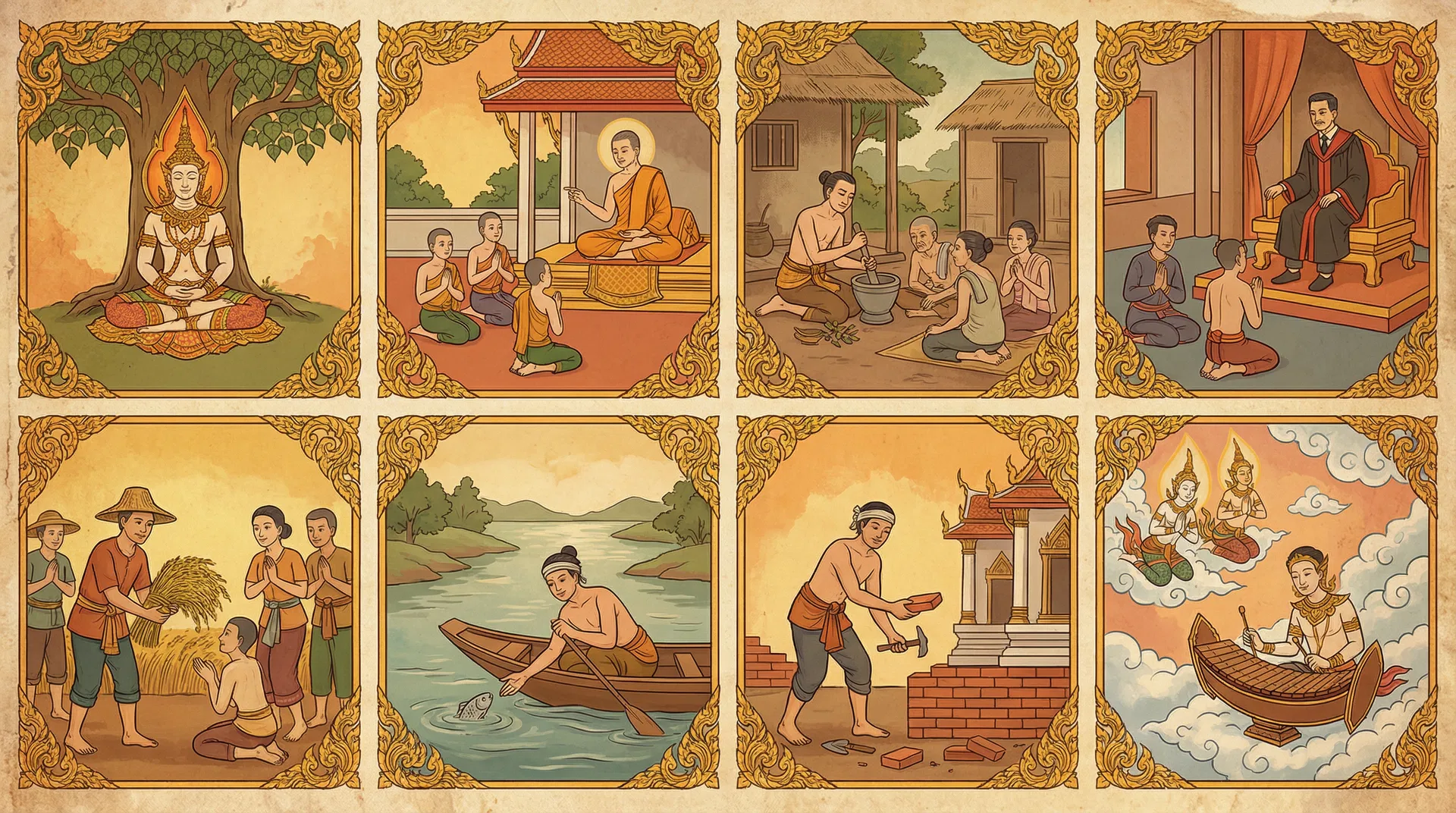
Mūgapakkha Jātaka
Mūgapakkha Jātaka
In the heart of the Kosala kingdom, where golden fields stretched to the horizon and the scent of jasmine perfumed the air, lived a king named Vidhura. Though wise and just, King Vidhura was cursed with a peculiar affliction: he could not speak. His tongue, though perfectly formed, remained stubbornly silent, rendering him mute from birth. This silence, however, did not diminish his sharp intellect or his compassionate spirit. He communicated through gestures, expressions, and the wise counsel of his trusted advisors, who understood his every nuanced movement.
The kingdom prospered under his silent reign. Farmers tilled their lands with joy, merchants plied their wares with honesty, and the people lived in harmony, their lives guided by the king's unspoken wisdom. Yet, a shadow loomed. King Vidhura longed for a successor, an heir to carry on his legacy of peace and prosperity. He had a queen, a woman of immense beauty and kindness, but she too remained childless. The royal court buzzed with hushed whispers and anxious prayers, all directed towards the heavens for a blessing of progeny.
One day, a renowned sage, known for his profound knowledge of the stars and his ability to foresee the future, was summoned to the palace. He knelt before the king, his eyes filled with reverence. Through a series of intricate gestures, King Vidhura conveyed his deepest desire. The sage observed the celestial patterns, his brow furrowed in concentration. After a long silence, he spoke, his voice a gentle rumble that filled the throne room. "Your Majesty," he began, "the stars foretell a child of great destiny. However, a great obstacle must be overcome before this blessing can manifest. A powerful demon, residing in the desolate mountains to the north, guards a sacred jewel that holds the key to your lineage. This demon is known for its insatiable greed and its cruel heart. To retrieve the jewel, one must possess not only courage but also an unwavering spirit of compassion and selflessness."
The king listened intently, his eyes reflecting a mixture of determination and apprehension. He knew the journey would be perilous, but the hope of an heir spurred him onward. He decided he would undertake this quest himself, despite his inability to speak. He believed that his actions would speak louder than any words. He meticulously prepared for the arduous journey, gathering provisions, maps, and the finest silk robes. His loyal guards pleaded with him to reconsider, but the king was resolute.
Accompanied by a small, handpicked retinue, King Vidhura set off towards the formidable mountain range. The journey was fraught with hardship. They traversed treacherous ravines, navigated dense forests where unseen creatures lurked, and endured scorching sun and chilling winds. The king, though physically challenged by his inability to verbally command or express his needs easily, led with unwavering resolve. His silent strength inspired his companions, who found themselves drawing courage from his quiet determination.
Finally, they reached the domain of the demon. The mountains were jagged and forbidding, shrouded in an eerie mist. A foul stench permeated the air, a testament to the demon's wicked presence. The demon, a grotesque creature with eyes like burning coals and a hide as tough as ancient stone, emerged from its lair. It roared, its voice a thunderous cacophony that shook the very ground. "Who dares trespass in my domain? Speak, intruders, or face my wrath!"
The king, standing tall despite his silence, stepped forward. He could not utter a plea or a threat, but he gestured towards the jewel, a radiant orb that pulsed with an inner light, which the demon clutched possessively. The demon, amused by the mute king's audacity, let out a guttural laugh. "You seek the jewel, little man? It is mine! And you, with your silent tongue, are no match for my power!"
The demon unleashed its fury, hurling boulders and spewing flames. The king's retinue, though brave, were no match for the monstrous beast. One by one, they fell, wounded or terrified. But the king remained, his resolve unbroken. He saw not just a fearsome monster, but a creature consumed by darkness and suffering. He remembered the sage's words about compassion.
Instead of fighting, King Vidhura performed an extraordinary act. He removed his own royal vestments, the finest silk, and laid them gently on the ground. Then, with calm and deliberate movements, he began to remove his own skin, piece by piece, offering it to the demon. His actions were not of self-harm, but of profound sacrifice. He was offering what he had, his own physical being, as a testament to his willingness to give for the sake of peace and a future heir.
The demon was utterly bewildered. It had expected a fight, a struggle for power. It had never encountered such selfless generosity, such utter disregard for personal safety. The king's silent, bleeding offering spoke volumes more than any war cry. The demon's heart, hardened by centuries of malice, began to soften. It saw the king's immense pain, but also his incredible strength of spirit. It understood that true power lay not in brute force or possession, but in selfless love and sacrifice.
Tears welled in the demon's fiery eyes. It dropped the jewel, which rolled to the king's feet. "Noble king," the demon rasped, its voice now devoid of its earlier menace, "I have guarded this jewel for ages, driven by greed and loneliness. Your sacrifice has shown me the error of my ways. I have never witnessed such boundless compassion. Take the jewel. May it bring you the happiness you deserve."
King Vidhura, weak but triumphant, picked up the jewel. He gestured his gratitude to the humbled demon, a silent promise of a kinder future. He returned to his kingdom, the jewel glowing in his hands. Soon after, the queen conceived, and a healthy, beautiful prince was born. The king, though still mute, was overcome with joy. He had proven that true leadership and profound wisdom could transcend the spoken word, and that the greatest strength lies in the boundless capacity for selfless love and compassion.
— In-Article Ad —
💡Moral of the Story
True strength lies not in the ability to speak or exert force, but in the power of selfless compassion and unwavering sacrifice. Actions, especially those born of immense kindness, speak louder than words.
Perfection: Generosity (Dāna) and Patience (Khanti)
— Ad Space (728x90) —
More Jataka Tales You May Enjoy
 252Tikanipāta
Muni-Jātaka
Muni-JātakaIn the ancient land of Mithila, where wisdom was revered and philosophers debated the nat...
💡 True wisdom is not achieved by mere abstinence from speech, but by mindful communication and the cultivation of inner peace. Words, when used with truth, compassion, and clarity, are powerful tools for good, not inherently the cause of suffering.
 368Pañcakanipāta
MAHAPADUMA JATAKA
MAHAPADUMA JATAKAIn the ancient Kingdom of Mithila, ruled a king named Dighiti, a benevolent monarch...
💡 Envy and ambition are destructive forces that lead to heinous crimes and immense suffering. Truth and justice, though sometimes delayed, will ultimately prevail. True royalty is characterized by wisdom, compassion, and the ability to admit and atone for one's mistakes.
 148Ekanipāta
Mahasutasoma Jataka
Mahasutasoma JatakaIn the magnificent city of Indapatta, ruled a king named Pothila, whose reign was...
💡 True strength lies not in retaliation or aggression, but in unwavering adherence to non-violence, wisdom, and mercy, which can transform enemies into allies and overcome evil with good.
 193Dukanipāta
Sarbhangajataka
Sarbhangajataka In the venerable city of Varanasi, where the Ganges flowed like a silken ribbon and ...
💡 Truth and virtue, when deeply rooted, cannot be destroyed by falsehood or malice. Those who spread lies and sow discord ultimately reveal their own corrupt nature.
61EkanipātaThe Tale of the Self-Sacrificing Crane
The Tale of the Self-Sacrificing Crane In the ancient kingdom of Mithila, nestled amidst verdant pl...
💡 Past actions have consequences in the present, and even in times of suffering, one can help others with compassion.
184DukanipātaAñjana Jātaka
The Tale of the Wise PhysicianIn the illustrious city of Indapatta, ruled a virtuous king named Digh...
💡 True healing addresses the root causes of illness, encompassing physical, mental, and spiritual well-being. Maintaining purity, practicing virtue, and cultivating a positive mindset are crucial for health.
— Multiplex Ad —