
Sarabhaṅga Jātaka
Sarabhaṅga Jātaka
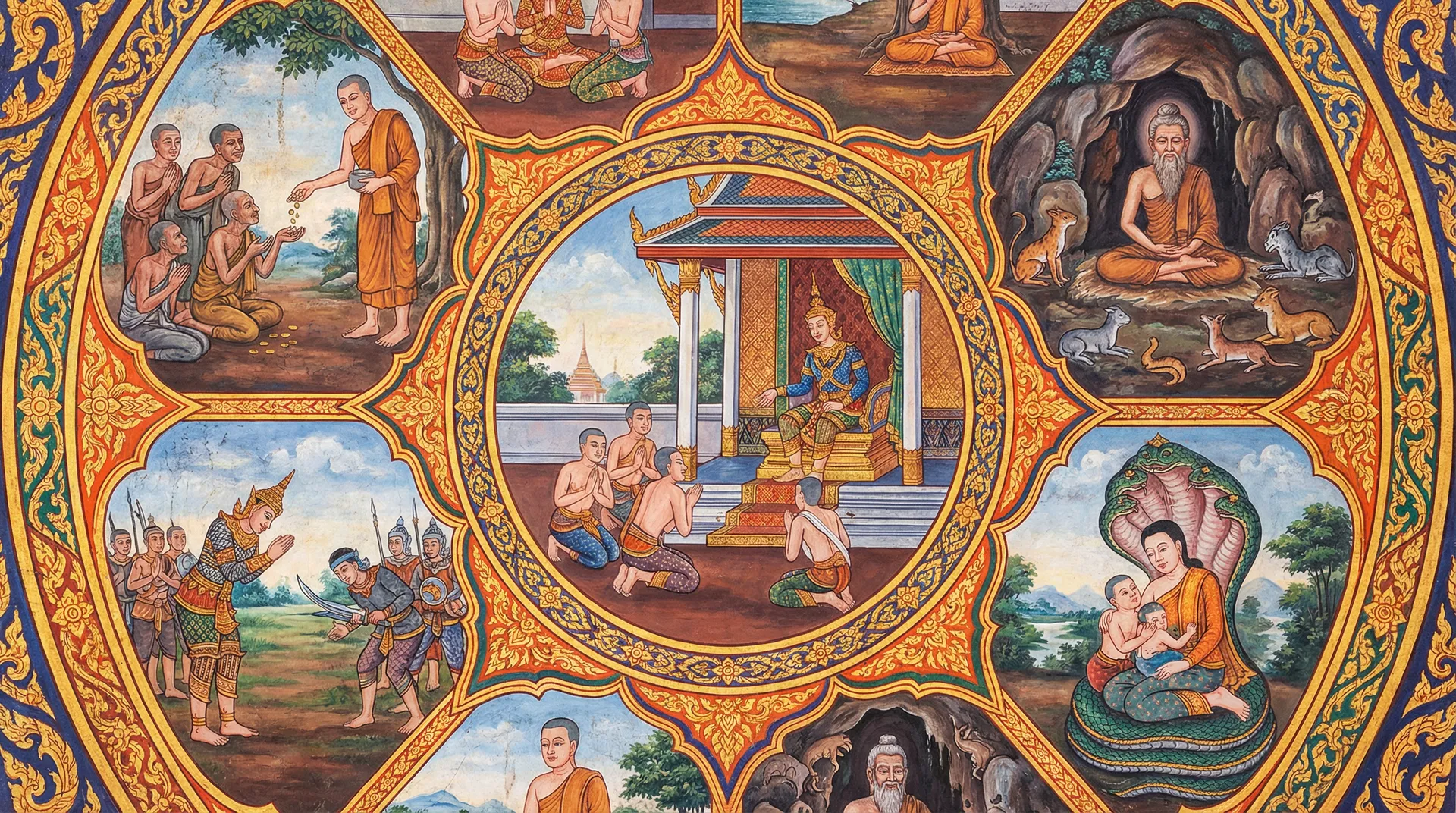
In the ancient land of Gandhāra, nestled amidst snow-capped mountains and whispering pine forests, lived a wise and virtuous prince named Sarabhaṅga. From his youth, he displayed an extraordinary intellect and a deep compassion that set him apart from his peers. He was devoted to the pursuit of knowledge and the practice of virtue, dedicating his life to understanding the nature of suffering and the path to liberation.
As he grew older, Prince Sarabhaṅga renounced the luxuries of royal life. He donned the simple robes of an ascetic and retreated to a secluded hermitage in the Himalayas. There, surrounded by nature's serene beauty, he engaged in deep meditation and rigorous spiritual discipline. His reputation for wisdom and piety spread far and wide, attracting seekers of truth from all corners of the land.
Among those who sought his guidance was King Pāṇḍava of Vidiha, a just ruler but one who was deeply troubled by the constant threats of war and the suffering it inflicted upon his people. He journeyed to Sarabhaṅga's hermitage, hoping to find solace and wisdom.
Upon meeting the ascetic prince, King Pāṇḍava prostrated himself. "O wise Sarabhaṅga," he implored, his voice filled with anguish, "my kingdom is perpetually under siege. My people live in constant fear. I strive for peace, but aggression seems to be the only language understood by my enemies. Tell me, how can I achieve lasting peace and protect my kingdom from destruction?"
Sarabhaṅga, his eyes radiating a profound calmness, listened patiently. He understood the king's plight, the heavy burden of leadership. "Your Majesty," Sarabhaṅga began, his voice gentle yet firm, "the desire for peace is noble, but the path to achieving it is often misunderstood. True peace does not come from the strength of arms or the imposition of will. It arises from within, from a heart that cultivates understanding, compassion, and wisdom."
The king looked perplexed. "But how can I show compassion to those who seek to destroy me? How can I be wise when faced with brutal force?"
Sarabhaṅga smiled. "Consider the natural world, Your Majesty. The sun shines upon all, the righteous and the wicked alike. The rain nourishes all lands. The earth bears all burdens without complaint. These elements do not retaliate when harmed; they continue to fulfill their purpose with unwavering equanimity. Likewise, true strength lies not in fighting fire with fire, but in cultivating an inner resilience that remains unshaken by external aggression."
He continued, "To achieve lasting peace, you must first cultivate it within yourself. Practice mindfulness, observe your reactions to anger and fear, and respond with reasoned compassion rather than impulsive retaliation. Seek to understand the motivations of your adversaries, even if their actions are deplorable. Often, conflict arises from misunderstanding and fear. By addressing these root causes, you can sow the seeds of reconciliation."
Sarabhaṅga then proposed a more direct approach. "I shall accompany you back to your kingdom, Your Majesty. I will stand with you, not as a warrior, but as a beacon of peace. My presence, and the principles I embody, will serve as a testament to the possibility of non-violent resolution."
King Pāṇḍava, filled with renewed hope, agreed. Sarabhaṅga, accompanied by the king, returned to Vidiha. Word of the wise ascetic prince's presence spread like wildfire. When the enemy king, known for his ruthlessness, launched another invasion, he was met not with a fierce army, but with a kingdom united in its quiet resolve, with Sarabhaṅga standing beside King Pāṇḍava at the forefront.
The enemy king, expecting a bloody battle, was taken aback by the serene demeanor of the Vidiha forces and the calm presence of Sarabhaṅga. Sarabhaṅga approached the enemy king, not with a weapon, but with open hands and a gentle gaze. He spoke not of defeat or surrender, but of the shared suffering that war inflicted upon all people, regardless of their allegiance. He spoke of the futility of violence and the enduring power of understanding.
He described the pain of a mother losing a son, the devastation of a village razed, the wasted potential of lives lost in conflict. He painted a vivid picture of the universal desire for safety, prosperity, and happiness that bound all people together. His words, imbued with genuine compassion and profound wisdom, resonated deeply, even with the hardened enemy king.
The enemy king, accustomed to the language of power and aggression, found himself disarmed by Sarabhaṅga's unwavering peace and his insightful perspective. He saw not a defeated foe, but a fellow human being appealing to their shared humanity. The seeds of doubt were sown in his mind about the righteousness of his war.
After a long deliberation, influenced by Sarabhaṅga's wisdom and the palpable sense of peace emanating from Vidiha, the enemy king chose not to wage war. Instead, he agreed to a parley. Negotiations began, guided by Sarabhaṅga's counsel, focusing on mutual understanding and shared interests rather than territorial gains or displays of power. Ultimately, a lasting peace treaty was forged, one that ensured the security of Vidiha without compromising the dignity of the opposing kingdom.
King Pāṇḍava was overjoyed. His kingdom was safe, and his people could finally live without fear. He realized that true victory was not in conquering enemies, but in transforming them, in finding common ground through compassion and wisdom. Sarabhaṅga had shown him that the greatest strength lies not in the ability to wage war, but in the power to cultivate peace, both within oneself and in the world.
— In-Article Ad —
💡Moral of the Story
True peace is cultivated from within and achieved through understanding, compassion, and wisdom, not through violence or the imposition of power. Inner resilience is the greatest defense against external aggression.
Perfection: Wisdom (Paññā) and Compassion (Karunā)
— Ad Space (728x90) —
More Jataka Tales You May Enjoy
 4Ekanipāta
The Tale of the Excellent Archer
The Tale of the Excellent Archer In the ancient kingdom of Mithila, a land blessed with fertile pla...
💡 Accusing others without reason and having impure intentions inevitably lead to one's own suffering. Forgiveness and genuinely good deeds are the path to peace and happiness.
78EkanipātaThe Jataka Tale of the Lion's Wisdom
The Jataka Tale of the Lion's Wisdom In the ancient city of Varanasi, a place renowned for its gran...
💡 Intelligence, the ability to see opportunities, and the courage to face risks can lead to wealth and benefit society.
 359Pañcakanipāta
Mulaka Jataka
Mulaka Jataka In the bustling city of Savatthi, renowned for its vibrant markets and learned scholar...
💡 Integrity and honest hard work are virtues that ultimately bring true reward and respect, even when initially met with injustice. True perfection lies in dedication and honesty, not in pleasing the whims of the corrupt.
2EkanipātaThe Bodhisatta's Golden Chariot
The Bodhisatta's Golden Chariot In a time long past, when the kingdom of Mithila flourished under t...
💡 When facing great challenges, wisdom, knowledge, and cooperation from all parties are the path to sustainable solutions.
21EkanipātaThe Bodhisatta as a Serpent
The Bodhisatta as a SerpentIn the cool, dark depths of a sacred cave, nestled within the shadow of t...
💡 The purest compassion, even at the cost of one's existence, can bring forth miraculous blessings.
60EkanipātaThe Tale of Ukkuthita
In the prosperous city of Savatthi, during an age long past, there lived a merchant named Ukkuthita....
💡 True skill and mastery are born from diligent practice and self-reliance, not from exploiting external circumstances or relying on deception.
— Multiplex Ad —