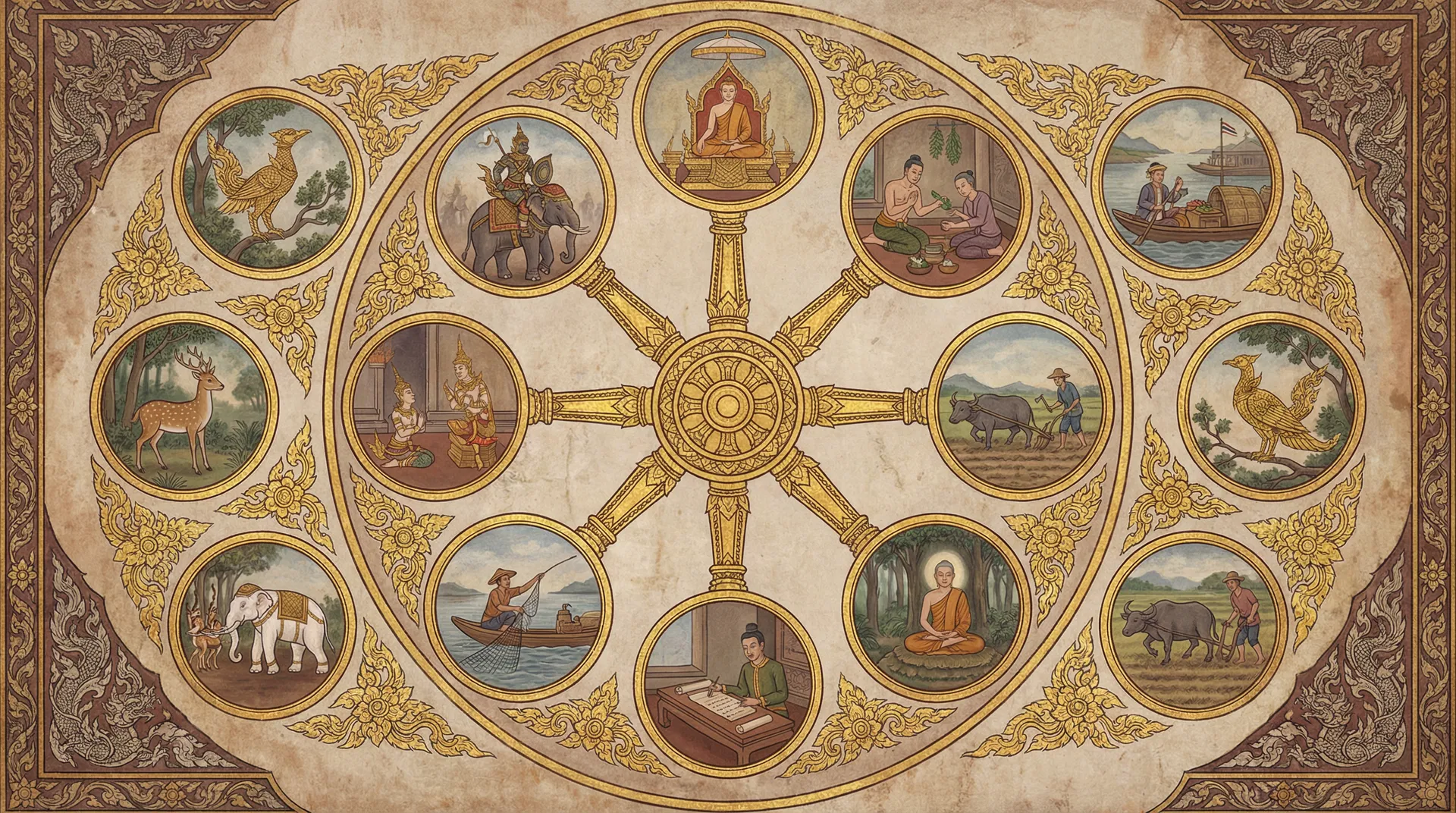
Mulasira Jataka
Mulasira Jataka
In the ancient city of Indapatta, there lived a king named Mulapariya. He was a benevolent ruler, loved by his subjects for his fairness and his deep sense of justice. However, despite his wisdom and his good heart, King Mulapariya was afflicted by a peculiar ailment: he was prone to fits of irrational anger and suspicion, which, if left unchecked, could lead him to make rash and unjust decisions. His trusted advisor, a man of immense learning and profound insight named Sarabhanga, was always on hand to guide him through these turbulent emotional storms.
One day, a merchant from a distant land arrived in Indapatta, bearing with him rare and precious gems. He sought an audience with the king to offer his most exquisite jewel, a sapphire of unparalleled blue, said to possess magical properties that could bring good fortune. The king, intrigued by the merchant's tale and the beauty of the sapphire, agreed to meet him.
As the merchant presented the sapphire, its brilliance captivated the king. He held it in his hand, mesmerized by its deep hue. However, at that very moment, a servant accidentally dropped a small, insignificant stone near the king's feet. In his agitated state, fueled by a flicker of suspicion and his peculiar ailment, King Mulapariya misinterpreted the event. He believed the servant had deliberately tried to distract him or even harm him, and that the merchant's gift was a mere pretext for some sinister plot.
His eyes narrowed, and a furious roar escaped his lips. "Treachery!" he bellowed, his voice shaking the hall. "You dare to plot against me in my own court?" He ordered the merchant and the servant to be seized and thrown into prison, their intentions deemed malicious.
Sarabhanga, the wise advisor, immediately recognized the king's irrationality. He saw that the king's anger was disproportionate to the event and that his suspicion was unfounded. He approached the king, bowing respectfully. "Your Majesty," Sarabhanga began, his voice calm and steady, "pray, consider this matter with a clear mind. The servant merely stumbled, and the stone is but a trifle. The merchant has brought a gift of great value, and his intentions seem pure."
The king, however, was blinded by his anger. "Silence, Sarabhanga! You are either a fool or a traitor yourself, to defend these schemers! I will not be deceived!" He dismissed Sarabhanga's counsel, his suspicion only deepening.
Sarabhanga, though rebuffed, did not give up. He knew that the king's anger, if allowed to fester, would lead to irreparable harm. He spent the night contemplating how to calm the king's turbulent mind. He recalled an ancient teaching about the nature of anger and suspicion – that they cloud judgment and distort reality.
The next morning, Sarabhanga approached the king again, this time with a different approach. He did not argue or try to reason directly with the king's anger. Instead, he brought with him a simple, unpolished stone, similar to the one the servant had dropped. He placed it before the king and then, with great care, began to polish it, revealing its hidden beauty and inherent value.
"Your Majesty," Sarabhanga said softly, "this stone, like the one the servant dropped, appeared insignificant and ordinary. Yet, with patient polishing, its true beauty is revealed. So too, perhaps, are the intentions of men. When viewed through the lens of anger and suspicion, even the purest heart may appear flawed, and a simple accident may seem like a deliberate act of malice."
He continued, his words resonating with profound wisdom, "Your Majesty, your anger, like a rough stone, obscures the truth. If you allow it to rule, you will see treachery where there is none, and you will destroy the innocent. True strength lies not in succumbing to rage, but in the ability to remain calm, to seek understanding, and to judge with fairness, even when faced with perceived slights."
King Mulapariya looked at the polished stone, then at his advisor. Sarabhanga's analogy struck a chord within him. He saw the reflection of his own clouded judgment in the unpolished stone, and the potential for clarity and fairness in the polished gem. He realized the harm his suspicion had caused and the wisdom in Sarabhanga's words.
Overcome with remorse, the king released the merchant and the servant, apologizing profusely for his unjust accusation. He thanked Sarabhanga for his guidance, acknowledging that without his intervention, he would have committed a grave injustice.
From that day forward, King Mulapariya made a conscious effort to control his temper and to examine his suspicions with a more discerning eye. He learned to pause, to breathe, and to seek counsel from Sarabhanga before acting on his impulses. He understood that true leadership required not just strength of will, but also the strength of a calm and discerning mind.
The Mulayara Jataka, or as it is often referred to, the story of the polished stone, became a timeless lesson on the destructive nature of uncontrolled anger and baseless suspicion. It taught that true wisdom lies in the ability to see beyond our immediate emotions, to seek clarity, and to judge with compassion and fairness, thereby preserving justice and maintaining harmonious relationships.
— In-Article Ad —
💡Moral of the Story
Uncontrolled anger and baseless suspicion are destructive forces that blind us to the truth and lead to injustice. Cultivating patience, seeking understanding, and maintaining a calm mind are essential for wise judgment and harmonious relationships.
Perfection: Patience (Khanti) and Wisdom (Panna)
— Ad Space (728x90) —
More Jataka Tales You May Enjoy
 389Chakkanipāta
Mahasutasoma Jataka
Mahasutasoma JatakaIn a distant land, where ancient trees touched the heavens and rivers flowed like...
💡 True power lies in wisdom, compassion, and self-control, not in force or selfish indulgence. Understanding the nature of suffering and craving is the path to liberation.
 74Ekanipāta
The Tale of the Sword
In the prosperous Kosala kingdom, within the renowned city of Savatthi, where King Pasenadi, the rig...
💡 True strength lies in collective effort, resourcefulness, and perseverance, not in mythical solutions.
28EkanipātaThe Bodhisatta as a King of Bears
The Bodhisatta as a King of BearsIn the vast, snow-laden wilderness of the far north, where towering...
💡 Wise leadership, determination, and inspiring trust can guide a community through perilous challenges to safety.
 183Dukanipāta
Muḷapariyāya Jātaka
The Tale of the Root of All EvilIn the ancient and prosperous city of Varanasi, ruled a king named B...
💡 The root of all suffering and evil lies within the human mind, stemming from craving, attachment, and ignorance. True peace is found by understanding and overcoming these internal afflictions.
36EkanipātaThe Tale of the Horse-Breeder
In a past aeon, in the flourishing city of Varanasi, the Bodhisatta was born as a young Brahmin, end...
💡 The highest form of virtue is selfless compassion, willing to sacrifice for the well-being of others.
4EkanipātaThe Tale of the Excellent Archer
The Tale of the Excellent Archer In the ancient kingdom of Mithila, a land blessed with fertile pla...
💡 Accusing others without reason and having impure intentions inevitably lead to one's own suffering. Forgiveness and genuinely good deeds are the path to peace and happiness.
— Multiplex Ad —