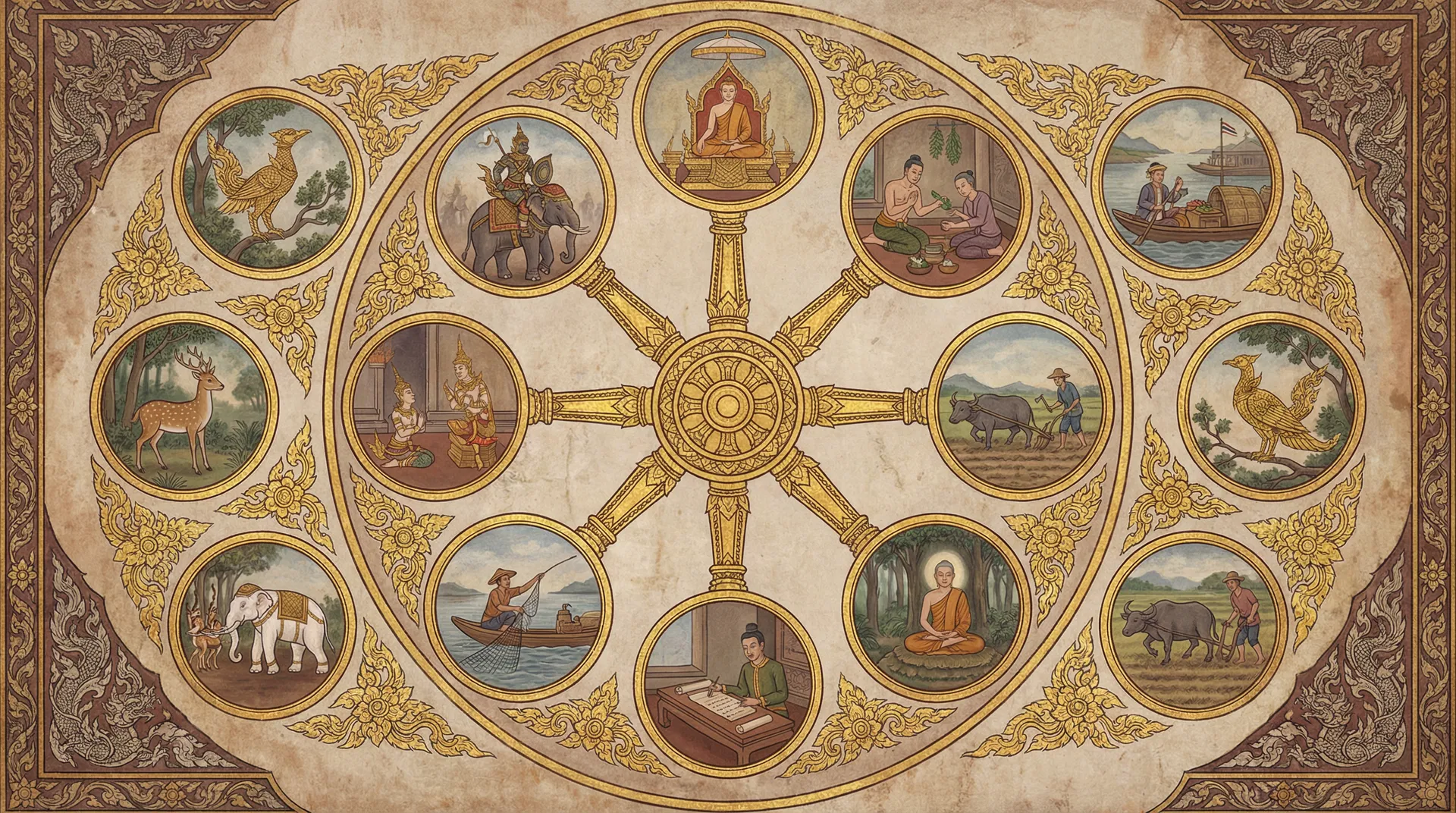
Mahā-Ummagga Jātaka
The Great Tunnel Jātaka (Mahā-Ummagga Jātaka)
In the ancient city of Mithila, ruled a wise and benevolent king named Vidhura. His reign was marked by justice and prosperity, but a shadow loomed on the horizon: the ambitious and envious King Kalābu of Anga. Kalābu, consumed by jealousy of Vidhura’s fame, plotted his downfall.
Kalābu’s chief minister, a cunning man named Pukkasa, proposed a treacherous plan. "Your Majesty," Pukkasa began, his voice a silken whisper, "King Vidhura is renowned for his wisdom. To prove your superiority, we must devise a test that even he cannot overcome." Kalābu’s eyes gleamed. "What have you in mind, Pukkasa?"
"We shall dig a great tunnel," Pukkasa explained, "from our palace gardens to the very heart of King Vidhura’s royal treasury. If we succeed, we can steal his treasures and humiliate him. If we fail, we can claim it was a foolish endeavor and escape blame." Kalābu, thrilled, agreed. Thousands of laborers were secretly put to work, digging day and night under the guise of expanding the royal gardens.
Meanwhile, in Mithila, King Vidhura, blessed with profound insight, sensed a disturbance. His Bodhisattva heart, ever vigilant, felt the subtle tremors of ill intent. He called his trusted ministers. "I perceive a great danger," he announced, his voice calm but firm. "A tunnel is being dug beneath our city. We must counter this threat not with brute force, but with superior intelligence."
The king then summoned the master architect, a man named Abhaya, and the chief engineer, named Cūḷa. "Abhaya," the king instructed, "you are renowned for your skill in stonework. Cūḷa, your understanding of the earth is unmatched. Together, you must devise a plan to intercept this tunnel."
Abhaya and Cūḷa, inspired by the king’s wisdom, devised a brilliant strategy. They decided to dig a cross-tunnel, designed to meet the enemy’s tunnel at a precise point. But this was not just any cross-tunnel. It was to be a masterpiece of deception and defense.
The king, in his infinite wisdom, ordered the creation of a decoy tunnel. This tunnel, richly adorned with glittering gems and precious stones, was designed to lead the invaders astray into a series of traps. "Let them believe they have reached the treasure," the king declared, "only to find their greed leads to their ruin."
The digging commenced. Abhaya and Cūḷa, guided by the king's foresight, worked with incredible precision. They calculated every angle, every depth, every turn. Meanwhile, King Kalābu’s laborers toiled on, unaware of the trap being laid.
One fateful night, the two tunnels met. The laborers from Anga, their faces grimy and triumphant, burst through the earth, expecting to find chests overflowing with gold. Instead, they found themselves in a dazzling chamber, illuminated by the reflected light of countless gems. They marveled at the sight, their greed blinding them to the danger.
As they ventured further, lured by the false promise of wealth, they triggered a series of ingenious traps. Hidden pits opened beneath their feet, falling nets ensnared them, and cleverly disguised sliding doors sealed them in. Panic erupted among the invaders.
Suddenly, King Vidhura, accompanied by his royal guards and the calm, resolute Abhaya and Cūḷa, emerged from a hidden passage. "Stop!" the king’s voice boomed, echoing in the chamber. "Your treacherous pursuit ends here."
King Kalābu, who had followed his men, emerged from the tunnel, his face a mask of shock and fury. "How is this possible?" he sputtered. "My tunnel was a marvel of engineering!"
King Vidhura smiled gently. "Your tunnel was indeed impressive, King Kalābu. But true wisdom lies not merely in digging deep, but in understanding the intentions behind the digging. You sought to steal and deceive; we sought to protect and outwit. Your greed was your undoing."
The trapped soldiers of Anga, seeing their king’s predicament, surrendered. King Vidhura, ever merciful, did not impose harsh punishments. He ordered the invaders to be disarmed and escorted back to their kingdom, with a stern warning. "Let this be a lesson to you, King Kalābu," he said. "True strength lies in virtue and righteousness, not in deceit and envy."
King Kalābu, humbled and ashamed, returned to Anga. He had learned a bitter lesson: that the wisdom of the Bodhisattva, guided by righteousness, could overcome even the most elaborate schemes born of malice. The people of Mithila rejoiced in their king’s victory, a victory of intellect and integrity over treachery.
— In-Article Ad —
💡Moral of the Story
True wisdom lies not only in skill but in understanding intentions and acting with righteousness. Deceit and envy ultimately lead to ruin, while integrity and foresight ensure security.
Perfection: Wisdom (Paññā) and Foresight (Ñāṇa)
— Ad Space (728x90) —
More Jataka Tales You May Enjoy
 121Ekanipāta
Dhammapala Jataka
Dhammapala Jataka In the ancient and prosperous city of Varanasi, lived a king named Brahmadatta, a ...
💡 Envy and deceit can lead to grave misunderstandings and suffering, while truth, courage, and wisdom will ultimately prevail, exposing falsehood and restoring justice.
 461Ekādasanipāta
Mahāsutasoma Jātaka
Mahāsutasoma JātakaIn the heart of a lush, verdant kingdom, nestled beside the roaring currents of a...
💡 True liberation from suffering comes not from indulging desires, but from transcending them through selfless compassion and sacrifice. The consequences of past actions can be overcome by present acts of great merit.
 190Dukanipāta
Mora Jataka
The Tale of the Wise PeacockHigh in the Himalayan mountains, where snow-capped peaks kissed the azur...
💡 True wisdom and the power of truth can transform hearts, overcome greed, and bring about positive change, even for those who seek to harm.
249DukanipātaSarabhanga Jataka
Sarabhanga JatakaIn the ancient land of Gandhara, amidst rolling hills and fertile valleys, lived a ...
💡 True strength lies not in external power or worldly achievements, but in the unwavering discipline and mastery of one's own mind.
153DukanipātaDaddabha Jātaka
Daddabha JātakaIn the verdant land of Mithila, ruled a king known for his love of music. His palace ...
💡 True mastery and profound communication stem from sincerity and heartfelt emotion, not just technical skill.
171DukanipātaMahīsosaka Jātaka
Mahīsosaka JātakaIn the ancient kingdom of Mithila, nestled amongst rolling hills and verdant forest...
💡 True loyalty and affection cannot be bought or coerced. The worth of a creature, or a person, is not determined by external forces but by their inner spirit and their bonds with those who truly care for them.
— Multiplex Ad —