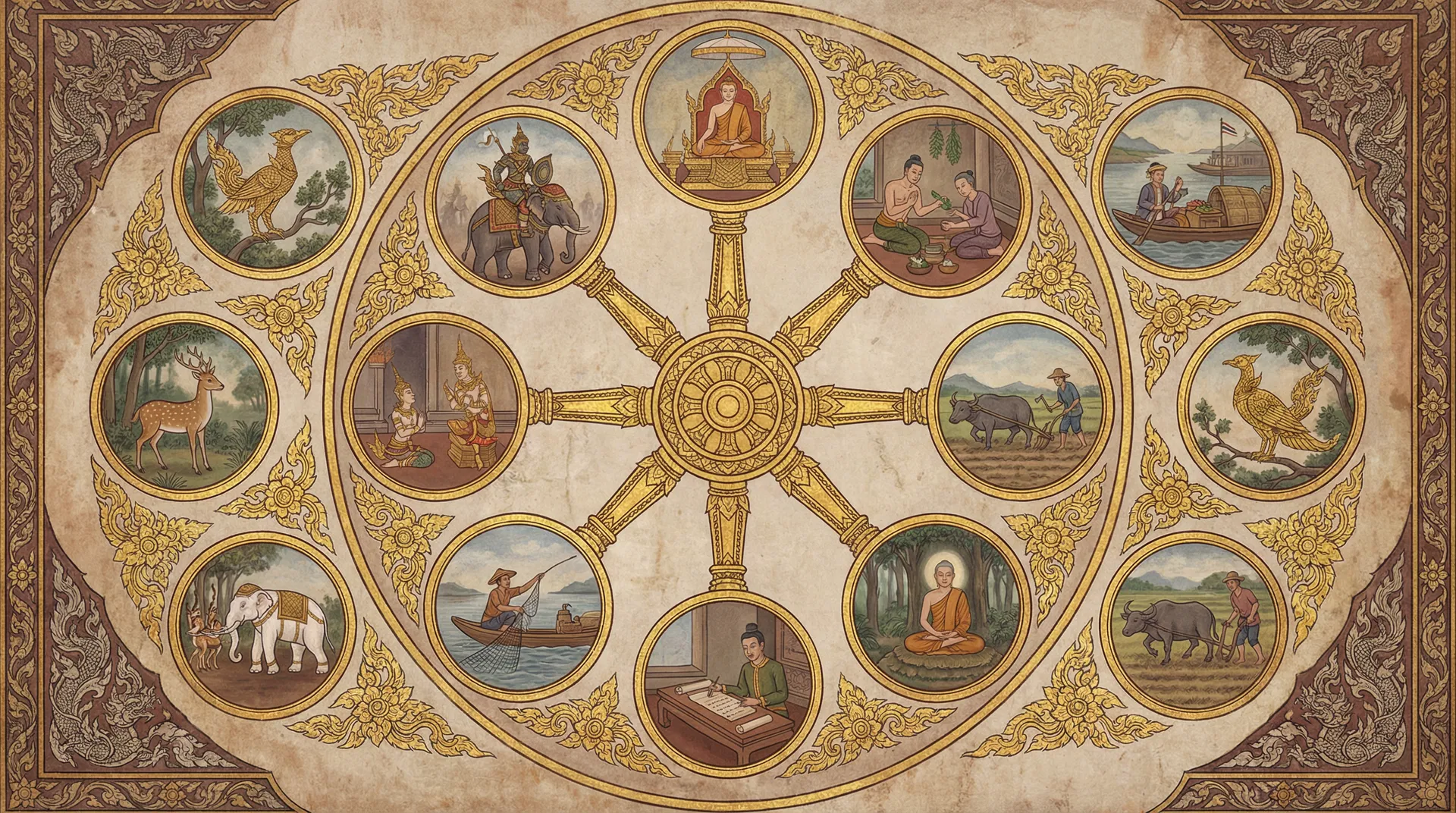
Mora Jātaka
The Peacock Jātaka (Mora Jātaka)
In the heart of a verdant forest, where ancient trees reached towards the heavens, lived a magnificent peacock. This was no ordinary peacock; it was the Bodhisattva in a previous existence, a creature of unparalleled beauty and virtue. His plumage shimmered with iridescent blues and greens, and his call was a melody that resonated with the very soul of the forest.
One day, a hunter, driven by greed and a lust for exotic trophies, entered the forest. He was a man known for his cunning and his disregard for the sanctity of life. He had heard tales of the peacock’s extraordinary beauty and vowed to capture it.
The hunter set his traps, cunningly disguised with leaves and branches, near the peacock’s favorite feeding grounds. He hid himself in the thick undergrowth, his heart pounding with anticipation.
The Bodhisattva peacock, aware of the dangers lurking in the forest, moved with caution. His wisdom, honed over countless lifetimes, allowed him to perceive even the subtlest signs of peril. As he approached the area where the hunter lay in wait, he sensed a disturbance, a discordant note in the forest’s harmony.
He stopped. His keen eyes scanned the surroundings. He noticed a twig unnaturally placed, a patch of disturbed earth. His inner wisdom warned him of a trap. He knew that if he stepped into the snare, his life, and the purity he embodied, would be compromised.
The hunter, seeing the peacock hesitate, thought his prey was merely being cautious. He grew impatient. He decided to force the issue. With a sudden lunge, he sprung from his hiding place, attempting to grab the peacock before it could fly away.
But the Bodhisattva peacock was too quick. With a powerful beat of his wings, he soared into the air. As he ascended, a single, resplendent tail feather detached and drifted down, landing near the frustrated hunter.
The hunter, enraged by his failure, picked up the feather. It was indeed the most beautiful feather he had ever seen, radiating a mystical glow. He clutched it tightly, a symbol of his thwarted ambition.
Meanwhile, the Bodhisattva peacock flew to a higher branch and surveyed the situation. He knew that his beauty, while a gift, could also be a source of temptation and danger to those with impure intentions. He decided to teach the hunter a lesson, not through violence, but through the power of truth and virtue.
He then flew down, landing gracefully a safe distance from the hunter. He began to sing, his voice filled with a profound sorrow and wisdom. He sang of the interconnectedness of all life, of the suffering caused by greed and violence, and of the peace that comes from living in harmony with nature.
"O hunter," the peacock sang, his voice echoing through the trees, "you seek to possess beauty, but you do not understand its true nature. True beauty lies not in the outward form, but in the purity of the heart and the virtuousness of one's actions. This feather you hold is but a fragment of a greater whole, a whole that thrives on freedom and respect, not on capture and possession."
The hunter, captivated by the peacock's song and the profound words, felt a stirring within him. He looked at the feather, then at the magnificent bird, and for the first time, he saw not just a prize, but a being of immense grace and wisdom. The hunter’s heart, hardened by years of cruelty, began to soften.
The Bodhisattva peacock continued, "If you wish to understand true beauty, abandon your destructive ways. Learn to see the wonder in every living creature, to protect rather than to harm. Live in accordance with the natural laws, and you will find a richness far greater than any material gain."
The hunter, deeply moved, dropped the feather. He bowed his head in shame and repentance. He realized the error of his ways and the emptiness of his pursuits. He vowed then and there to give up hunting and to live a life of compassion.
From that day forward, the hunter became a protector of the forest. He would often visit the place where he had encountered the Bodhisattva peacock, reflecting on the lesson he had learned. The single feather remained a reminder, not of his greed, but of the moment his heart was transformed by wisdom and compassion. The Bodhisattva peacock continued to live in the forest, his presence a silent testament to the enduring power of virtue over malice.
— In-Article Ad —
💡Moral of the Story
True beauty resides in virtue, wisdom, and compassion, not in outward appearance or possession. Greed and violence lead to suffering, while respect for life and adherence to moral principles bring inner peace and true fulfillment.
Perfection: Virtue (Sīla) and Wisdom (Paññā)
— Ad Space (728x90) —
More Jataka Tales You May Enjoy
 156Dukanipāta
Dhopa Jataka
Dhopa JatakaIn the ancient kingdom of Mithila, renowned for its flourishing arts and discerning popu...
💡 Do not be fooled by superficial allurements and intoxicating fragrances; seek that which is pure, genuine, and lasting.
 360Pañcakanipāta
Sutasoma Jataka
Sutasoma Jataka In the ancient kingdom of Kampilya, known for its chivalrous knights and its strong ...
💡 Unwavering truth, courage, and compassion possess a power that can overcome even the greatest evil and transform the hearts of those who inflict suffering. True strength lies in moral conviction, not brute force.
176DukanipātaMahāsuka Jātaka
Mahāsuka JātakaIn the ancient city of Mithila, nestled amidst lush gardens and bustling marketplaces...
💡 True happiness is not found in external possessions or fleeting pleasures, but in the cultivation of inner peace, wisdom, and virtue. The greatest treasure is the joy of a contented mind, free from the bondage of insatiable desires.
250DukanipātaSasa Jataka
Sasa JatakaIn a time long past, when the world was young and the forests were vast and untamed, ther...
💡 The greatest gift one can offer is oneself, given freely and with boundless compassion, for the benefit of all.
 276Tikanipāta
Mugapakkha Jataka
The Tale of the Mute Prince In the ancient kingdom of Mithila, a wise king reigned with a heart as v...
💡 True communication transcends words; it is found in understanding, empathy, and compassionate actions. Leadership is demonstrated through deeds, not just pronouncements.
200DukanipātaSutasoma Jātaka
The Tale of the Bodhisattva as a Pacifist KingIn the ancient city of Suvarna, there reigned a king n...
💡 True strength lies in non-violence, restraint, and compassion. Conflicts can often be resolved through dialogue, understanding, and sincere efforts towards peace, rather than through aggression.
— Multiplex Ad —