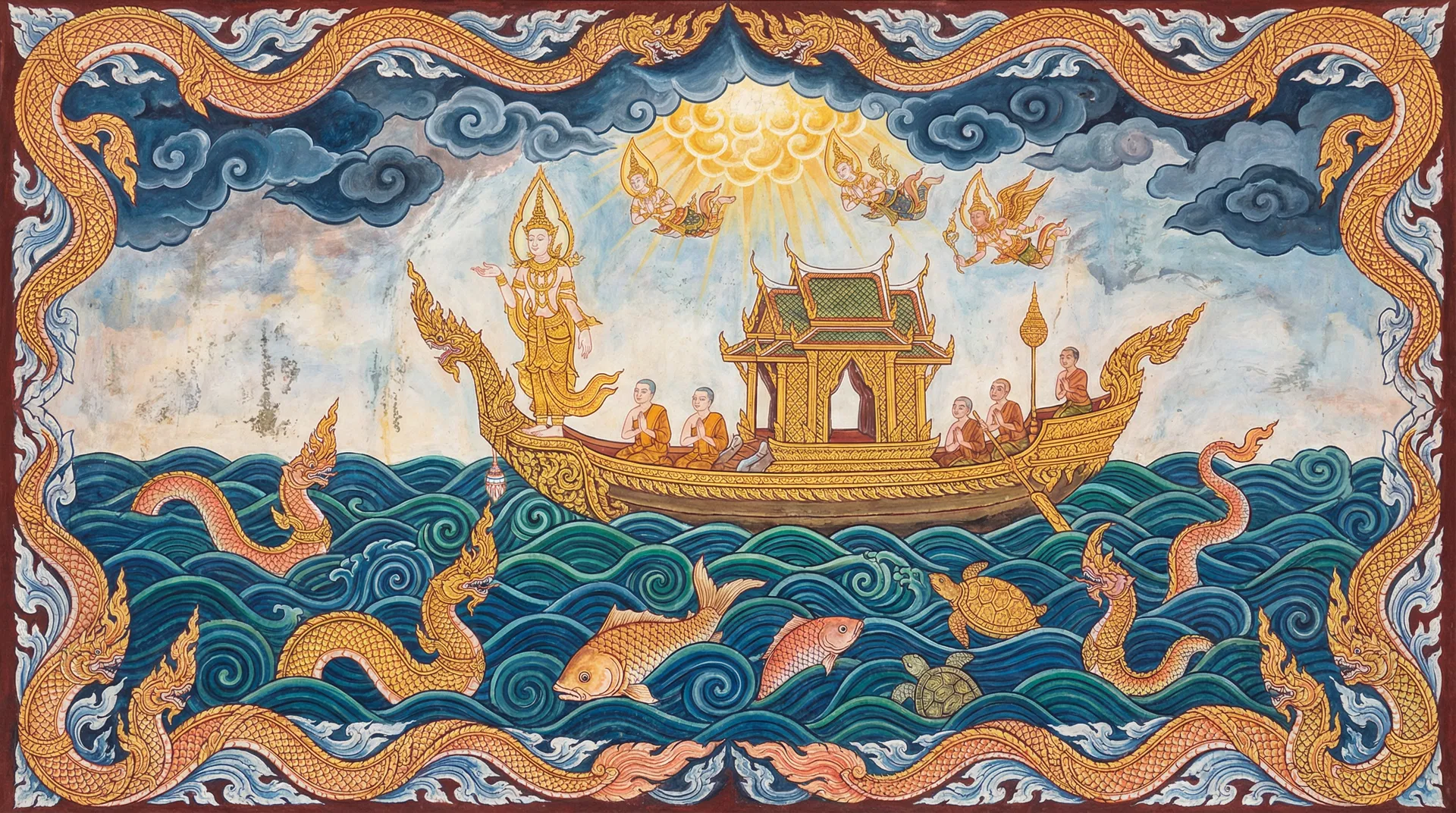
Lankayutta Jataka
Lankayutta Jataka
In the ancient and prosperous city of Varanasi, there once lived a Bodhisattva who was renowned for his exceptional wisdom and his ability to discern the truth in all matters. In this past life, he was born as a wise old monkey, a leader of a troop that dwelled in a magnificent grove of mango trees near the city walls. This monkey, named Lankayutta, was not only intelligent but also deeply responsible for the well-being of his community.
One sweltering summer day, as the sun beat down relentlessly, the troop of monkeys grew increasingly thirsty. Their usual watering hole had dried up, and the nearest river was a long and arduous journey away, a journey too perilous for the young and the old.
Lankayutta, seeing the distress of his troop, felt a surge of concern. He knew he had to find a solution, and quickly. He gathered the elder monkeys and said, "My friends, our water sources are depleted. We must find a new source, one that can sustain us through this drought."
He then led his troop on a search. They scoured the surrounding forest, their eyes scanning every nook and cranny, their noses sniffing the air for any sign of moisture. Days passed, and their thirst grew more intense, their hope beginning to dwindle.
Finally, after much searching, Lankayutta spotted a peculiar sight. High up on a rocky outcrop, near the city's boundary, he saw a large, ancient banyan tree. Its roots seemed to delve deep into the earth, and around its base, the ground appeared unusually lush and green, even in the dry season. He suspected that this might be a hidden spring.
Excited, Lankayutta instructed his troop to follow him. They cautiously approached the banyan tree. As they drew closer, they discovered a deep pit, hidden beneath a thick canopy of leaves, from which a small stream of water was trickling. It was a precious find, a life-saving discovery.
However, their joy was short-lived. As they were about to drink, a fearsome, monstrous serpent emerged from the pit. This serpent, a creature of immense size and terrifying power, was the guardian of the hidden spring. Its scales shimmered with an unholy light, and its eyes glowed with a malevolent fire. It hissed menacingly, its forked tongue flicking, clearly intending to prevent the monkeys from accessing the water.
The monkeys, terrified, scattered in panic. Only Lankayutta, the wise leader, stood his ground. He knew that fear would not save them. He understood that brute force would be futile against such a creature. He needed to use his intellect and his understanding of the serpent's nature.
Lankayutta observed the serpent closely. He noticed its immense size, its powerful coils, and its clear territorial instinct. He also noticed its vanity; the serpent seemed to relish its own fearsome appearance and the terror it inspired.
"O mighty serpent!" Lankayutta called out, his voice steady despite the fear that gripped his heart. "I come not to challenge your power, nor to steal your precious water. I come as a messenger, bearing tidings of great importance!"
The serpent, surprised by the monkey's boldness, paused its hissing. "A messenger? What tidings could a mere monkey bring to me, the guardian of this sacred spring?" it sneered, puffing itself up.
"Your power is undeniable, O great one," Lankayutta continued, playing on the serpent's vanity. "Your scales gleam brighter than any jewel, your hiss shakes the very earth, and your presence commands fear. The King of Varanasi himself speaks of your magnificence!"
The serpent, flattered, coiled itself more majestically. "The King? What does the King say of me?"
"He marvels at your strength and your beauty," Lankayutta said, carefully choosing his words. "But he also laments that such a glorious creature has no one to truly appreciate its splendor. He believes that a guardian of such magnificence deserves a royal procession, a public display of its greatness, so that all may witness and celebrate your might!"
The serpent, completely captivated by the idea of public adoration, puffed out its chest. "A royal procession, you say? For me?"
"Indeed!" Lankayutta exclaimed. "The King is preparing a grand ceremony. He wishes to honor you. But for this, he requires a special jewel, a gem of unparalleled brilliance, to adorn your head, so that you may shine even brighter during the procession. He has instructed me to find the most radiant jewel in the land to present to you."
The serpent, blinded by vanity, eagerly asked, "And where can such a jewel be found?"
"There is a cave, deep within the mountains," Lankayutta explained, pointing vaguely towards the distant peaks. "It is said to hold a gem that reflects the very light of the moon and stars. But the cave is guarded by a fearsome beast, and only one as brave and powerful as you could retrieve it."
The serpent, completely taken in by Lankayutta's elaborate lie, could barely contain its excitement. The thought of being honored by the king and adorned with a magnificent jewel was irresistible. "Show me this cave! I shall retrieve the jewel myself!"
Lankayutta, with feigned urgency, led the serpent away from the spring, pointing it in the direction of the distant mountains. He walked with it for a considerable distance, ensuring it was far from the watering hole. Once he was certain the serpent was well on its way, chasing a phantom jewel, Lankayutta turned and hurried back to his troop.
"The serpent is gone!" he announced to his relieved monkeys. "It has gone in search of a treasure. Now, we can drink in peace!"
The monkeys, their thirst overpowering their fear, rushed to the pit and drank their fill from the precious spring. They were saved, all thanks to the wisdom and cunning of their leader, Lankayutta.
The serpent, of course, never found the jewel. It wandered for days in the barren mountains, its pride slowly giving way to confusion and then to anger. Eventually, it realized it had been tricked and slithered back towards the spring, only to find it occupied by the monkeys. Enraged, it lunged, but the monkeys, now refreshed and emboldened, had learned from Lankayutta. They used their agility and numbers to distract and evade the serpent, eventually driving it away, further into the wilderness where it could no longer trouble them.
Lankayutta, having secured a vital resource for his community, continued to lead his troop with wisdom and foresight, always prioritizing their safety and well-being through intelligent problem-solving rather than brute force.
— In-Article Ad —
💡Moral of the Story
Wisdom and intelligence are more powerful than brute force or fear. By understanding the nature of a problem and using cleverness, one can overcome even the most formidable obstacles.
Perfection: Wisdom (Panna) and Courage (Virya)
— Ad Space (728x90) —
More Jataka Tales You May Enjoy
 258Tikanipāta
Sutasoma Jātaka
Sutasoma JātakaIn the ancient city of Indapattha, a kingdom blessed with fertile lands and prosperou...
💡 True immortality is found not in the fear of death, but in the legacy of virtuous deeds and selfless sacrifice.
 485Pakiṇṇakanipāta
Mahā-pankatthera Jātaka
The Tale of the Bodhisatta Who Endured the Muddy Path In the ancient city of Jetuttara, a great Bodh...
💡 Unwavering determination and immense patience are essential to overcome life's challenges and progress on the spiritual path.
 16Ekanipāta
The Monkey King's Courage
The Monkey King's CourageIn the heart of a verdant jungle, teeming with life and vibrant with the ch...
💡 True courage lies in facing fear and acting for the protection of others, regardless of the odds.
128EkanipātaKusa Jataka
Kusa JatakaIn the kingdom of Videha, ruled a wise and benevolent king named King Okkaka. His court w...
💡 Wisdom and courage, when combined with patience and self-sacrifice, can overcome even the most difficult and unjust circumstances, leading to truth and liberation.
5EkanipātaThe Monkey King's Sacrifice
The Monkey King's SacrificeIn the dense, emerald heart of the Vindhya Mountains, where ancient trees...
💡 True leadership is defined by selfless sacrifice for the well-being of others.
78EkanipātaThe Jataka Tale of the Lion's Wisdom
The Jataka Tale of the Lion's Wisdom In the ancient city of Varanasi, a place renowned for its gran...
💡 Intelligence, the ability to see opportunities, and the courage to face risks can lead to wealth and benefit society.
— Multiplex Ad —