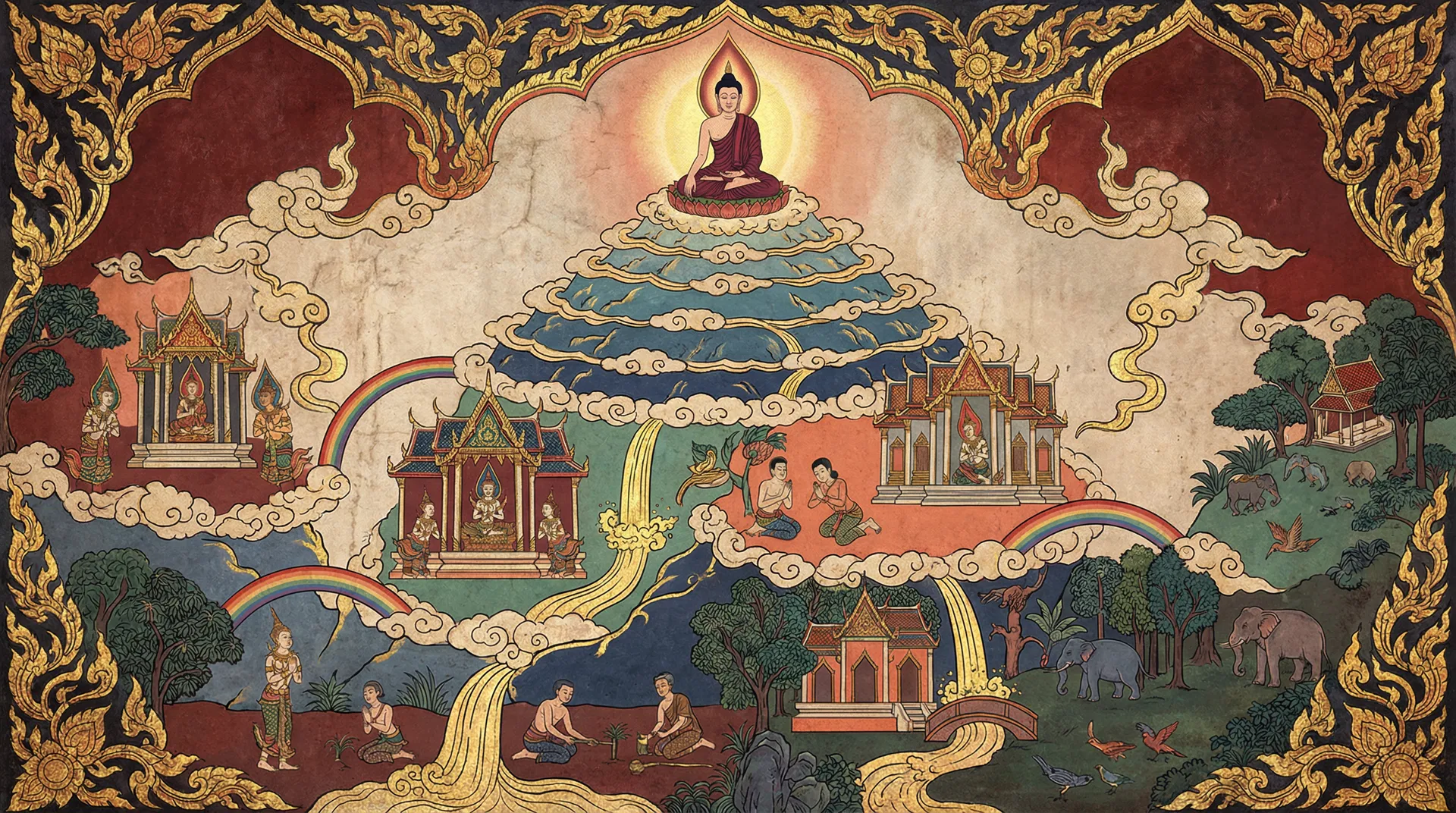
Mūkapacca Jātaka
Mūkapacca Jātaka
In the ancient city of Varanasi, nestled beside the sacred River Ganges, lived a king renowned for his wisdom and just rule. His name was King Brahmadatta, and his reign was a golden age for his people. Yet, even in this era of prosperity, a shadow of discontent flickered in the heart of the royal court. The King’s chief advisor, a man named Vidura, was a sage whose counsel was sought by princes and potentates from distant lands. His brilliance, however, bred envy in the hearts of some. Among these was a cunning minister, Kondañña, whose ambition was as boundless as the ocean and whose heart was as cold as the northern winds. Kondañña, seeing Vidura’s unwavering influence, plotted his downfall.
One day, Kondañña approached the King with a seemingly innocent proposal. “Your Majesty,” he began, his voice dripping with feigned concern, “I have observed that the great sage Vidura, despite his unparalleled wisdom, has grown rather… quiet. His pronouncements, once like the thunder of the heavens, are now mere whispers. Could it be that his mind, once a sharp blade, has begun to dull with age? Perhaps it is time to seek a new voice, a younger mind, to guide your illustrious reign.”
King Brahmadatta, though wise, was also deeply trusting of his ministers. He pondered Kondañña’s words, a seed of doubt planted in his mind. He summoned Vidura, not to question him directly, but to test him in a way that would appear natural. “Vidura, my trusted friend,” the King said, “the realm faces new challenges. I require your counsel on matters of state, but I also wish for you to share your insights on the nature of music. Tell me, what is the most beautiful sound in the world?”
Vidura, a man of profound understanding, knew this was no ordinary question. He sensed Kondañña’s machinations, but he answered with the calm equanimity that was his hallmark. “Your Majesty,” he replied, his voice clear and resonant, “the most beautiful sound is the sound of silence. For in silence, one can hear the true voice of one’s own heart and the harmony of the universe.”
Kondañña, who had anticipated a more worldly answer, was momentarily flustered. He pressed on, “But surely, my lord, the songs of the celestial dancers, the music of the lute, the roar of the lion – these are sounds of great beauty!”
Vidura smiled gently. “Those are indeed beautiful sounds, Minister Kondañña. But they are transient. They arise and they pass away. The true beauty of silence is that it is eternal, and within it, all other sounds find their true meaning.”
The King, however, was still swayed by Kondañña’s subtle whispers and his own burgeoning doubts. He decided on a more drastic test. He decreed that Vidura should be banished from the court and sent to a remote village. “Let him reflect on his words,” the King declared, “and perhaps find a new voice there.”
Vidura, with grace, accepted the King’s decree and departed for the village of Mūkapacca, a place known for its quietude and the simplicity of its inhabitants. The villagers, simple folk who lived in harmony with nature, welcomed the wise stranger. Vidura, freed from the clamor of the court, found solace in the gentle rhythm of village life. He spent his days meditating, observing the natural world, and engaging in quiet contemplation. The villagers, initially curious, soon came to revere him for his serene presence and the occasional, profound words of wisdom he shared.
Meanwhile, back in Varanasi, Kondañña’s influence grew. He advised the King on matters of war and commerce, and his counsel, though often self-serving, was cloaked in the language of expediency. The kingdom, however, began to suffer. The King, misled by Kondañña’s advice, made costly mistakes. Trade routes faltered, alliances weakened, and the people’s faith in their ruler began to wane. The King, once proud of his wisdom, now found himself adrift in a sea of uncertainty.
One day, a delegation of merchants from a neighboring kingdom arrived in Varanasi. They had been victims of Kondañña’s avarice, their caravans plundered and their goods confiscated under false pretenses. They pleaded with King Brahmadatta for justice, but Kondañña, ever the manipulator, silenced their pleas and painted them as troublemakers. The King, blinded by Kondañña’s fabrications, dismissed their grievances.
Desperate, the merchants recalled tales of the exiled sage Vidura, a man of immense justice and wisdom. They decided to seek him out, hoping he might offer a solution. Their journey to Mūkapacca was arduous, but they were determined. Upon reaching the village, they found Vidura meditating under the shade of a Bodhi tree, his presence radiating an aura of peace.
They explained their plight, their voices heavy with despair. Vidura listened patiently, his eyes closed. When they had finished, he opened his eyes and looked at them with compassion. “Your suffering is great,” he said, his voice soft yet firm. “But despair is the enemy of justice. Let us return to Varanasi. The King needs to hear the truth, not the lies of ambition.”
The merchants, filled with renewed hope, accompanied Vidura back to the capital. As they approached the palace gates, Kondañña, seeing Vidura’s return, was filled with a cold dread. He ordered the guards to bar their entry, but Vidura, with a calm voice, declared, “I have been summoned by the King. And I bring with me the voices of those he has unjustly silenced.”
The King, hearing of Vidura’s return and the commotion at the gates, felt a strange stirring within him. He ordered Vidura to be brought before him. In the grand audience hall, the King sat on his throne, Kondañña by his side, his face a mask of smug confidence. Vidura stood before them, his demeanor serene, the merchants standing behind him, their faces etched with anticipation.
“Vidura,” the King began, his voice tinged with a mixture of relief and apprehension, “you have returned. Why have you come?”
“Your Majesty,” Vidura replied, “I have come to speak the truth, a truth that has been drowned out by the noise of deceit. Minister Kondañña has advised you poorly, leading your kingdom to ruin and causing suffering to your people and your neighbors.”
Kondañña scoffed. “Lies! This exiled fool speaks only out of bitterness. His mind is clouded by his banishment.”
But Vidura was not deterred. He then called upon the merchants. “Let these men speak,” he said. One by one, the merchants recounted their tales of woe, their voices clear and strong, detailing Kondañña’s corruption and the injustice they had suffered. The King listened, his face growing pale as the truth unfolded before him. He saw the avarice in Kondañña’s eyes, the subtle manipulations, the calculated lies.
Finally, Vidura spoke again. “Your Majesty,” he said, his voice rising with conviction, “you asked me what the most beautiful sound was. I said it was silence. But I was incomplete. The most beautiful sound is not just silence, but the sound of truth, spoken with courage, and heard with an open heart. And the most terrible sound is the lie, which breeds only suffering and destruction.”
King Brahmadatta, his heart heavy with remorse, banished Kondañña from his kingdom. He reinstated Vidura as his chief advisor, his trust renewed and his understanding deepened. The kingdom of Varanasi, under Vidura’s wise guidance, gradually recovered. The merchants received their due compensation, and the kingdom’s reputation for justice was restored. Vidura, having seen the folly of noise and the power of silence and truth, continued to serve his King with unparalleled wisdom, his counsel always guided by the quiet strength of inner understanding.
— In-Article Ad —
💡Moral of the Story
The deceptive noise of ambition and lies can lead a kingdom to ruin, while the quiet strength of truth and wisdom, though sometimes overlooked, ultimately prevails and brings lasting peace and prosperity.
Perfection: Wisdom (Paññā)
— Ad Space (728x90) —
More Jataka Tales You May Enjoy
 540Mahānipāta
Sama Jataka
The Tale of Prince Sama and the Mother's Love In the ancient kingdom of Kuruksetra, there lived a pi...
💡 Unwavering filial piety and selfless devotion are virtues of the highest order, capable of inspiring compassion and even divine intervention. True love transcends personal sacrifice.
 8Ekanipāta
The Wise King of Birds
The Wise King of BirdsPerched atop the highest peak of the Himalayas, where the air was thin and cry...
💡 True wisdom lies in selfless compassion, and the greatest sacrifices bring about miraculous salvation.
19EkanipātaThe Bodhisatta as a Lion
The Bodhisatta as a LionIn the heart of a vast, sun-baked desert, where sand dunes stretched as far ...
💡 True leadership lies in selfless sacrifice for the well-being of subjects, bringing immeasurable blessings.
28EkanipātaThe Bodhisatta as a King of Bears
The Bodhisatta as a King of BearsIn the vast, snow-laden wilderness of the far north, where towering...
💡 Wise leadership, determination, and inspiring trust can guide a community through perilous challenges to safety.
42EkanipātaThe Bodhisatta as the Golden Deer
The Bodhisatta as the Golden DeerIn the ancient kingdom of Mithila, nestled beside a shimmering, eme...
💡 Unwavering truthfulness and selfless compassion can overcome even the direst of circumstances, leading to prosperity for all.
7EkanipātaThe Steadfast Deer
The Steadfast DeerIn the serene and emerald expanse of a sacred grove, where ancient banyan trees sp...
💡 Unwavering steadfastness and a pure heart can overcome the direst of circumstances.
— Multiplex Ad —