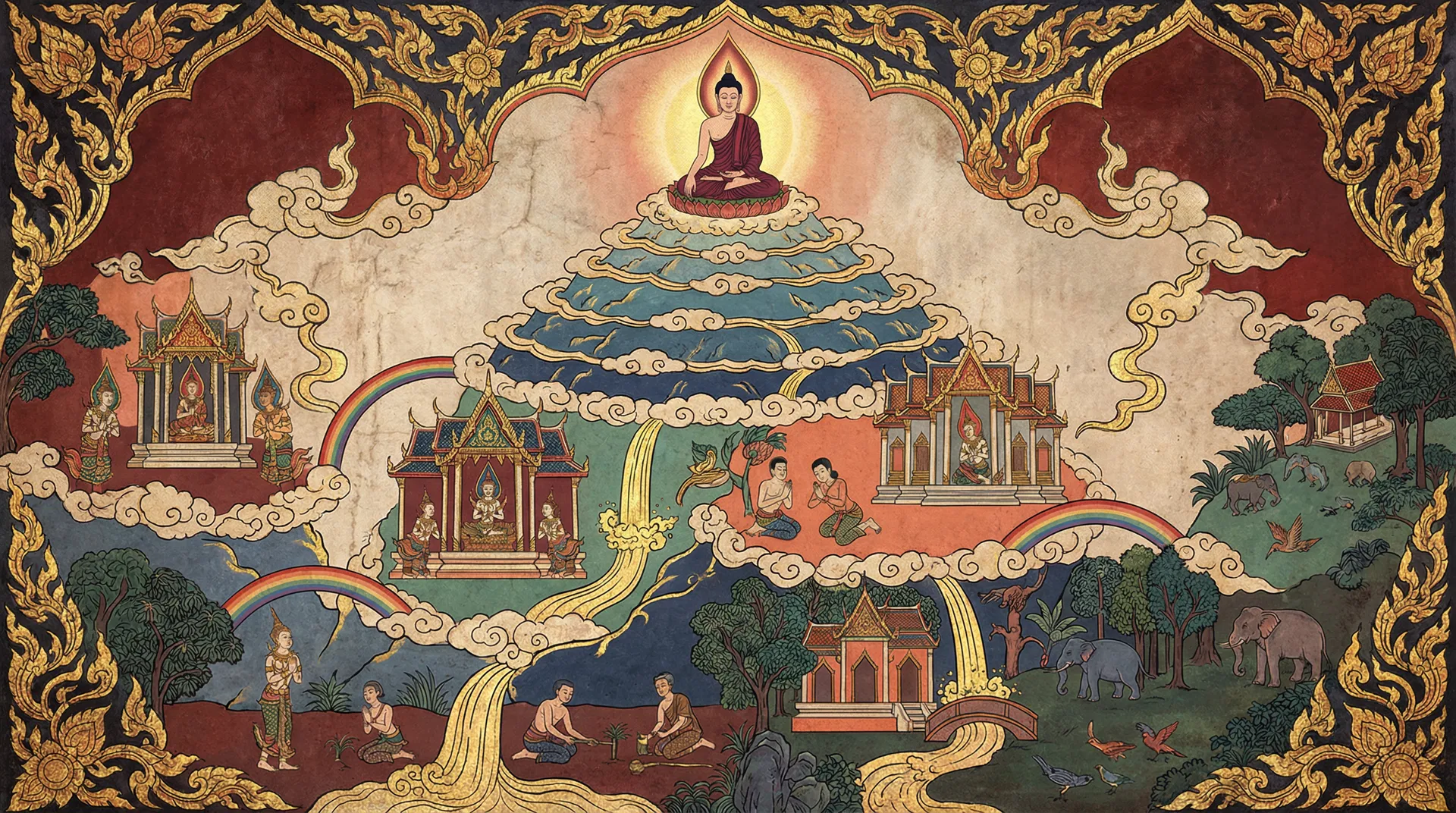
Sasa Jātaka
Sasa Jātaka
In the deep, verdant forests of ancient India, where sunlight dappled through a canopy of ancient trees and the air hummed with the symphony of nature, lived a community of compassionate beings. Among them were rabbits, deer, monkeys, and otters, all coexisting in harmony, their lives guided by a shared sense of kindness and mutual respect. Among these noble creatures was a rabbit, a being of extraordinary virtue and gentle spirit.
This rabbit was not just any rabbit; he was a Bodhisatta, destined to embody the highest ideals of compassion and selflessness. He lived a simple life, finding joy in the rustling leaves, the babbling brooks, and the companionship of his fellow creatures. He was known for his unwavering kindness, always ready to offer a helping paw or a comforting presence to anyone in need.
One day, the sky above the forest darkened, not with clouds, but with an ominous celestial sign. A deva, dwelling in the heavens, descended from his abode, disguised as an old, weary Brahmin. He had come to test the virtue of the forest dwellers, to see if true compassion still existed in the world.
The Brahmin, with a frail voice and a sorrowful countenance, approached the rabbit and his companions. 'Oh, noble creatures,' he crooned, his voice laced with feigned despair, 'I have traveled far and wide, and I am weary and hungry. I have no food to sustain me. Could you possibly spare a morsel for a starving old man?'
The deer, hearing his plea, offered him the tender shoots of grass they had gathered. The monkeys, nimble and quick, brought him sweet fruits from the highest branches. The otter, diving into the river, presented him with glistening fish. Each creature offered what they had, their hearts brimming with generosity.
Finally, the Brahmin turned to the rabbit. 'And you, little rabbit,' he said, his eyes fixed on the gentle creature, 'what can you offer a starving soul like me?'
The rabbit looked at the Brahmin, his heart aching with empathy. He knew that the fruits, grass, and fish were sustenance for the body, but he longed to offer something more, something that would truly nourish the spirit. He looked at his own body and realized that it, too, could be an offering. He looked at the fire pit that the Brahmin had made.
'Brahmin,' the rabbit said, his voice clear and resolute, 'I have no grass, no fruits, no fish to give you. But I have my own body. If you wish, you may take my flesh and eat it. It will sustain you.'
With these words, the rabbit hopped towards the fire pit. He shook his fur, as if to shed his earthly form, and then, with a leap of faith and boundless love, he leaped into the flames. He offered his entire being, his flesh and bones, to the Brahmin.
The Brahmin, witnessing this ultimate act of self-sacrifice, was moved to tears. He revealed himself in his true form as the deva Sakka, king of the gods. He gently lifted the rabbit's remains from the fire and, with deep reverence, inscribed the image of the rabbit on the moon. This is why, to this day, we can see the shape of a rabbit imprinted on the lunar surface.
The deva then spoke, his voice filled with awe, 'Such pure compassion, such utter selflessness, is a rare and precious gem. The world needs to remember this sacrifice, to be inspired by it. Let this image on the moon serve as a constant reminder of the boundless love that a Bodhisatta can embody.'
The other animals, witnessing this profound event, were deeply moved. They understood that true generosity was not about what one possessed, but about what one was willing to give, even one's own life, for the sake of others. They continued to live in the forest, their hearts forever touched by the rabbit's ultimate sacrifice, striving to embody the same spirit of compassion and selflessness in their own lives.
— In-Article Ad —
💡Moral of the Story
Selfless compassion and the willingness to sacrifice one's own well-being for the benefit of others are the highest virtues.
Perfection: Generosity (Dāna) and Compassion (Karunā)
— Ad Space (728x90) —
More Jataka Tales You May Enjoy
 436Navakanipāta
Mugapakkha Jataka
The Tale of the Mute PrinceIn the ancient city of Mithila, ruled a just and benevolent king named Vi...
💡 True strength and wisdom are not always expressed through words. Courage, intelligence, and unwavering resolve can speak volumes, even in silence. The ability to inspire and protect others transcends the need for a voice.
 193Dukanipāta
Sarbhangajataka
Sarbhangajataka In the venerable city of Varanasi, where the Ganges flowed like a silken ribbon and ...
💡 Truth and virtue, when deeply rooted, cannot be destroyed by falsehood or malice. Those who spread lies and sow discord ultimately reveal their own corrupt nature.
 9Ekanipāta
The Generous Merchant
The Generous MerchantIn the bustling port city of Bharuch, where the air was thick with the scent of...
💡 True wealth lies in selfless giving, which ultimately brings its own abundant rewards.
10EkanipātaThe Bodhisatta as a Tortoise
The Bodhisatta as a TortoiseIn the tranquil embrace of a sacred forest, where ancient trees formed a...
💡 The ultimate act of compassion, even at the cost of one's own life, can bring forth miraculous salvation.
128EkanipātaKusa Jataka
Kusa JatakaIn the kingdom of Videha, ruled a wise and benevolent king named King Okkaka. His court w...
💡 Wisdom and courage, when combined with patience and self-sacrifice, can overcome even the most difficult and unjust circumstances, leading to truth and liberation.
28EkanipātaThe Bodhisatta as a King of Bears
The Bodhisatta as a King of BearsIn the vast, snow-laden wilderness of the far north, where towering...
💡 Wise leadership, determination, and inspiring trust can guide a community through perilous challenges to safety.
— Multiplex Ad —