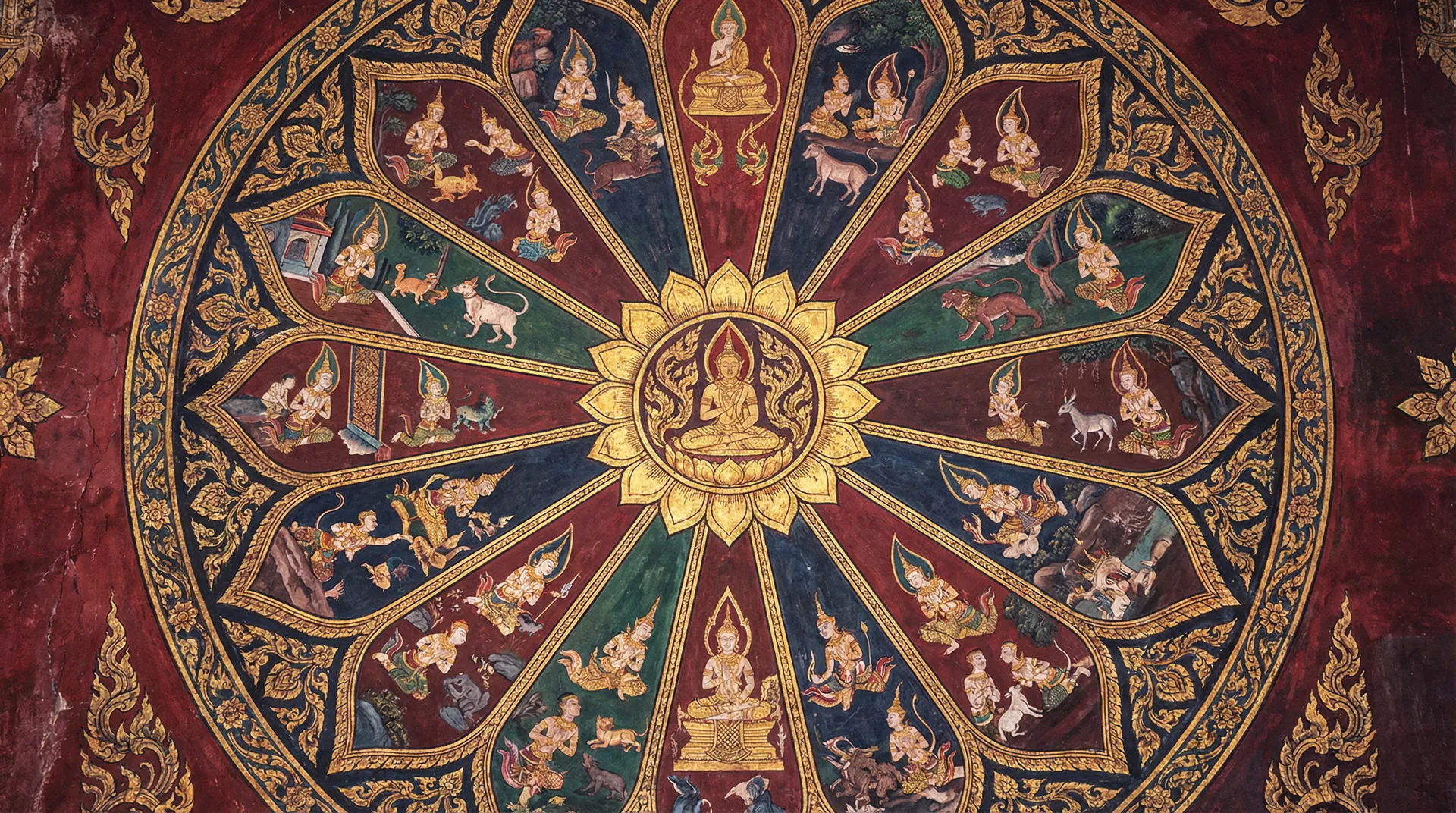
Nimi Jātaka
Nimi Jātaka
In the glorious city of Mithila, there reigned a king named Nimi, whose virtue was as renowned as his kingdom's prosperity. King Nimi was a man of deep piety, a devoted follower of righteous principles, and a generous patron of all good deeds. His reign was a golden age, marked by peace, justice, and abundance. Yet, despite his earthly blessings, King Nimi harbored a profound spiritual yearning, a desire to understand the ultimate nature of existence and the path to true liberation.
One day, while performing acts of merit, King Nimi was visited by Sakka, the king of the gods, who had been observing Nimi's virtuous deeds. Sakka, impressed by Nimi's unwavering righteousness, appeared before him in a radiant form. "King Nimi," Sakka declared, his voice like the chiming of celestial bells, "your devotion to dharma is commendable. To reward your merit and to further guide you on the spiritual path, I offer you a journey to the Tavatimsa heaven, where you may witness firsthand the fruits of good karma and the realms of the gods."
King Nimi, though awestruck, accepted the offer with humility. Sakka then instructed his celestial charioteer, Matali, to prepare the divine chariot. As Nimi ascended, he was filled with a mix of wonder and trepidation. The chariot soared through the heavens, leaving the mortal realm far below.
Their journey took them through realms of breathtaking beauty and profound peace. Nimi witnessed the celestial beings enjoying the fruits of their past good deeds, dwelling in palaces of light and surrounded by heavenly music and fragrances. He saw the consequences of virtuous actions manifested in celestial bliss, and the suffering of beings who had accumulated negative karma. He observed the intricate workings of cause and effect, the undeniable law of karma playing out on a cosmic scale.
During their journey, Matali, the divine charioteer, acted as Nimi's guide. He explained the nature of each realm, the reasons behind the beings' destinies, and the principles that governed the universe. Matali spoke of the impermanence of all conditioned phenomena, even the blissful states of the heavens. He explained that true liberation, Nirvana, lay beyond these realms of cyclic existence, attained through the eradication of craving and ignorance.
"Your Majesty," Matali explained as they passed a celestial garden where beings rejoiced, "their happiness here is the result of their past generosity, their adherence to moral precepts, their wisdom. But even this joy is temporary. It is bound to the cycle of rebirth, which is ultimately characterized by suffering, however subtle."
As they approached the Tavatimsa heaven, Sakka himself greeted King Nimi. Sakka showed Nimi the glorious celestial city, the Padana Vihara, and the heavenly gardens. He explained that while the heavenly realms offered immense pleasure, they were not the final destination. The ultimate goal was to transcend the cycle of birth and death entirely.
"The pleasures of the heavens are intoxicating," Sakka said, "but they are like a beautiful cage. True freedom lies in understanding the nature of suffering and in cultivating the path that leads out of it. Continue to practice generosity, uphold morality, and develop wisdom. Seek not merely to enjoy the fruits of your karma, but to transcend the karmic cycle itself."
King Nimi spent some time in the heavenly realms, observing and learning. He saw the stark reality of karma – how every action, no matter how small, had a consequence. He witnessed the immense joy derived from acts of kindness and the deep sorrow resulting from cruelty and deceit. But he also understood the impermanent nature of even the greatest celestial pleasures.
When it was time to return, Matali guided him back to Mithila. King Nimi descended to his earthly kingdom, forever changed by his celestial journey. He returned not with celestial treasures, but with a profound understanding of dharma and the path to liberation. He saw his kingdom and his own life with new eyes, understanding the transient nature of worldly power and pleasure.
Upon his return, King Nimi redoubled his efforts in practicing virtue. He governed his kingdom with even greater wisdom and compassion, but his focus had shifted. He now understood that true fulfillment lay not in earthly or heavenly pleasures, but in the cultivation of wisdom and the practice of the Noble Eightfold Path, which leads to the cessation of suffering. He shared his profound insights with his people, encouraging them to practice generosity, to live ethically, and to seek inner peace, guiding them towards the ultimate liberation that lay beyond the cycle of rebirth.
— In-Article Ad —
💡Moral of the Story
The fruits of good karma lead to temporary happiness in heavenly realms, but true and lasting liberation (Nirvana) is achieved by transcending the cycle of rebirth through wisdom, ethical conduct, and the eradication of craving and ignorance.
Perfection: Wisdom (Prajna), Generosity (Dana), Morality (Sila)
— Ad Space (728x90) —
More Jataka Tales You May Enjoy
 451Dasakanipāta
Mahā-Ummagga Jātaka
The Great Tunnel Jātaka (Mahā-Ummagga Jātaka) In the ancient city of Mithila, ruled a wise and benev...
💡 True wisdom lies not only in skill but in understanding intentions and acting with righteousness. Deceit and envy ultimately lead to ruin, while integrity and foresight ensure security.
 11Ekanipāta
The Dutiful Son
The Dutiful SonIn a small, humble village nestled at the foot of rolling hills, lived a young man na...
💡 Filial piety, determination, and a pure heart can overcome formidable obstacles and bring about miraculous healing.
 166Dukanipāta
Mūga-pakka Jātaka
Mūga-pakka JātakaIn the heart of a lush, vibrant jungle, where ancient trees reached for the heavens...
💡 True wisdom and leadership can manifest in many forms, and understanding transcends spoken words. Trust and keen observation are vital in interpreting silent guidance.
71EkanipātaThe Jataka of the Clenched Fist
In a time long past, in the prosperous city of Varanasi, the Bodhisatta was born as a young Brahmin ...
💡 True leadership lies in protecting the vulnerable, even at great personal risk.
106EkanipātaBhaddasala Jataka
The Tale of the Wise Elephant and the Foolish King In the ancient kingdom of Mithila, ruled a king n...
💡 True wisdom often comes from unexpected sources. A leader's true strength is shown not in anger or pride, but in humility, compassion, and the willingness to serve their people.
32EkanipātaThe Bodhisatta as a Compassionate King
The Bodhisatta as a Compassionate KingIn the prosperous kingdom of Avanti, renowned for its fertile ...
💡 True leadership is defined by profound compassion, and tending to suffering with kindness can overcome calamities.
— Multiplex Ad —