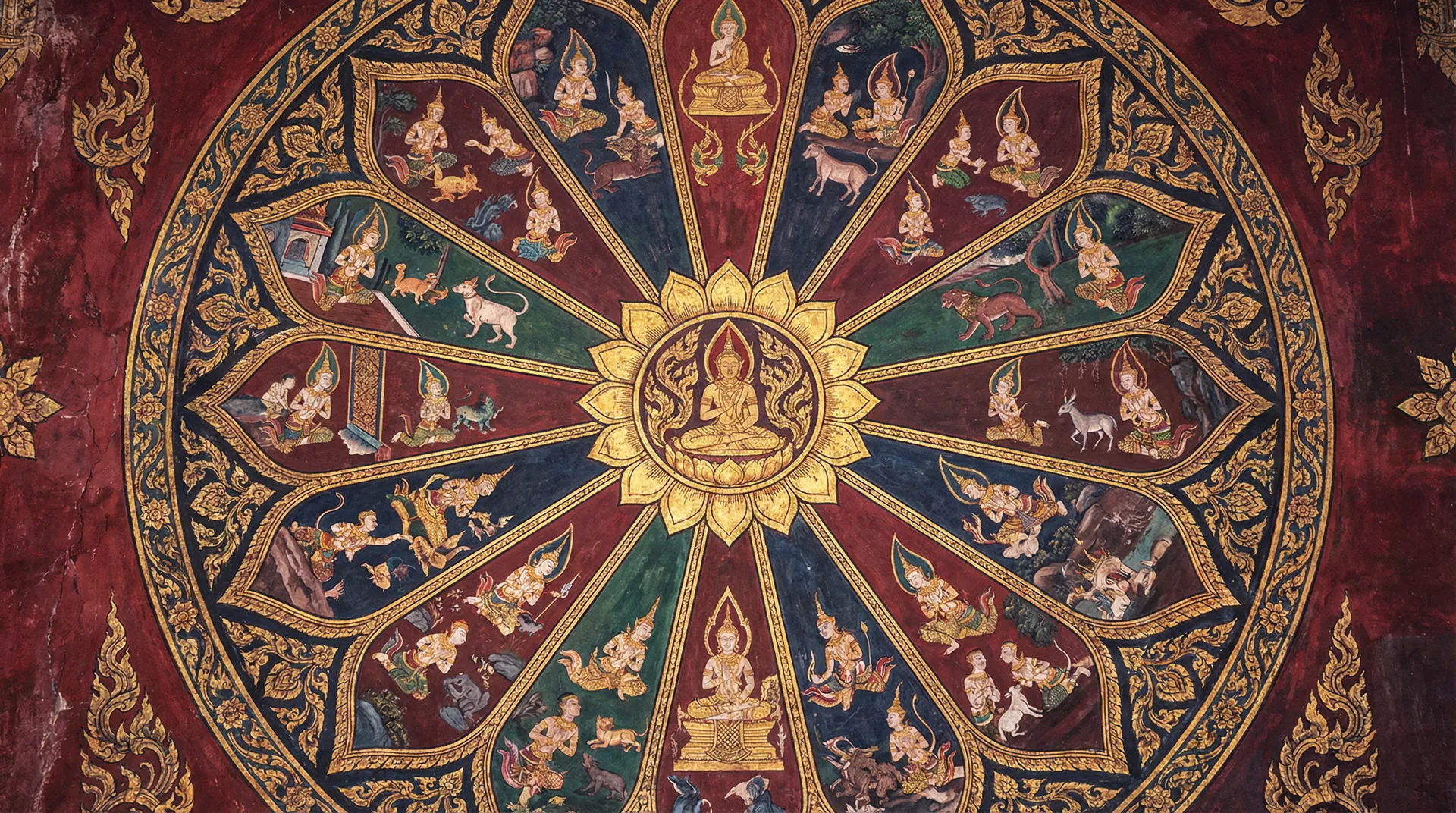
Bhuri Datta Jataka
The Serpent Prince's Noble Deeds
In the ancient kingdom of Kampila, nestled beside the mystical Himalayas, there lived a benevolent king named Bodhisattva. Unbeknownst to his subjects, the king was, in fact, a Nāga (serpent) prince, who had taken human form to experience life among mortals and to fulfill his spiritual aspirations. He was known for his wisdom, his compassion, and his unwavering adherence to the principles of righteousness.
One day, a powerful and wicked sorcerer, envious of the king’s virtue and his people’s prosperity, plotted to capture him. This sorcerer, skilled in dark arts, desired to harness the Nāga prince’s immense power for his own malevolent purposes. He concocted a potent sleeping potion, intending to drug the king and drag him back to the underworld of the Nāgas, where he could exploit his abilities.
The sorcerer, disguised as a humble Brahmin, approached the king while he was meditating in his royal gardens. He offered the king a special drink, claiming it was a sacred elixir that would enhance his spiritual focus. The unsuspecting king, ever trusting and mindful of the supposed sanctity of a Brahmin, accepted the drink and consumed it. As expected, the potent potion took effect, and the king fell into a deep, enchanted slumber.
The sorcerer, gleeful at his success, immediately began to perform his dark rituals, chanting incantations to transport the sleeping king. However, the king, though under the spell, was a Nāga prince of immense spiritual merit. His inherent purity and the good karma he had accumulated throughout his lives resisted the sorcerer's dark magic. The enchantment wavered, and the king began to stir.
As the king started to awaken, the sorcerer grew desperate. He intensified his chanting, but the Nāga prince’s innate power proved too strong. The sorcerer’s own dark magic began to backfire, ensnaring him instead. He found himself bound by his own spells, unable to move or escape, his body transforming into a giant, grotesque toad.
The king, now fully awake and seeing the sorcerer transformed into a toad, understood what had transpired. He saw the wickedness of the sorcerer’s intent and the power of his own virtue. Instead of retaliating with anger or punishment, the Nāga prince, guided by compassion, approached the trapped sorcerer.
'You sought to capture me,' the king said, his voice calm and resonant, 'but your own greed and malice have ensnared you. You have tasted the bitter fruit of your own actions.' He then used his spiritual power, not to harm, but to break the sorcerer’s self-inflicted curse, freeing him from his toad-like form.
However, the king did not let the sorcerer go without a lesson. He decreed that the sorcerer must now dedicate his life to repentance and good deeds, using his knowledge of the arts for the benefit of others, not for destruction. The sorcerer, humbled and ashamed by the king’s immense compassion and forgiveness, readily agreed. He renounced his wicked ways and spent the remainder of his days performing acts of kindness and service.
The Nāga prince, having thwarted the sorcerer’s plot and demonstrated the power of virtue and compassion, continued to rule Kampila with wisdom and justice. He showed his people that true strength lies not in power or conquest, but in righteousness, selflessness, and the ability to forgive even those who wish to do us harm. His reign was marked by peace and prosperity, a testament to the noble deeds of the serpent prince who walked among men.
— In-Article Ad —
💡Moral of the Story
True strength lies in virtue, compassion, and the ability to forgive. Malice and greed ultimately lead to one's own downfall.
Perfection: Compassion, Truthfulness, Wisdom
— Ad Space (728x90) —
More Jataka Tales You May Enjoy
 487Pakiṇṇakanipāta
Sutasoma Jātaka
Sutasoma JātakaIn the heart of the ancient kingdom of Kampilya, a kingdom famed for its magnificent ...
💡 True strength lies not in violence or the taking of life, but in unwavering compassion, understanding, and the courage to break cycles of suffering through acts of profound kindness and non-violence.
 112Ekanipāta
Mūga-Pakkhaya Jātaka
Mūga-Pakkhaya Jātaka In the ancient city of Mithila, renowned for its scholars and philosophers, liv...
💡 True understanding comes from listening more than speaking. Selfless sacrifice, even of something deeply cherished, can lead to profound healing and growth.
63EkanipātaThe Bodhisatta and the Self-Sacrificing Monk
The Bodhisatta and the Self-Sacrificing Monk In the verdant kingdom of Mithila, where palaces of po...
💡 Sharing and helping others brings true happiness. Greed and stinginess are the source of suffering.
 267Tikanipāta
Daddabha Jataka
Daddabha JatakaLong ago, in the kingdom of Kasi, where verdant plains met the shimmering waters of t...
💡 True loyalty is revealed through consistent actions for the good of others, and a discerning mind is crucial to uncovering deception and preventing internal strife.
265TikanipātaMahapothada Jataka
Mahapothada JatakaIn the ancient kingdom of Videha, nestled amidst fertile plains and rolling hills,...
💡 Unwavering patience and profound compassion have the power to transform even the most hardened individuals. True strength lies not in violence, but in empathy and the courage to offer understanding.
 248Dukanipāta
Katthahari Jataka
Katthahari JatakaIn the bustling city of Savatthi, there lived a woodcutter named Katthahari. He was...
💡 Selfless compassion, even towards the smallest creatures and when faced with personal temptation, is a virtue that brings great rewards and blessings.
— Multiplex Ad —