Nimi Jataka
The King Who Dreamt of Heaven
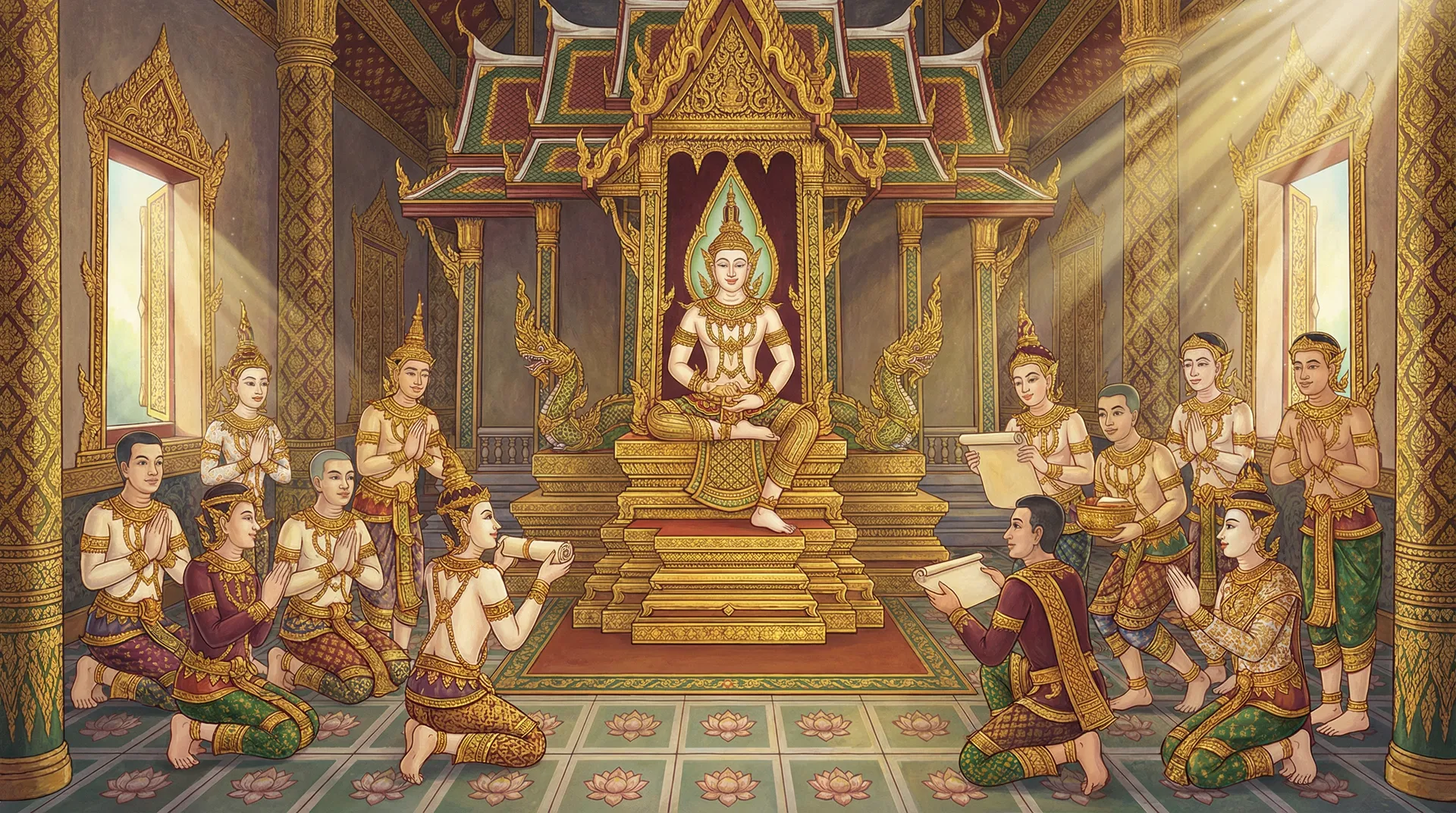
In the prosperous kingdom of Mithila, there reigned a virtuous and just king named Nimi. King Nimi was known throughout the land for his piety, his unwavering adherence to the moral precepts, and his deep devotion to the welfare of his subjects. He ruled with fairness and compassion, and his kingdom flourished under his wise guidance. Yet, despite his earthly accomplishments, King Nimi harbored a secret yearning, a desire to witness firsthand the celestial realms he had heard of in scriptures and tales.
One night, King Nimi had a most vivid dream. He found himself soaring through the starry expanse, his body light as a feather. He traveled further and further, beyond the clouds, beyond the reach of mortal eyes, until he arrived at the glorious gates of a heavenly abode. The air was filled with celestial music, and the light that emanated from within was more brilliant than a thousand suns. He saw beings of ethereal beauty, adorned in radiant garments, their faces beaming with joy and serenity.
He was greeted by heavenly guardians who, recognizing the purity of his heart, invited him in. King Nimi spent what felt like an eternity in this celestial paradise. He witnessed the blissful existence of the gods, the endless joy, and the profound peace that permeated the realm. He saw beings enjoying the fruits of their past good deeds, living in a state of utter contentment. He walked through gardens of unimaginable beauty, where flowers bloomed with divine fragrances, and crystal streams flowed with nectar.
The dream was so real, so intoxicating, that King Nimi was reluctant to awaken. He felt a profound sense of longing, a desire to remain in this heavenly realm forever. He engaged in conversations with the celestial beings, learning about their lives, their joys, and the principles that governed their existence. He saw that their happiness stemmed from their past virtuous actions, their generosity, and their devotion to righteousness.
As the dream began to fade, a heavenly architect, sensing the King's deep admiration and his desire to understand the mechanics of heaven, approached him. "Your Majesty," the architect's voice resonated like gentle chimes, "you admire our realm and its bliss. This happiness is earned through merit. If you wish to comprehend the path to such realms, you must cultivate the same virtues in your own life."
The architect then presented King Nimi with a vision. He showed him how to construct a grand palace, a reflection of the celestial mansions, but built with the principles of generosity and righteousness as its foundation. He instructed the King to offer grand feasts and acts of charity, not for personal glory, but as a genuine expression of compassion and merit-making. He told the King to invite virtuous ascetics and to offer them comfort and sustenance, thus earning merit that would lead to heavenly rebirths.
King Nimi awoke with a start, the celestial music still echoing in his ears and the vision of heaven imprinted on his mind. He was no longer content with his earthly kingdom alone. His heart was filled with an overwhelming desire to create a life that would lead him back to that heavenly realm. He immediately summoned his most trusted advisors and architects. He recounted his dream, not as a mere fantasy, but as a divine revelation.
He commanded them to build a magnificent palace, not just for his own residence, but as a sanctuary for acts of merit. He instructed that it be adorned with symbols of righteousness and that its halls be open to all who sought solace or assistance. He decreed that grand feasts of charity be held regularly, inviting not only learned scholars and ascetics but also the poor and needy of his kingdom. He personally oversaw these charitable activities, his actions guided by the memory of his heavenly dream.
King Nimi dedicated his reign to embodying the virtues he had witnessed in heaven. He practiced unwavering generosity, spoke only truthful and kind words, and lived a life of profound ethical discipline. He ensured that justice prevailed in his kingdom and that every subject was treated with respect and compassion. His earthly reign became a reflection of the heavenly realm he so deeply admired.
His subjects prospered, not just materially, but spiritually, inspired by their king's devotion. When his time came to pass from this earthly life, King Nimi did not face death with fear, but with eager anticipation. His virtuous deeds had paved the way, and he was reborn into the very celestial realm he had dreamt of, his heart filled with eternal joy and peace, a testament to his unwavering aspiration and righteous conduct.
— In-Article Ad —
💡Moral of the Story
Virtuous actions, unwavering generosity, and a life dedicated to righteousness pave the path to heavenly realms and lasting peace. Aspirations for higher existence should be pursued through diligent merit-making.
Perfection: Generosity (Dana), Morality (Sila), Patience (Khanti)
— Ad Space (728x90) —
More Jataka Tales You May Enjoy
 36Ekanipāta
The Tale of the Horse-Breeder
In a past aeon, in the flourishing city of Varanasi, the Bodhisatta was born as a young Brahmin, end...
💡 The highest form of virtue is selfless compassion, willing to sacrifice for the well-being of others.
 179Dukanipāta
Mahāpuṇṇa Jātaka
Mahāpuṇṇa JātakaIn the heart of the kingdom of Kasi, a land blessed with fertile soil and a prospero...
💡 By consciously pausing and reflecting when anger arises, one can gain control over impulsive reactions, leading to wiser decisions, improved relationships, and inner peace. Cultivating patience and understanding is a path to great merit.
 521Mahānipāta
Mugapakkha Jataka
Mugapakkha JatakaIn the ancient kingdom of Mithila, nestled beside the roaring Gandaki River, lived ...
💡 True healing and redemption are found not just in seeking cures for oneself, but in performing selfless acts of compassion and atonement for past wrongs, thereby restoring balance to both the body and the spirit.
108EkanipātaKacchapa Jataka
The Tale of the Wise Tortoise and the Foolish Fishermen In a lush, verdant forest, far from the clam...
💡 Respect the natural world and its resources. Greed that depletes without thought for replenishment leads to ruin and loss.
58EkanipātaThe Great Ocean Jataka
In a land of bountiful shores, where the vast sea met fertile lands, there lay a small fishing villa...
💡 True wealth is found in generosity and compassion, not in material possessions. Greed blinds the mind and leads to self-destruction.
155DukanipātaMahājanaka Jātaka
Mahājanaka JātakaIn the glorious kingdom of Mithila, there once lived a prince named Mahājanaka. He ...
💡 True strength lies not in resisting the inevitable, but in accepting what cannot be changed with equanimity and maintaining one's principles regardless of circumstances.
— Multiplex Ad —