Temiya Jataka
The Prince Who Found Joy in Stillness
In the ancient city of Ujjeni, amidst the grandeur of a royal palace, lived a prince named Temiya. He was the son of a virtuous king and a queen of unparalleled beauty, destined for a life of power and privilege. Yet, from the moment he was born, Prince Temiya was different. While other children delighted in games and laughter, Temiya found no joy in the material world. He was born with a profound sense of detachment, an unshakeable awareness of the impermanence of all things.
As he grew, his disinterest in worldly pursuits became more pronounced. He showed no inclination towards martial arts, no desire for wealth, and no interest in the affairs of the kingdom. His parents, the king and queen, were deeply perplexed and saddened by their son's peculiar disposition. They consulted learned scholars, renowned physicians, and wise ascetics, all of whom were baffled by the prince's profound indifference to the life he was meant to lead.
"He is a prince," the king would lament, his voice heavy with worry. "He has a kingdom to rule, people to lead. How can he be so unmoved by it all?"
The queen, her heart aching, would often whisper, "Perhaps he is ill. Perhaps his mind is not like ours."
Despite their efforts, Temiya remained steadfast in his quiet contemplation. He spent his days observing the world around him with a keen, yet serene, intellect. He saw the fleeting nature of youth, the inevitable decay of beauty, the rise and fall of power, and the ultimate sorrow that accompanied attachment to these transient phenomena. This understanding did not bring him despair, but a deep sense of peace, a realization that true happiness lay beyond the superficialities of existence.
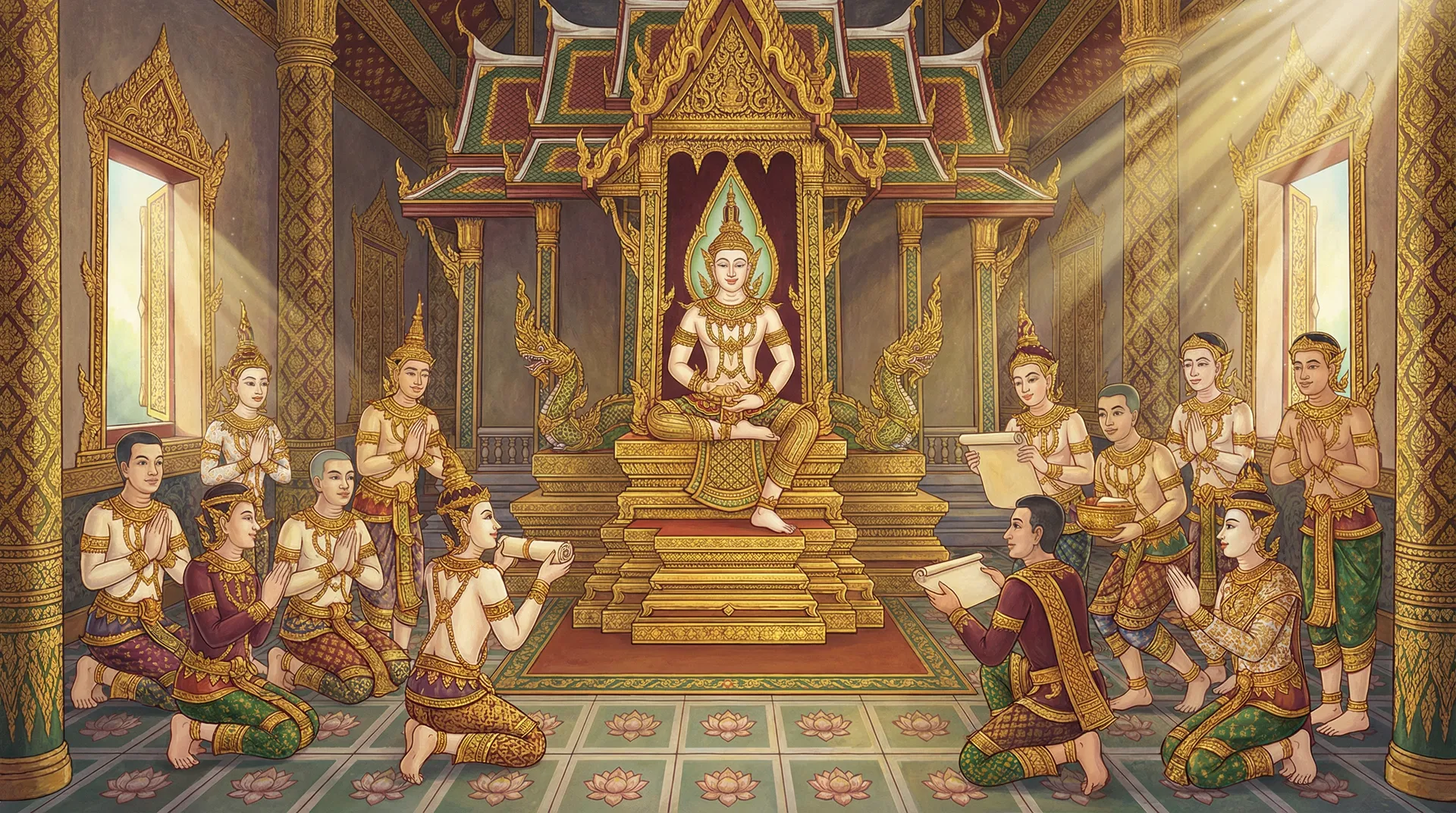
When Temiya reached the age of sixteen, the king, desperate to awaken his son's interest in worldly life, decided to perform a grand coronation ceremony. He believed that the pomp and ceremony, the acclamation of the people, would surely stir something within the prince. The city was adorned with banners and flowers, the streets filled with jubilant crowds, and the air resonated with music and cheers.
As Temiya was about to be formally crowned, surrounded by the dazzling spectacle of his impending reign, he looked out at the faces of the people. He saw their hopes, their fears, their transient joys and sorrows. And in that moment, his understanding of impermanence became absolute. He realized that all this – the power, the glory, the adulation – was but a fleeting dream. His heart yearned for a peace that could not be disturbed by the changing tides of fortune.
With a calmness that belied the shock he was about to deliver, Prince Temiya stood up. He turned to his bewildered parents and the stunned assembly and spoke, his voice clear and steady. "Father, Mother, esteemed subjects," he began, "I cannot accept this crown. I cannot embrace a life that is bound by the illusion of permanence. My heart seeks a different path, a path of true liberation from suffering."
Before anyone could react, Temiya walked away from the throne, from the assembled crowd, and from the life that had been meticulously planned for him. He did not run, nor did he show any sign of haste. He simply walked with deliberate steps, his gaze fixed on the horizon, seeking the stillness he craved.
The king and queen were devastated. The court was thrown into chaos. Yet, Temiya's departure, though shocking, was not an act of rebellion or despair. It was an act of profound self-realization, a courageous choice to follow the dictates of his inner truth.
Temiya wandered through forests and mountains, living a life of extreme simplicity, meditating and contemplating the nature of reality. He found immense joy in the silence of nature, in the absence of worldly desires. His detachment, which had once seemed like a affliction, was now his greatest liberation. He understood that true freedom came not from possessing the world, but from being free from the need to possess it.
Years later, the king, having mourned his son's departure but eventually coming to understand his profound wisdom, sought him out. He found Temiya living a life of pure contentment, his face serene and radiant. The king, humbled by his son's enlightenment, finally understood that Temiya's path, though unconventional, was one of true spiritual wealth. He realized that Temiya, by renouncing the superficial, had found a deeper, more enduring form of happiness and wisdom.
Temiya, though he never returned to claim his throne, became a beacon of spiritual insight, his life a testament to the fact that true joy and fulfillment are found not in worldly achievements, but in the profound stillness of a detached and awakened mind.
— In-Article Ad —
💡Moral of the Story
True happiness and liberation are found in detachment from worldly possessions and transient pleasures. Understanding the impermanence of all things leads to inner peace and freedom from suffering.
Perfection: Renunciation (Nekkhamma) and Wisdom (Paññā)
— Ad Space (728x90) —
More Jataka Tales You May Enjoy
 304Catukkanipāta
Mahasattva Jataka
Mahasattva JatakaIn the heart of the Himalayas, where snow-capped peaks touched the heavens and anci...
💡 True compassion involves selfless sacrifice for the well-being of others, even at the cost of one's own life. The greatest strength lies in the willingness to give.
 143Ekanipāta
Sasa Jataka
The Tale of the Hare Who Gave Himself to the Gods In a time long past, when the Bodhisattva was born...
💡 Selfless sacrifice and compassion for all beings are the highest virtues.
13EkanipātaThe Steadfast Brahmin
The Steadfast BrahminIn the ancient city of Varanasi, a beacon of spiritual learning, lived a devout...
💡 Unwavering steadfastness and a pure heart can inspire others and lead to rebuilding.
106EkanipātaBhaddasala Jataka
The Tale of the Wise Elephant and the Foolish King In the ancient kingdom of Mithila, ruled a king n...
💡 True wisdom often comes from unexpected sources. A leader's true strength is shown not in anger or pride, but in humility, compassion, and the willingness to serve their people.
115EkanipātaMittavindaka Jātaka
Mittavindaka Jātaka In the bustling city of Savatthi, there lived a wealthy merchant named Mittavind...
💡 Extreme stinginess leads to isolation, regret, and a life devoid of true happiness. Generosity and compassion are the real treasures that enrich life.
67EkanipātaThe Bodhisatta's Compassion for His Foes
In the glorious city of Rājagaha, the capital of Magadha, in an age when kingdoms were often rife wi...
💡 True strength is a combination of physical power, wisdom, and restraint. It is important to protect oneself and one's domain, but to do so without unnecessary violence.
— Multiplex Ad —