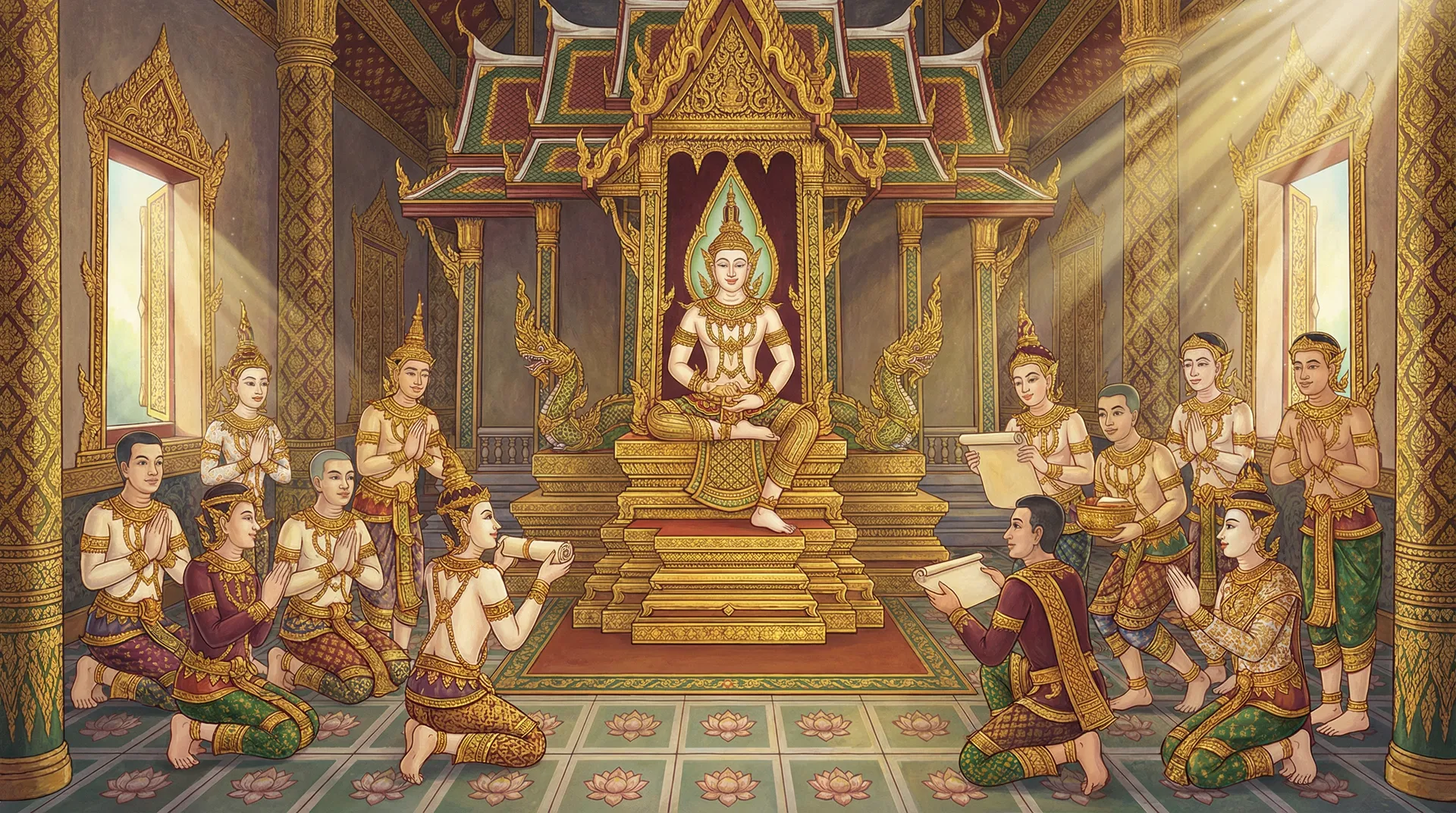
Nemi Jataka
The Bodhisatta as King Nemi, The Righteous Ruler
In the ancient city of Mithila, there reigned a king named Nemi, a monarch whose virtue shone as brightly as the morning sun. He was a wise and just ruler, deeply devoted to his people, and his reign was marked by unparalleled peace and prosperity. King Nemi was not merely a king; he was a Bodhisatta, one who was on the path to Buddhahood, dedicated to cultivating the highest virtues for the benefit of all beings.
One celestial day, the great god Sakka, ruler of the heavens, observed King Nemi's exceptional righteousness. Impressed by the king's unwavering adherence to the Dhamma, Sakka decided to bestow upon him a divine gift. He sent his celestial chariot, drawn by magnificent horses, to the earthly realm to transport King Nemi to the heavenly abode of Tavatimsa for a visit, so that the king might witness the fruits of his own virtuous deeds.
As the celestial chariot descended, King Nemi, with his profound understanding, recognized its divine origin. He greeted the heavenly messenger with reverence and, without hesitation, ascended into the chariot. The chariot ascended into the heavens, leaving the earthly kingdom in the care of trusted ministers. King Nemi, a Bodhisatta embodying wisdom and compassion, was eager to see the results of a life lived in accordance with the Dhamma.
Upon arriving in Tavatimsa, King Nemi was greeted with great honor and wonder. He was shown the magnificent palaces, the celestial gardens, and the joyous beings who resided there. Sakka, the king of gods, personally guided him, explaining how the merits earned through virtuous actions in countless past lives had led to such blissful existence. King Nemi witnessed firsthand the rewards of generosity, ethical conduct, mindfulness, and wisdom.
However, Sakka also showed King Nemi the unfortunate fate of those who had lived lives of greed, hatred, and delusion. He was shown the realms of suffering, the places where beings endured immense pain as a consequence of their unwholesome actions. This stark contrast between the realms of bliss and suffering deeply affected King Nemi. He saw the direct correlation between actions and their consequences, the inescapable law of karma.
Sakka then presented King Nemi with a profound choice. He explained that he could choose to remain in the heavens, enjoying the fruits of his accumulated merit, or he could choose to return to his earthly kingdom, knowing the profound truths he had witnessed. He showed King Nemi two paths: one leading to eternal bliss in heaven, and another, a path of thorns and suffering, which represented the path back to the human realm, a path he would have to traverse to continue his journey towards enlightenment and to guide others.
King Nemi, the Bodhisatta, did not hesitate. Though the heavenly realm offered unparalleled pleasure, his compassionate heart yearned to alleviate the suffering he had witnessed. He understood that his purpose was not to seek personal comfort, but to guide others towards liberation. He chose the thorny path, the path of return, knowing that it would be fraught with difficulties, but also knowing that it was the path of true compassion and selfless service.
"I choose to return to the human realm," King Nemi declared, his voice filled with unwavering resolve. "For it is there that beings suffer the most, and it is there that my efforts can bring the greatest benefit. I wish to share the Dhamma, to teach the path of virtue and wisdom, so that others may also escape the cycle of suffering and attain liberation."
Sakka, deeply moved by the Bodhisatta's selfless choice, commended his profound compassion. He then instructed his charioteer to guide King Nemi back to his kingdom. As the celestial chariot began its descent, Sakka gave King Nemi a parting gift: a divine bell. When rung, this bell would resonate with the sounds of the Dhamma, reminding all beings of the importance of virtue and the consequences of their actions.
Upon returning to Mithila, King Nemi was not the same king who had ascended into the heavens. He was now filled with an even deeper wisdom and a greater compassion. He ruled his kingdom with renewed vigor, his every action guided by the profound insights he had gained. He often rang the divine bell, its ethereal sound echoing throughout the land, reminding his people to cultivate merit, to live ethically, and to strive for spiritual liberation. His reign became a golden era, a testament to the power of a ruler who embodied righteousness and compassion, a Bodhisatta dedicated to the welfare of all sentient beings.
— In-Article Ad —
💡Moral of the Story
True fulfillment comes from selfless service and compassion, not from personal comfort or heavenly pleasures. The law of karma is absolute, and our actions in this life determine our future destinies.
Perfection: Generosity (Dāna), Ethical Conduct (Sīla), Wisdom (Paññā), and Renunciation (Nekkhamma)
— Ad Space (728x90) —
More Jataka Tales You May Enjoy
 530Mahānipāta
Samyuttakapālajātaka
The Tale of the Broken Pot In the heart of a vibrant city, known for its skilled artisans and bustli...
💡 Anger can be destructive, preventing us from seeing new possibilities. When faced with setbacks and brokenness, it is important to manage our anger, adapt, and look for new ways to create and find beauty.
 256Tikanipāta
Kaccābarāva Jātaka
Kaccābarāva JātakaIn the ancient land of Mithila, where rivers flowed like silver ribbons and forest...
💡 The greatest strength lies in selfless sacrifice for the well-being of others.
 145Ekanipāta
Mahosadha Jataka
The Tale of Mahosadha, the Wisest of All In the ancient city of Mithila, under the reign of King Ved...
💡 Profound wisdom, applied with compassion and foresight, can bring peace, prosperity, and justice to a kingdom and its people.
 163Dukanipāta
Maha-Ummagga Jataka
The Great Wisdom of Prince Vessantara (The King of Wisdom)In the magnificent city of Jetuttara, rule...
💡 True generosity lies in selfless giving, not for recognition or reward, but for the alleviation of suffering and the pursuit of peace. Wisdom is found in understanding the impermanence of possessions and transcending attachment.
179DukanipātaMahāpuṇṇa Jātaka
Mahāpuṇṇa JātakaIn the heart of the kingdom of Kasi, a land blessed with fertile soil and a prospero...
💡 By consciously pausing and reflecting when anger arises, one can gain control over impulsive reactions, leading to wiser decisions, improved relationships, and inner peace. Cultivating patience and understanding is a path to great merit.
148EkanipātaMahasutasoma Jataka
Mahasutasoma JatakaIn the magnificent city of Indapatta, ruled a king named Pothila, whose reign was...
💡 True strength lies not in retaliation or aggression, but in unwavering adherence to non-violence, wisdom, and mercy, which can transform enemies into allies and overcome evil with good.
— Multiplex Ad —