
The Bodhisatta as the Wise King of Varanasi
The Bodhisatta as the Wise King of Varanasi
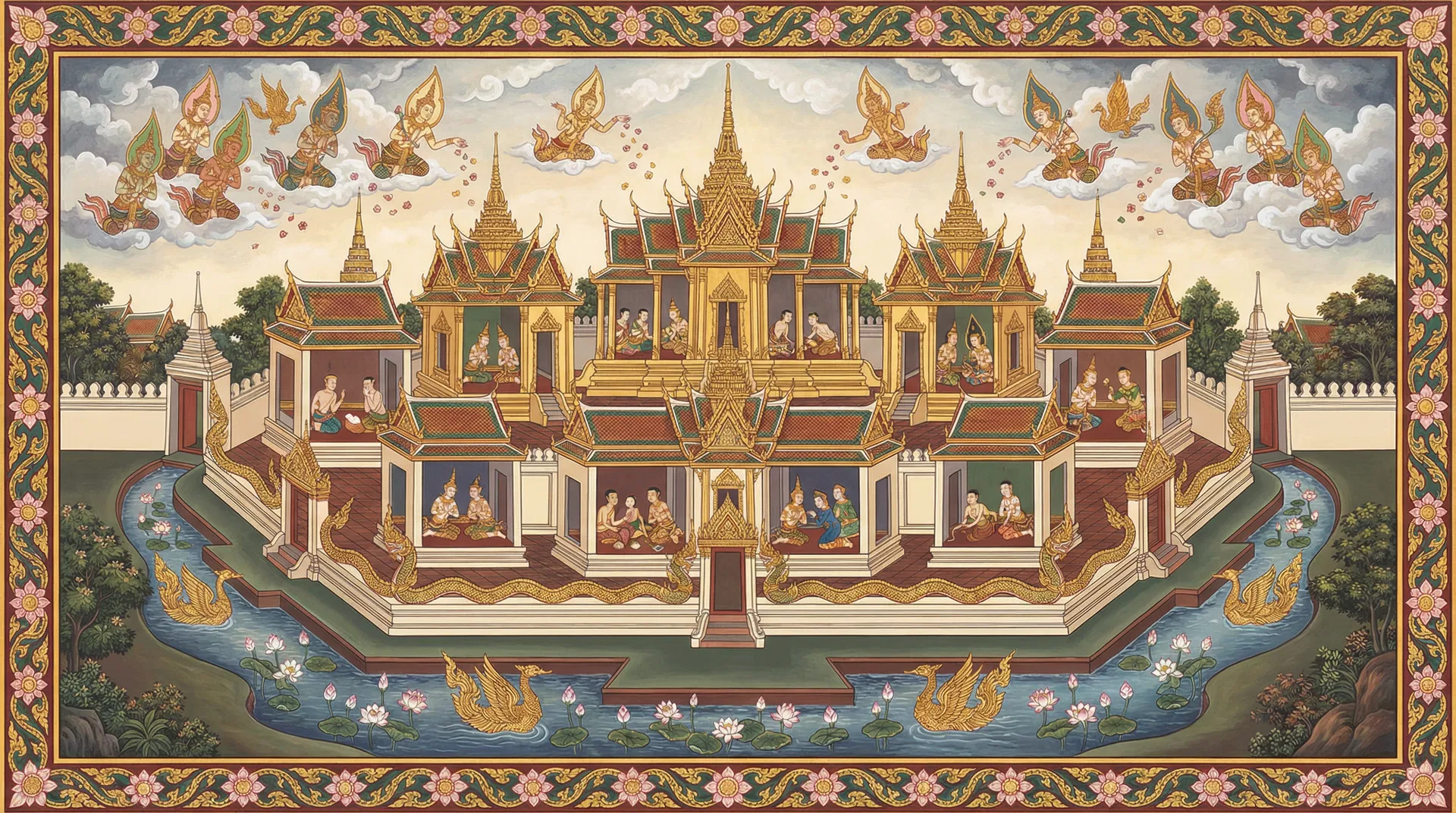
In the magnificent city of Varanasi, a beacon of prosperity and culture, reigned King Brahmadatta. This was the Bodhisatta, a monarch whose wisdom was as profound as his compassion was boundless. His reign was a golden age, marked by justice, fairness, and an unwavering commitment to the well-being of his people. His palace, adorned with precious gems, was a symbol of his kingdom's wealth, but it was his discerning judgment and his deep understanding of human nature that truly made his rule legendary. The city itself was a vibrant hub of activity, its markets overflowing with exotic goods, its temples echoing with chants, and its people living in peace and contentment under his benevolent gaze. The air was alive with the scent of incense and the cheerful chatter of everyday life.
One day, a dispute arose between two wealthy merchants of the city. One accused the other of cheating him in a lucrative trade deal, claiming a large sum of money was owed. The accused merchant vehemently denied the accusation, and the situation escalated, threatening to disrupt the city's harmony. Both merchants, their pride wounded and their fortunes at stake, demanded the king's judgment.
The king, Brahmadatta, summoned both merchants to his royal court. The hall was filled with the expectant silence of the courtiers, the air thick with anticipation. The accuser, a portly man with a florid face, presented his case with fiery rhetoric, his voice booming with indignation. "Your Majesty! This scoundrel has defrauded me! He owes me a thousand gold coins, and he refuses to pay!"
The accused merchant, a leaner, more calculating man, countered with equal vehemence. "It is a lie, Your Majesty! I have never owed him a single coin. He is simply trying to extort money from me!"
The king listened intently to both sides, his brow furrowed in thought. He saw the anger and the pride etched on their faces, the conviction in their voices, but he also sensed the underlying currents of deception. He knew that a hasty judgment could lead to further injustice.
He then posed a question, not to the merchants directly, but to the entire court. "If a man claims he has been robbed of a treasure," the Bodhisatta asked, his voice calm and measured, "what is the first thing he would do to prove his loss?"
The courtiers, accustomed to the king's insightful queries, pondered his words. Some offered various suggestions: he would report it to the guards, he would search for the thief, he would lament his misfortune.
The king, however, patiently waited. Then, he turned his gaze back to the accuser and said, "You claim you were owed a thousand gold coins. Tell me, if you were truly cheated, where are the traces of this transaction? What evidence do you possess?"
The accuser, taken aback by the question, stammered, "I... I have no evidence, Your Majesty. But I know it is true!"
The Bodhisatta then addressed the accused merchant. "And you," he said, his gaze steady, "you deny owing any money. Have you kept records of your dealings with this man?"
The accused merchant, a flicker of unease crossing his face, replied, "I... I conduct my business in good faith, Your Majesty. Such meticulous records are not always kept for every small transaction."
The king then delivered his judgment. "You both claim a dispute over a thousand gold coins, yet neither of you can provide any concrete evidence of this transaction, nor its absence. This suggests that the alleged debt is not a matter of fact, but of contention born of pride and greed. Therefore, I decree that neither of you shall receive the sum in question."
He continued, his voice resonating with authority, "Instead, you will each contribute five hundred gold coins to the royal treasury. These funds will be used to provide education for the children of Varanasi, ensuring they grow up with the knowledge and wisdom to avoid such disputes in the future. Let this be a lesson to you both: true wealth lies not in accumulating gold, but in cultivating understanding and contributing to the common good."
The merchants, though initially disappointed at not winning their case, could not argue with the king's logic. They saw the wisdom in his decree and the potential for positive impact. They paid their contributions, their hearts humbled by the experience. The courtiers marveled at the king's astuteness, his ability to see through the facade of their arguments and deliver a judgment that served the greater good.
From that day forward, the story of King Brahmadatta's wise judgment became a legend in Varanasi. It served as a reminder that true wisdom lies in discerning the truth, not in succumbing to pride or emotion, and that the greatest rulers are those who prioritize the well-being and education of their people above all else. The kingdom flourished, its citizens living in a society guided by the principles of fairness and wisdom that their Bodhisatta king so consistently embodied.
— In-Article Ad —
💡Moral of the Story
True wisdom lies in discerning truth beyond superficial claims, and in using resources for the common good, fostering education and understanding.
Perfection: Wisdom
— Ad Space (728x90) —
More Jataka Tales You May Enjoy
 506Pakiṇṇakanipāta
Mugapakkha Jataka
The Tale of the Mute PrinceIn the ancient kingdom of Mithila, ruled a wise and benevolent king. His ...
💡 True strength and leadership are not defined by eloquent speech alone, but by courage, wisdom, and unwavering determination in the face of adversity. Inner qualities shine brighter than outward appearances.
 451Dasakanipāta
Mahā-Ummagga Jātaka
The Great Tunnel Jātaka (Mahā-Ummagga Jātaka) In the ancient city of Mithila, ruled a wise and benev...
💡 True wisdom lies not only in skill but in understanding intentions and acting with righteousness. Deceit and envy ultimately lead to ruin, while integrity and foresight ensure security.
 478Terasanipāta
Titthira Jataka
Titthira Jataka In the verdant kingdom of Kosala, nestled beside the gentle flow of the Sarayu River...
💡 The truth, though sometimes difficult to speak or to hear, ultimately prevails and exposes the destructive consequences of greed and dishonesty.
 426Aṭṭhakanipāta
Mugapakkha Jataka
The Tale of the Muzzled Ox In the ancient city of Mithila, nestled amidst lush gardens and bustling ...
💡 True salvation comes not from superstitious rituals or sacrifices, but from cultivating wisdom, compassion, and living in harmony with the natural world. Our actions, our understanding, and our respect for life are what truly bring about prosperity and balance.
 445Dasakanipāta
Temiyavada Jataka
Temiyavada JatakaIn the kingdom of Supparaka, there was a prince named Temiya. From the moment of hi...
💡 True freedom and peace are found not in worldly possessions or status, but in detachment from suffering and the dedicated pursuit of spiritual liberation.
 468Dvādasanipāta
Mugapakkha Jataka
Mugapakkha JatakaIn the ancient kingdom of Kosala, under the benevolent gaze of a king who ruled wit...
💡 Selfless sacrifice and boundless compassion are powerful forces that can overcome malice and bring about peace and prosperity.
— Multiplex Ad —