Sama Jataka
The Tale of Prince Sama and the Mother's Love
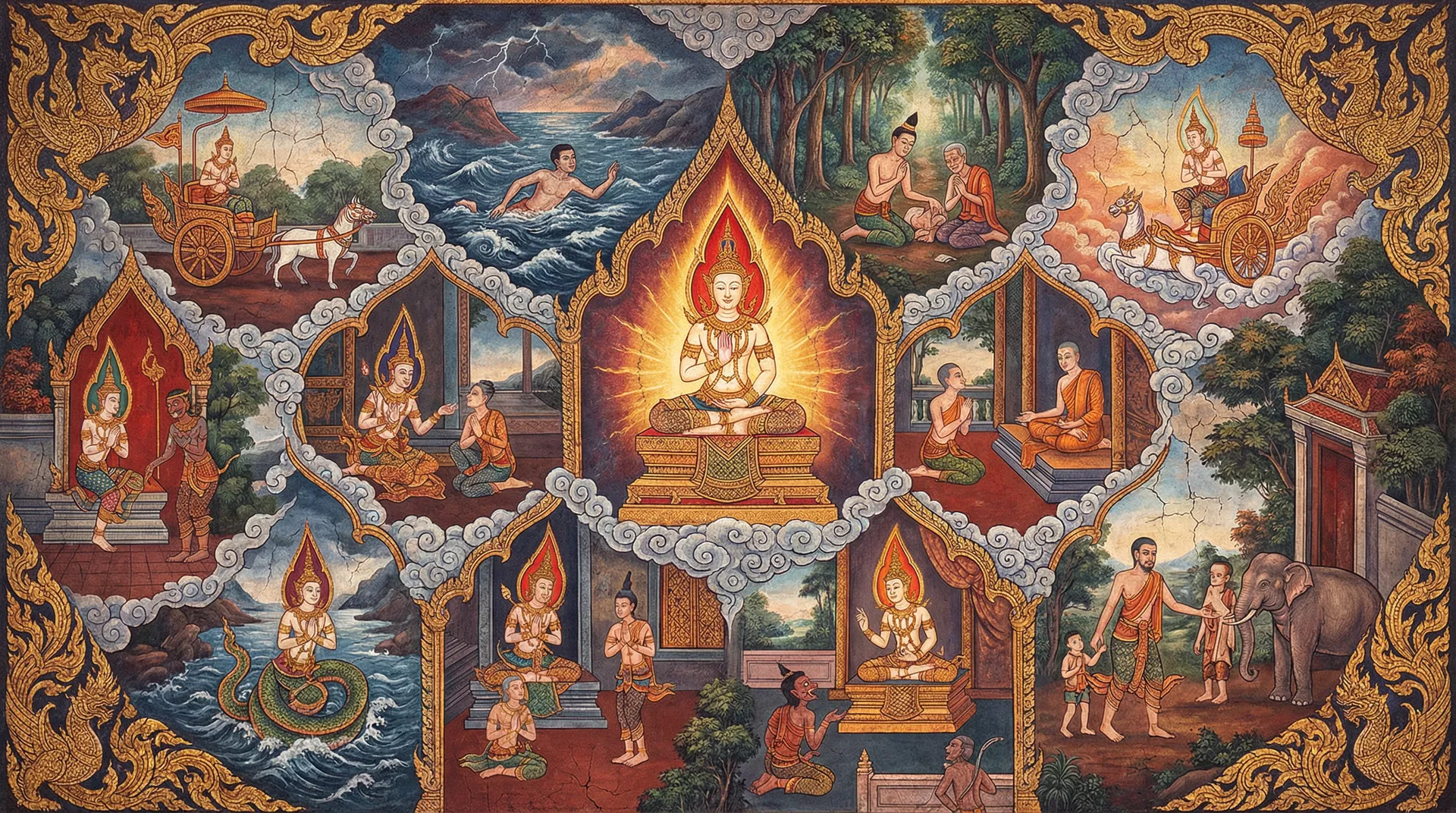
In the ancient kingdom of Kuruksetra, there lived a pious king and queen who, after many years, were blessed with a son named Sama. However, their joy was short-lived. During a royal hunt, the king was mortally wounded by a hunter's arrow, and the queen, grief-stricken, followed him in death shortly thereafter. Young Prince Sama was orphaned, left in the care of his devoted nurse.
As Sama grew, he became increasingly devoted to his blind parents. He understood their plight and dedicated his life to their service. He would venture into the deep forest daily, gathering fruits and roots, fetching water, and tending to their every need. His love for them was absolute, a pure and selfless devotion that filled his young heart.
One day, as Prince Sama was fetching water from the river, he heard the sound of arrows being shot in the forest. It was the king, King Dighavapi, practicing archery. Unbeknownst to Sama, the king had heard tales of the prince's filial piety and had been curious to see him. However, mistaking the prince for a deer or some other creature due to the dense foliage and the prince's humble attire, and perhaps driven by a moment of pride in his own skill, the king loosed an arrow.
The arrow struck Prince Sama, and he fell mortally wounded. As he lay dying, his only thought was of his blind parents. "Who will care for them now?" he lamented, his voice weak.
The king, realizing his terrible mistake, rushed to the scene. He was horrified to see the young prince, whom he had accidentally slain. He saw the devotion in Sama's eyes, the selfless concern for his parents, and was overcome with remorse.
"Young prince," the king stammered, his voice choked with tears, "I am the cause of your suffering. I have committed an unforgivable act. What can I do to atone?"
Sama, with his dying breath, pleaded, "My lord, my parents are blind and helpless. Please, go to them and tell them of my fate. And for their sake, I beg you, bring them water from this river."
The king, humbled and deeply moved by Sama's selfless concern even in his final moments, promised to fulfill his dying wish. He carried the prince's body back to his parents and, with a heavy heart, explained what had happened.
The blind parents, upon hearing of their son's death, were devastated. They wept uncontrollably, their grief inconsolable. The mother cried out, "Oh, my son! If only I had the power to bring you back to life, I would give my own!" The father echoed her sorrow, lamenting the loss of his beloved son.
At that moment, the gods, witnessing the profound love and sacrifice of Prince Sama and the immense grief of his parents, were moved by their devotion. They descended from heaven and, using their divine power, restored Prince Sama to life. They then granted the blind parents the ability to see again, so they could behold their son once more.
The king, witnessing this miracle, was filled with awe and gratitude. He saw the power of true filial piety and the divine intervention that rewarded such selfless love. From that day forward, King Dighavapi dedicated his life to the practice of righteousness and compassion, never forgetting the lesson he learned from Prince Sama.
Prince Sama, restored to life, continued to serve his parents with even greater devotion. The kingdom of Kuruksetra flourished under the king's just rule, inspired by the tale of Sama's unwavering love and the divine grace that followed his selfless act.
— In-Article Ad —
💡Moral of the Story
Unwavering filial piety and selfless devotion are virtues of the highest order, capable of inspiring compassion and even divine intervention. True love transcends personal sacrifice.
Perfection: Truthfulness (Sacca) and Devotion (Anuraga)
— Ad Space (728x90) —
More Jataka Tales You May Enjoy
 496Pakiṇṇakanipāta
Mūgapakkha Jātaka
Mūgapakkha JātakaIn the ancient kingdom of Mithila, nestled amidst lush green hills and crystal-clea...
💡 True wisdom and effective communication can manifest in ways beyond spoken words, such as through actions, illustrations, and deep understanding.
 148Ekanipāta
Mahasutasoma Jataka
Mahasutasoma JatakaIn the magnificent city of Indapatta, ruled a king named Pothila, whose reign was...
💡 True strength lies not in retaliation or aggression, but in unwavering adherence to non-violence, wisdom, and mercy, which can transform enemies into allies and overcome evil with good.
15EkanipātaThe Bodhisatta as a Scholar
The Bodhisatta as a ScholarIn the hallowed halls of an ancient monastery, nestled amidst serene, rol...
💡 True wisdom is demonstrated through the compassionate application of knowledge for the well-being of others.
3EkanipātaThe Bodhisattva and the Golden Deer
The Bodhisattva and the Golden Deer In the ancient kingdom of Mithila, nestled amidst emerald fores...
💡 Selfishness and the failure to help others lead to suffering. When we help others, we receive good in return.
27EkanipātaThe Bodhisatta as a Deer King
The Bodhisatta as a Deer KingIn the heart of a verdant forest, where ancient trees stood sentinel an...
💡 True courage and leadership are demonstrated through selfless sacrifice for the well-being of others.
33EkanipātaThe Bodhisatta as a Brave Lion
The Bodhisatta as a Brave LionIn the heart of a vast and ancient forest, where towering trees formed...
💡 True courage is demonstrated by the willingness to make the ultimate sacrifice for the well-being of others.
— Multiplex Ad —