Mahāsutasoma Jātaka
The Tale of the Great Sutasoma
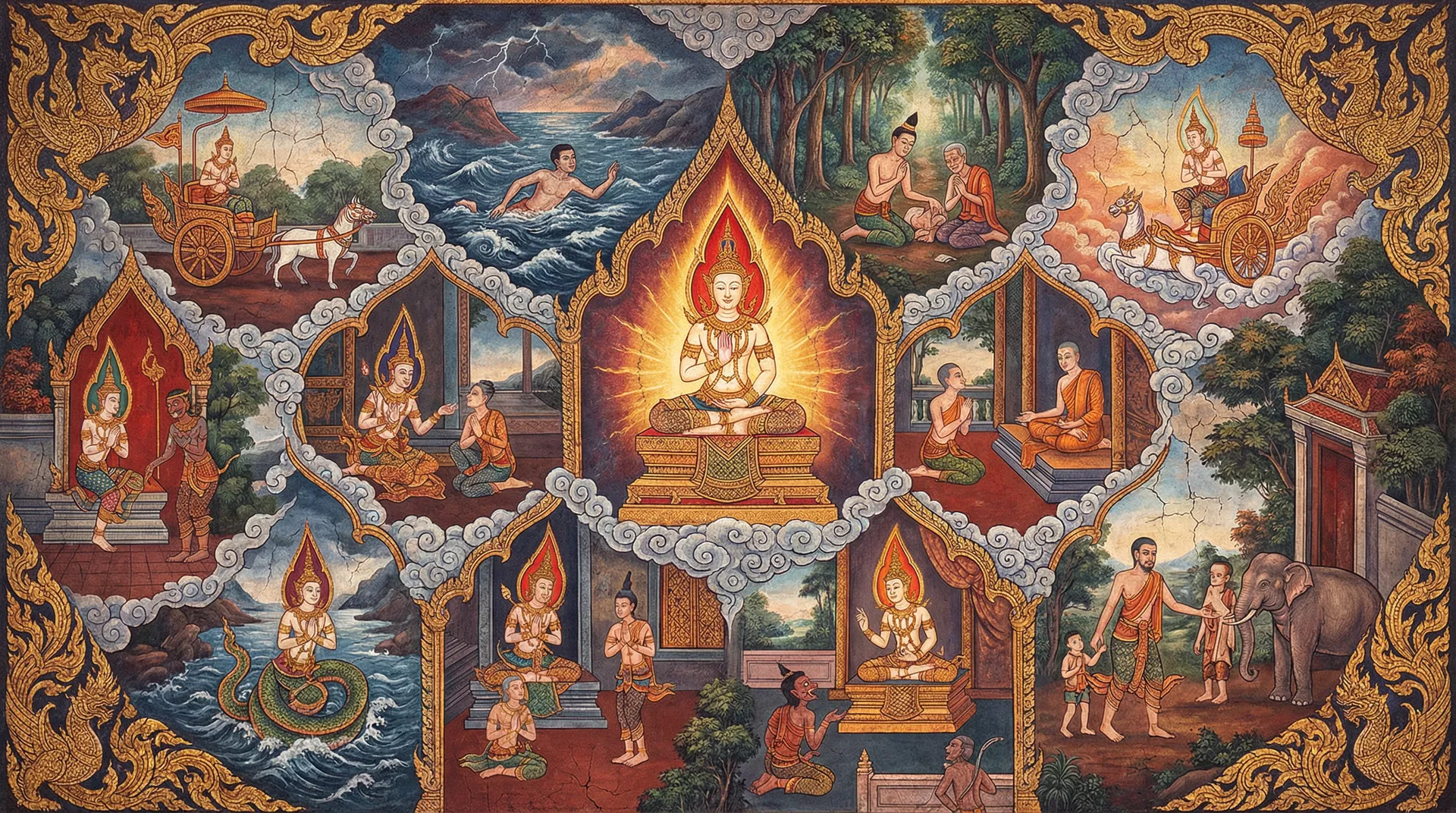
In the city of Indapatta, ruled a wise and just king named Pāṭaliputta. His kingdom flourished, and his reputation for righteousness spread far and wide. He had a son, Prince Sutasoma, who was as virtuous and brave as his father. Prince Sutasoma was known for his unwavering adherence to the truth, even in the face of great adversity. He believed that truth was the highest principle, the foundation upon which all goodness was built.
One day, a terrible drought descended upon the land. The rivers dwindled to trickles, the fields cracked and parched, and the people began to suffer greatly. King Pāṭaliputta, despite his best efforts, could not alleviate the suffering. He performed all the customary rites and made offerings, but the heavens remained stubbornly shut.
Meanwhile, in the dense forest bordering the kingdom, lived a fearsome ogre named Kalmāsa. This ogre was a creature of immense power and insatiable hunger, sustained by the flesh of humans. He possessed a magical chariot that could travel at impossible speeds, and his presence instilled terror in all who knew of him. The ogre’s hunger was particularly keen during times of hardship, and he saw the drought-stricken kingdom as a bountiful hunting ground.
The ogre, in his monstrous form, appeared before King Pāṭaliputta. His voice was a thunderous growl that shook the palace walls. “King Pāṭaliputta,” he boomed, “your kingdom is suffering, and so am I. My hunger is great. I will spare your people if you offer me a daily sacrifice. Bring me one young man or woman, chosen by lot, and I will sustain myself with them, leaving the rest of your subjects unharmed.”
The king was horrified. The thought of sacrificing his own people was unbearable. But the ogre’s threat was dire, and the suffering of his people was already immense. With a heavy heart, King Pāṭaliputta agreed to the ogre’s cruel terms. A lottery was established, and each day, a soul was chosen to face the monstrous Kalmāsa.
The city was plunged into despair. Each dawn brought with it the dread of the lottery, and each dusk saw a family plunged into inconsolable grief. Prince Sutasoma, witnessing the agony of his people, could bear it no longer. He knew he could not stand idly by while innocent lives were sacrificed.
One morning, as the king was preparing to announce the day’s victim, Prince Sutasoma stepped forward. His face was calm, his eyes resolute. “Father,” he declared, his voice clear and steady, “I shall offer myself as the sacrifice.”
King Pāṭaliputta was aghast. “My son! You cannot! You are the heir to the throne, the hope of our kingdom!”
“Father,” Sutasoma replied, “my life is but one. The lives of my people are many. If my sacrifice can bring an end to this suffering, then it is a sacrifice gladly made. Furthermore,” he added, his gaze unwavering, “I have a promise to keep. Many years ago, in my youth, I made a vow to uphold the truth above all else. If I allow innocent people to be sacrificed when I can prevent it, I would be betraying my vow and the very principle of truth.”
Despite his father’s pleas, Prince Sutasoma was resolute. He prepared himself not with fear, but with a sense of solemn duty. He donned simple robes, reflecting his humble acceptance of his fate. He did not carry a weapon, for he intended to face the ogre with truth and righteousness, not with violence.
As the sun began to set, Prince Sutasoma entered the forest and made his way to the place appointed for the sacrifice. He sat beneath a great tree, his back straight, his mind serene. Soon, the ground trembled, and a fearsome roar echoed through the trees. The magical chariot of Kalmāsa appeared, and the ogre himself stood before the prince. He was a terrifying sight, his skin like rough bark, his eyes burning with malevolent hunger.
“So,” the ogre sneered, his voice like grinding stones, “the prince himself has come to be my meal. You are foolish, boy. Do you think your royal blood will make you taste any sweeter?”
Prince Sutasoma looked up at the ogre without a trace of fear. “Ogre Kalmāsa,” he said, his voice calm and clear, “I have come to offer myself. But before you take my life, I have a request. I have lived my life by the principle of truth. I ask you to grant me one boon: that you will not harm another living being after you have consumed me.”
The ogre burst into a roar of laughter. “You jest! You ask me, Kalmāsa the ogre, to give up my sustenance? That is a foolish request indeed! I will devour you, and then I will continue to hunt as I always have!”
“If that is your answer,” Prince Sutasoma said, his voice unwavering, “then I have no choice but to fulfill my vow in another way. You seek to devour me, and I seek to uphold truth. If you are truly a creature of power, then test yourself against the power of truth. I will not resist you. Eat me, if you will. But know this: the merit gained from this act of self-sacrifice for the sake of truth and the well-being of my people will create such a powerful merit field that it will transform your very being. Your hunger will cease, and you will never harm another creature again.”
The ogre was intrigued by the prince’s calm demeanor and the strange prophecy. He had never encountered such a fearless and righteous victim. Driven by a mixture of hunger and a flicker of curiosity, Kalmāsa decided to accept the challenge. He lunged forward and, with a single, mighty bite, consumed Prince Sutasoma.
As the prince’s body entered the ogre’s stomach, a blinding light erupted from within Kalmāsa. The ogre cried out in pain and astonishment. His monstrous form began to shimmer and change. The insatiable hunger that had plagued him for centuries vanished. He felt a profound sense of peace and remorse wash over him. The power of Prince Sutasoma’s self-sacrifice, fueled by his unwavering commitment to truth and compassion, had completely transformed the ogre.
When the light subsided, the terrifying ogre was gone. In his place stood a man, clad in simple robes, his eyes filled with a newfound wisdom and kindness. He looked around the forest, no longer with hunger, but with reverence. He then turned his chariot, not to hunt, but to seek out places where he could do good.
Word of this miraculous transformation reached King Pāṭaliputta. He rushed to the forest with his retinue and found the former ogre, now a benevolent sage, meditating peacefully. The sage explained what had happened, and the king, overcome with emotion, understood the immense power of his son’s sacrifice. The drought, as if by magic, began to recede. The skies opened, and rain fell upon the parched land, replenishing the rivers and bringing life back to the kingdom.
Prince Sutasoma, though his physical body was gone, had achieved a victory greater than any earthly conquest. He had vanquished not just an ogre, but the very essence of cruelty and suffering, through the ultimate act of truth and self-sacrifice. His name became synonymous with righteousness, and the story of the Great Sutasoma was told for generations, a testament to the power of truth and the boundless strength of a virtuous heart.
— In-Article Ad —
💡Moral of the Story
The unwavering commitment to truth, even in the face of death, possesses a transformative power that can overcome the deepest darkness and bring about profound change.
Perfection: Truthfulness (Sacca) and Generosity (Dana)
— Ad Space (728x90) —
More Jataka Tales You May Enjoy
 386Chakkanipāta
Mugapakkha Jataka
Mugapakkha JatakaIn the heart of a lush, ancient forest, where sunlight dappled through emerald cano...
💡 True strength lies not in power or ambition, but in compassion, forgiveness, and unwavering virtue. Even the deepest betrayal can be overcome by a benevolent heart.
 19Ekanipāta
The Bodhisatta as a Lion
The Bodhisatta as a LionIn the heart of a vast, sun-baked desert, where sand dunes stretched as far ...
💡 True leadership lies in selfless sacrifice for the well-being of subjects, bringing immeasurable blessings.
 188Dukanipāta
Kacchapa Jataka
The Tale of the Steadfast TortoiseIn the heart of a vast, sun-drenched jungle, where ancient trees r...
💡 Steadfastness, patience, and unwavering determination are virtues that can overcome immense challenges and lead to salvation.
 270Tikanipāta
Mulakamsa Jataka
Mulakamsa JatakaIn the thriving city of Varanasi, famed for its artisans and its bustling markets, r...
💡 True justice requires accountability for harm caused, even if disguised by clever arguments; wisdom lies in discerning intentions beyond mere words.
243DukanipātaMasa Jataka
Masa JatakaIn the bustling city of Varanasi, where the Ganges flowed like a silver ribbon and the ma...
💡 True wealth is not in accumulation, but in the boundless joy and merit derived from generosity and compassion.
246DukanipātaKosiya Jataka
Kosiya JatakaIn the ancient city of Mithila, nestled amidst lush gardens and bustling marketplaces, ...
💡 True wealth is not measured in material possessions, but in the depth of one's compassion and the extent of one's generosity towards others.
— Multiplex Ad —