
The Tale of the Water-Pot Elephant
The Tale of the Water-Pot Elephant
In the ancient city of Varanasi, nestled beside the sacred Ganges, lived a king renowned for his wisdom and his unwavering commitment to justice. His reign was a golden age, a time of peace and prosperity that echoed through the land. Yet, even in such a blessed kingdom, the seeds of folly could be sown, and it was a peculiar ailment that first tested the king's discerning eye.
A great drought had descended upon the land, a relentless parching that withered crops and turned fertile fields into dust. The rivers dwindled, the wells ran dry, and a gnawing fear began to grip the hearts of the people. In their desperation, they turned to their king, their voices a chorus of entreaties for relief. The king, a man of deep compassion, felt their suffering as his own. He consulted his wisest advisors, his most learned brahmins, but their pronouncements offered no solace. The heavens remained stubbornly silent, the clouds refusing to yield their precious bounty.
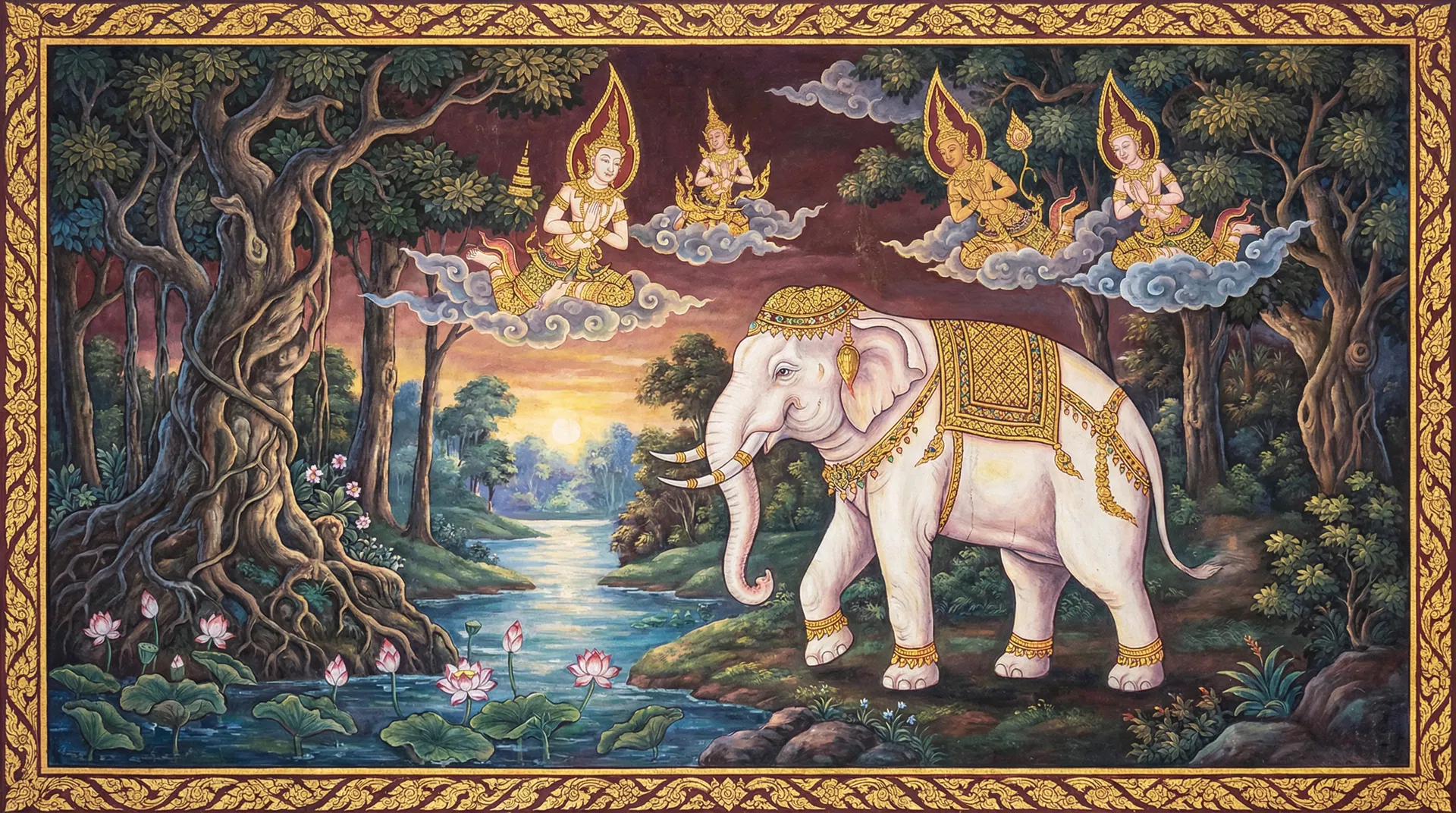
Then, a whisper began to circulate through the royal court, a tale of a miraculous elixir, a potion brewed from the tears of a celestial being, capable of summoning rain. The source of this legend was none other than the royal elephant, a magnificent creature named Gumbhadāsa, whose name, ironically, meant "water-pot." Gumbhadāsa was a beast of unparalleled beauty, his ivory tusks gleaming like polished moonstones, his hide a rich, dark grey, and his eyes, large and liquid, held a profound gentleness. He was the pride of the kingdom, a symbol of its strength and grandeur.
The legend claimed that Gumbhadāsa, through some divine intervention or an ancient curse, was capable of weeping tears that, when collected and mixed with specific herbs, would bring forth the much-desired rain. The king, though skeptical of such fantastical claims, was desperate. He summoned the royal physician, a man of considerable learning but also of a pragmatic mind. "Is there any truth," the king asked, his voice heavy with the weight of his kingdom's thirst, "to this tale of Gumbhadāsa's tears?"
The physician, stroking his long, grey beard, replied, "Your Majesty, I have studied the ancient texts. While I find no definitive proof, there are certain obscure passages that speak of extraordinary beings whose bodily fluids possess unique properties. However, the notion of an elephant weeping tears to summon rain is, to say the least, unconventional."
Undeterred, the king ordered that Gumbhadāsa be brought to a specially prepared pavilion. The elephant, sensing the unusual attention, stood patiently, his massive form exuding an aura of quiet dignity. The king, along with his courtiers and the physician, watched with bated breath. Days turned into weeks. Gumbhadāsa remained calm, his large eyes blinking slowly, but no tears fell. The whispers of doubt began to grow louder amongst the onlookers. Some muttered that the legend was false, others that the elephant was not of the right lineage. The king's hope, once a flickering candle, began to dim.
One sweltering afternoon, as the sun beat down mercilessly, a young novice monk, barely more than a boy, entered the pavilion. He was new to the monastery adjacent to the palace, and his heart was filled with a boundless compassion for all living beings. He had heard the hushed conversations about the drought and the suffering of the people. Seeing the magnificent elephant standing so still, his massive form radiating a silent plea, the novice felt a pang of sympathy. He approached Gumbhadāsa, not with the expectation of a miracle, but with a simple desire to offer comfort.
He bowed his head and spoke softly, "Noble Gumbhadāsa, you stand here in the heat, a symbol of our kingdom's pride, yet you seem to carry a silent burden. I know not your sorrow, but if it is within my power, I wish to share it with you. Know that you are not alone in your stillness, and that even in this drought, there is life that yearns for relief." He then began to chant, a gentle, melodious chant that spoke of the interconnectedness of all things, of the cyclical nature of life and death, of the inherent beauty that persists even in times of hardship.
As the novice's pure voice filled the pavilion, a strange transformation began to occur. The air around Gumbhadāsa seemed to shimmer. The elephant, who had been stoic and unmoving, slowly raised his trunk, his large eyes, filled with an ancient wisdom, fixed on the young monk. And then, slowly, deliberately, a single, glistening tear rolled down his cheek. It was not a tear of pain or sorrow, but a tear of profound empathy, a reflection of the novice's compassionate heart and the collective yearning of the suffering populace. Another tear followed, and then another, each one a perfect pearl, falling onto the polished floor of the pavilion.
The assembled crowd gasped. The royal physician, his skepticism shattered, rushed forward with a collection vessel. The tears were gathered with utmost care. The novice, his face radiant with a quiet joy, continued his chant, and as he did, the sky, which had been a relentless expanse of blue, began to darken. Wisps of grey clouds appeared, then grew, coalescing into a thick, heavy blanket that promised much-needed rain. A hush fell over the city as the first fat drops began to fall, then a torrential downpour, a joyous symphony of nature's release. The parched earth drank greedily, the rivers began to swell, and the people, their faces upturned to the heavens, wept tears of gratitude.
The king, witnessing this miracle, was overcome with emotion. He understood that the true magic lay not in the tears themselves, but in the profound compassion that had evoked them. He summoned the novice monk and knelt before him, a gesture of humility that stunned the court. "Young one," the king declared, his voice filled with reverence, "you have shown us a truth far greater than any legend. It is not in the physical properties of an elephant's tears, but in the boundless wellspring of compassion that resides within all beings, a compassion that can move mountains and summon the heavens."
The king then addressed his people, standing in the refreshing rain. "Let this day be a reminder to us all. When we face hardship, let us not seek for miraculous cures in the extraordinary, but rather cultivate the ordinary virtue of kindness. Let us share in each other's burdens, offer comfort to those in need, and understand that true power lies not in might, but in the gentle strength of a compassionate heart. From this day forth, Gumbhadāsa shall be known not merely as the water-pot elephant, but as the elephant who reminded us of the power of empathy."
The drought was broken, and the land flourished once more. The story of Gumbhadāsa and the compassionate novice became a cherished legend, passed down through generations, a testament to the enduring power of kindness and the profound connection between all living things.
The moral of the story is: True compassion has the power to bring forth blessings, and empathy can achieve what force or magic cannot.
— In-Article Ad —
💡Moral of the Story
The ultimate offering is the selfless sacrifice of one's life for others, driven by genuine compassion, capable of bringing about complete restoration and healing.
Perfection: Perfection of Generosity, Perfection of Loving-kindness
— Ad Space (728x90) —
More Jataka Tales You May Enjoy
 317Catukkanipāta
Sutasoma Jataka
Sutasoma JatakaIn the ancient kingdom of Gandhara, nestled amidst rolling hills and verdant valleys,...
💡 True liberation from suffering comes through selfless sacrifice and detachment from worldly attachments, particularly the craving for existence.
 440Dasakanipāta
Sama Jataka
The Bodhisatta's Compassion for All BeingsIn the lush, verdant forests of the Himalayas, lived a wis...
💡 The highest form of compassion includes forgiveness, even towards those who have caused immense suffering. True peace and reconciliation can be achieved when individuals and rulers embrace righteousness, kindness, and the understanding that all beings deserve protection and love.
 501Pakiṇṇakanipāta
Mūkapacca Jātaka
Mūkapacca Jātaka In the ancient kingdom of Mithila, nestled amidst verdant plains and traversed by t...
💡 True wisdom and strength are often found in quiet contemplation and keen observation, rather than in outward pronouncements. A lack of outward expression does not signify a lack of understanding or capability; indeed, it can foster deeper insight.
 468Dvādasanipāta
Mugapakkha Jataka
Mugapakkha JatakaIn the ancient kingdom of Kosala, under the benevolent gaze of a king who ruled wit...
💡 Selfless sacrifice and boundless compassion are powerful forces that can overcome malice and bring about peace and prosperity.
 471Dvādasanipāta
Mahājanaka Jātaka
The Tale of King MahājanakaIn the ancient kingdom of Mithilā, a prosperous land graced by gentle bre...
💡 Even in the face of overwhelming adversity, unwavering perseverance and courage can lead to ultimate success. Never give up hope, for even in the darkest of times, a glimmer of light can appear.
 422Aṭṭhakanipāta
Sammodamāna Jātaka
Sammodamāna JātakaIn the ancient city of Varanasi, nestled beside the sacred Ganges River, lived a w...
💡 Unity, open communication, and mutual respect are the cornerstones of lasting success and true prosperity. Harmony achieved through collaboration is far more powerful than individual cunning or division.
— Multiplex Ad —