
Māhāsukha Jātaka
Māhāsukha Jātaka
Long ago, in the bustling city of Mithila, lived a king named Brahmadatta. He was a just and benevolent ruler, beloved by his subjects. Yet, despite his good fortune, King Brahmadatta harbored a secret discontent. He yearned for a happiness that was deeper and more profound than the fleeting pleasures of worldly life. He often found himself gazing at the stars, contemplating the vastness of the universe and the mysteries of existence.
One day, while meditating in his royal gardens, the King encountered a wise hermit named Ānanda. The hermit, with his serene countenance and eyes that held the wisdom of ages, emanated an aura of profound peace. Intrigued, King Brahmadatta approached him.
"Venerable sir," the King began, his voice filled with respect, "I am King Brahmadatta of Mithila. I have ruled justly and lived a life of virtue, yet I find my heart still restless. I seek a happiness that is everlasting, a joy that transcends all worldly attachments. Can you guide me?"
Ānanda smiled gently. "Your Majesty, the happiness you seek is not found in the accumulation of riches or the adoration of your subjects. It is an inner state, a tranquility that arises from understanding and detachment. It is the state of Mahāsukha, the Great Bliss."
The King, eager to learn, bowed deeply. "Pray tell me, how can I attain this Mahāsukha?"
Ānanda then began to narrate a story. "In a past life, I was a Bodhisatta, born as a prince named Māhāsukha in a kingdom far to the east. My father, the King, was a man of great wisdom and virtue, and he instilled in me the importance of compassion and righteousness. However, even as a prince, I felt the impermanence of all things and the inherent suffering in attachment.
"One day, a renowned ascetic visited our kingdom. He spoke of the path to liberation, of understanding the nature of reality, and of cultivating inner peace. His words resonated deeply with me. I realized that true happiness lay not in the external world, but within my own mind. Determined to pursue this path, I approached my father, the King, and expressed my desire to renounce the worldly life and become an ascetic myself.
"My father, though saddened by my decision, understood my quest. He granted me his blessing and allowed me to leave the palace. I took with me only my robes, a begging bowl, and a profound aspiration to seek the ultimate truth.
"I wandered through forests and mountains, practicing rigorous austerities. I meditated under the shade of ancient trees, observed the cycles of nature, and contemplated the nature of suffering. I learned to control my desires, to detach myself from worldly pleasures, and to cultivate equanimity in the face of hardship.
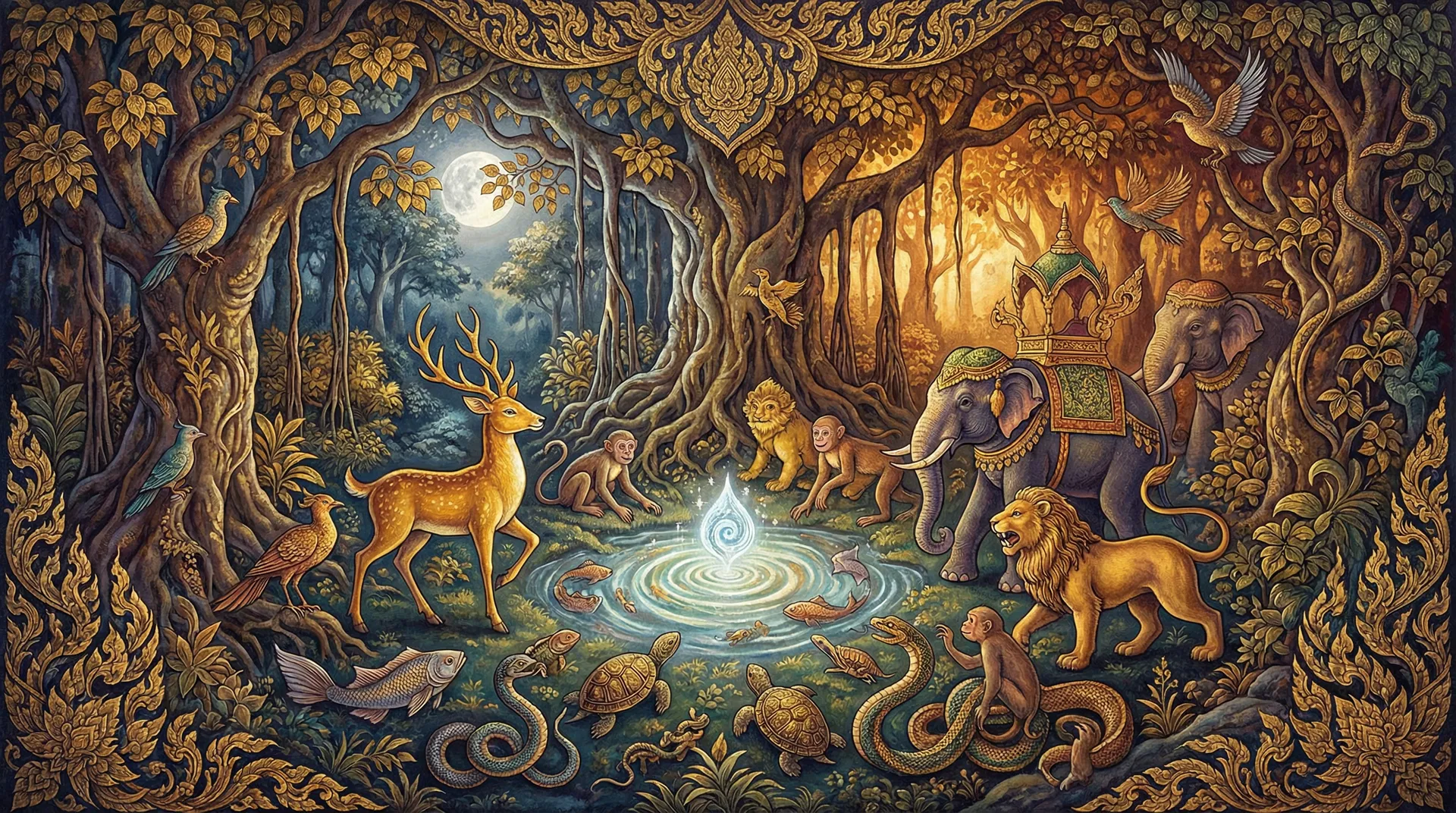
"One day, as I sat meditating by a clear stream, a fearsome lion emerged from the dense jungle. It was hungry and its eyes gleamed with predatory intent. Fear coursed through the hearts of the nearby deer, who scattered in panic. But I, Māhāsukha, remained calm. I understood that the lion, too, was a creature caught in the cycle of birth and death, driven by its instincts.
"Instead of fleeing, I spoke to the lion in a calm and steady voice. 'Noble creature,' I said, 'why do you seek to harm these innocent beings? Are you not weary of this endless struggle for survival?'
"The lion paused, surprised by my lack of fear and my gentle words. It growled, 'I am hungry. It is my nature to hunt and to eat.'
"I then offered myself. 'If you seek sustenance, take my flesh. I have no attachment to this body. My life is dedicated to the pursuit of truth, and if my death can serve to satisfy your hunger and perhaps even bring you some peace, then I offer it willingly.'
"The lion looked at me with a mixture of confusion and awe. It had never encountered such a being before. It saw no fear in my eyes, only a deep sense of peace. After a long moment, the lion turned and slowly walked away, its hunger seemingly forgotten. It was as if my complete detachment and unwavering compassion had disarmed its ferocity.
"From that day on, my practice deepened. I realized that true strength lay not in physical prowess, but in the mastery of the mind and the cultivation of boundless compassion. I continued my ascetic practices, and through unwavering diligence and wisdom, I eventually attained enlightenment, the state of Mahāsukha."
Ānanda, the hermit, concluded his story. "Your Majesty, the path to Mahāsukha is not an easy one. It requires self-discipline, renunciation of worldly desires, and the unwavering cultivation of compassion and wisdom. It is through understanding the impermanent nature of all things and by letting go of attachments that one can find true and lasting happiness."
King Brahmadatta listened intently, his heart filled with a newfound understanding. He realized that the restlessness he felt was a consequence of his attachment to his royal status, his possessions, and even his own identity. He thanked Ānanda profusely and vowed to follow the path of Dharma, not by renouncing his kingdom immediately, but by transforming his inner state. He began to practice mindfulness, generosity, and compassion in his daily life. He ruled his kingdom with even greater wisdom and empathy, and slowly, but surely, he found the Mahāsukha, the Great Bliss, blossoming within his own heart.
— In-Article Ad —
💡Moral of the Story
True happiness is found not in external possessions or status, but in inner peace, detachment, and boundless compassion.
Perfection: Wisdom (Prajñā) and Compassion (Karunā)
— Ad Space (728x90) —
More Jataka Tales You May Enjoy
 470Dvādasanipāta
Mahosadha Jataka
Mahosadha JatakaIn the prosperous kingdom of Mithila, under the wise and just rule of King Vedeha, t...
💡 Profound wisdom, combined with compassion and strategic thinking, can overcome any challenge and lead to justice and prosperity.
 200Dukanipāta
Sutasoma Jātaka
The Tale of the Bodhisattva as a Pacifist KingIn the ancient city of Suvarna, there reigned a king n...
💡 True strength lies in non-violence, restraint, and compassion. Conflicts can often be resolved through dialogue, understanding, and sincere efforts towards peace, rather than through aggression.
212DukanipātaMulasutta Jataka
The Root of All EvilIn the prosperous city of Varanasi, ruled a king known for his immense wealth an...
💡 Greed and envy are the root of all evil, leading to deception, loss, and suffering. True contentment comes from appreciating what one possesses and cultivating inner virtue.
218DukanipātaMasa Jataka
Masa JatakaIn a serene monastery nestled amidst rolling hills, lived a devout monk named Bodhisattva...
💡 Attachment to desires and possessions leads to suffering. True contentment comes from inner peace and detachment, not from external things.
150EkanipātaMahapada Jataka
Mahapada JatakaIn the ancient and prosperous city of Varanasi, there reigned a king named Bodhisatta...
💡 The greatest gift a ruler can give to their people is the teaching of righteousness and virtue (Dhamma), which leads to inner peace, wisdom, and lasting happiness.
192DukanipātaMugapakkajataka
Mugapakkajataka In the ancient and verdant land of Savatthi, a king named Supparaka ruled with a ben...
💡 True leadership is not about external displays of power, but about inner peace, wisdom, and selfless service. The most impactful actions often come from a place of quiet strength and genuine compassion.
— Multiplex Ad —